Conflict of Laws
  • About
  • Editorial board
  • Subscription
  • Submission
  • Materials
  • Contact
  • Click to open the search input field Click to open the search input field Search
  • Menu Menu

[Out Now] Bruijnen on Recognition of Kafala and Child Marriage in Family Law and Migration Law

December 25, 2025/in News/by Béligh Elbalti
image_pdfimage_print

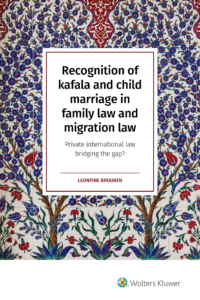
Leontine Bruijnen (Maastricht University) has recently published a book titled Recognition of kafala and child marriage in family law and migration law (Wolters Kluwer, 2025) based on her dissertation written under the supervision of Prof. Dr. Thalia Kruger and Prof. Dr. Marta Pertegás.

According to the publisher’s website, “This book explores how the recognition of kafala and child marriage varies between family law and migration law, and how greater alignment can be achieved.” “It analyzes the role of private international law, EU principles, and legal concepts such as the best interests of the child and legal certainty. Through case studies from Belgium and Germany, the study offers an in-depth perspective on the legal challenges and possibilities for better harmonizing these complex issues. It constitutes a valuable resource for legal scholars and policymakers.”


The book’s blurb reads as follows:

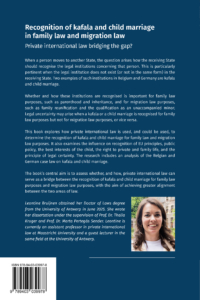
When a person moves to another State, the question arises how the receiving State should recognise the legal institutions concerning that person. This is particularly pertinent when the legal institution does not exist (or not in the same form) in the receiving State. Two examples of such institutions in Belgium and Germany are kafala and child marriage.

Whether and how these institutions are recognised is important for family law purposes, such as parenthood and inheritance, as well as for migration law purposes, such as family reunification and the qualification as an unaccompanied minor. Legal uncertainty may arise when a kafala or child marriage is recognised for family law purposes but not for migration law purposes, or vice versa.

Recognition of kafala and child marriage in family law and migration law: private international law bridging the gap? explores how private international law is used, and could be used, to determine the recognition of kafala and child marriage for family law and migration law purposes. It also examines the influence on recognition of EU principles, public policy, the best interests of the child, the right to private and family life, and the principle of legal certainty. The research includes an analysis of the Belgian and German case law on kafala and child marriage.

The book’s central aim is to assess whether, and how, private international law can serve as a bridge between the recognition of kafala and child marriage for family law purposes and migration law purposes, with the aim of achieving greater alignment between the two areas of law.


The book’s table of contents and an excerpt from the book are available on the publisher’s website.

Tags: recognition, private international law, family law, child marriage, Kafala, migration law
Share this entry
  • Share on Facebook
  • Share on X
  • Share on WhatsApp
  • Share on Pinterest
  • Share on LinkedIn
  • Share on Tumblr
  • Share on Vk
  • Share on Reddit
  • Share by Mail
https://conflictoflaws.net/News/2020/08/CoL_Banner-1.png 0 0 Béligh Elbalti https://conflictoflaws.net/News/2020/08/CoL_Banner-1.png Béligh Elbalti2025-12-25 06:14:022025-12-26 10:32:39[Out Now] Bruijnen on Recognition of Kafala and Child Marriage in Family Law and Migration Law
Categories

  • Views
  • News

Most Recent Posts

  • The New Zealand Supreme Court’s judgment in Kea Investments Ltd v Wikeley on anti-enforcement relief August 3, 2026
  • Beyond Domicile: The BHP Litigation and the Functional Interconnection of Public and Private International Law August 3, 2026
  • Conflicts of jurisdiction in Senegal: lesson from the Senegalese Supreme Court on Lis Pendens and the Exequatur of foreign judgments July 27, 2026
  • Adoption in the proposal for a European Parenthood Regulation July 21, 2026
  • Copyright, Targeting and Geo-Blocking: The CJEU Stirs the Pot July 15, 2026
  • A Follow-Up: The German Judges Association’s Response to the HCCH Draft Text of a Future Convention on Parallel Proceedings and Related Actions July 15, 2026
  • Private International Law Dimensions of Singapore’s New Legislation to Combat Online Harms July 14, 2026
  • The 1961 HCCH Apostille Convention: Why All African Countries Should Ratify It? — Insights from Judicial Practice in Africa July 14, 2026
  • The enforcement of an advance on costs for substitute performance at the expense of a Russian debtor in German-French legal relations July 2, 2026
  • “Yes, in principle, but not quite there yet…” – Some Observations on the Public Consultation on the HCCH Draft Text of a Future Convention on Parallel Proceedings and Related Actions June 29, 2026
  • Judgment Mobility Rules in India’s Private International Law Regime: No place for a revision au fond? June 26, 2026
  • Nothing to See Here: The CJEU’s Decision in Case C-232/25 Idzinski June 18, 2026
  • Refusal to Enforce in Egypt of a Californian (U.S.) Judgment for Lack of Reciprocity: What Has Gotten into the Egyptian Supreme Court? June 15, 2026
  • PRC Double Interest neither Double nor Penal: Australian Courts Clear Its Name When Enforcing Chinese Judgments June 10, 2026
  • The AIFC Court, Gazprom v Naftogaz and the Emergence of a New Conduit Jurisdiction Debate June 6, 2026
Link to: Out Now: Un Derecho Internacional Privado centrado en los derechos de las personas (Tirant lo Blanch 2025) Link to: Out Now: Un Derecho Internacional Privado centrado en los derechos de las personas (Tirant lo Blanch 2025) Out Now: Un Derecho Internacional Privado centrado en los derechos de las personas... Link to: XLK v XLJ: Comity Beyond the Child Abduction Convention Link to: XLK v XLJ: Comity Beyond the Child Abduction Convention XLK v XLJ: Comity Beyond the Child Abduction Convention
Scroll to top Scroll to top Scroll to top