Conflict of Laws
  • About
  • Editorial board
  • Subscription
  • Submission
  • Materials
  • Contact
  • Click to open the search input field Click to open the search input field Search
  • Menu Menu

Tag Archive for: recognition

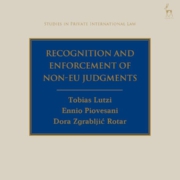
New Book Alert: Recognition and Enforcement of Non-EU Judgments

February 11, 2026/in News/by Ivana Kunda

An upcoming milestone in private international law — Recognition and Enforcement of Non-EU Judgments (Bloomsbury / Hart Publishing, Feb. 19 2026), edited by Tobias Lutzi, Ennio Piovesani, and Dora Zgrabljic Rotar.

This is not just another doctrinal text, but the first comprehensive comparative deep dive into how EU Member States handle judgments from outside the EU, an area of law that has been notoriously fragmented and under-theorized.

The book contains country reports from 21 EU Member States on their national rules on recognition and enforcement of non-EU judgments in a unified framework, giving the reader both breadth and comparative depth. The editors pull these strands together in a detailed comparative report that highlights patterns of convergence and divergence across EU jurisdictions. Additionally, the book situates the Member State approaches in relation to the Brussels I regime and the 2019 HCCH Judgments Convention, which is itself reshaping global judicial cooperation. It had practical and scholarly appeal

The release date is 19 February 2026 and it is available for pre-order already at here.

https://conflictoflaws.net/News/2026/02/RecEnforc-Non-EU2026A.jpg 565 540 Ivana Kunda https://conflictoflaws.net/News/2020/08/CoL_Banner-1.png Ivana Kunda2026-02-11 08:54:102026-02-11 08:54:10New Book Alert: Recognition and Enforcement of Non-EU Judgments

[Out Now] Bruijnen on Recognition of Kafala and Child Marriage in Family Law and Migration Law

December 25, 2025/in News/by Béligh Elbalti

Leontine Bruijnen (Maastricht University) has recently published a book titled Recognition of kafala and child marriage in family law and migration law (Wolters Kluwer, 2025) based on her dissertation written under the supervision of Prof. Dr. Thalia Kruger and Prof. Dr. Marta Pertegás. Read more

https://conflictoflaws.net/News/2020/08/CoL_Banner-1.png 0 0 Béligh Elbalti https://conflictoflaws.net/News/2020/08/CoL_Banner-1.png Béligh Elbalti2025-12-25 06:14:022025-12-26 10:32:39[Out Now] Bruijnen on Recognition of Kafala and Child Marriage in Family Law and Migration Law

A Judgment is a Judgment? How (and Where) to Enforce Third-State Judgments in the EU After Brexit

January 20, 2025/1 Comment/in Views/by Tobias Lutzi

In the wake of the CJEU’s controversial judgment in H Limited (Case C-568/22), which appeared to open a wide backdoor into the European Area of Justice through an English enforcement judgments (surprisingly considered a ‘judgment’ in the sense of Art. 2(a), 39 Brussels Ia by the Court), international law firms had been quick to celebrate the creation of ‘a new enforcement mechanism‘ for non-EU judgments.

As the UK had already completed its withdrawal from the European Union when the decision was rendered, the specific mechanism that the Court seemed to have sanctioned was, of course, short-lived. But crafty judgment creditors may quickly have started to look elsewhere.

In a paper that has just been published in a special issue of the Journal of Private International Law dedicated to the work of Trevor Hartley, I try to identify the jurisdictions to which they might look. Read more

https://conflictoflaws.net/News/2025/01/e5f74cf1-b2bc-43ea-8819-87bbb496e4ba-ezgif.com-webp-to-jpg-converter.jpg 1024 1792 Tobias Lutzi https://conflictoflaws.net/News/2020/08/CoL_Banner-1.png Tobias Lutzi2025-01-20 18:03:072025-02-08 00:25:55A Judgment is a Judgment? How (and Where) to Enforce Third-State Judgments in the EU After Brexit

U.S. Courts Recognize NAFTA Award Against Mexico

January 13, 2025/in News/by Charles Kotuby

This submission written by Celeste Hall, JD Candidate at the University of Pittsburgh School of Law and Global Legal Scholar.

The legal news has been awash lately in the recognition and enforcement of investment arbitration awards by U.S. courts. Most of the press is on the long-running and still-unfolding saga regarding Spain (see here and here). And a new decision recognizing an award against Zimbabwe was just issue at the end of December, as well. Here, however, we would like to add to the news with the recent decision recognizing an investment arbitration award against Mexico in United Mexican States v. Lion Mexico Consolidated.

Like most investment arbitrations, the decision tells a sordid tale. Lion Mexico Consolidated (LMC) is a Canadian company which provided financing to a Mexican businessman, Mr. Hector Cardenas Curiel, to develop real estate projects in Nayarit and Jalisco, Mexico. Cardenas’ company failed to pay on the loans, and LMC tried for years to obtain payment, all to no avail. Cardenas then began what was described as a “complex judicial fraud” to avoid payment, including a forgery and a subsequent lawsuit in a Jalisco court to cancel the loans. LMC was never informed of the suit and therefore, never appeared. The Jalisco Court issued a default judgment discharging the loans and ordering LMC to cancel the mortgages; Cardenas then arranged for an attorney to act fraudulently on LMC’s behalf to file and then purposefully abandon the appeal. LMC only learned of the entire scheme when they attempted to file their own constitutional challenge and were rejected. The Mexican Courts refused to allow LMC to submit evidence of the forgeries, so LMC brought a NAFTA Chapter 11 arbitration against Mexico for its failure to accord Lion’s investments protection under Article 1105(1) of NAFTA. Read more

https://conflictoflaws.net/News/2020/08/CoL_Banner-1.png 0 0 Charles Kotuby https://conflictoflaws.net/News/2020/08/CoL_Banner-1.png Charles Kotuby2025-01-13 17:16:462025-01-14 08:25:57U.S. Courts Recognize NAFTA Award Against Mexico

Compensation, y nada más – CJEU decides against Real Madrid in Case C-633/22

October 4, 2024/in Views/by Tobias Lutzi

Just two days after losing to LOSC Lille in the Champions League, Real Madrid suffered another defeat against a French opponent. Among the 44 (!) judgments published this Friday by the CJEU – a flurry of decisions reminiscent of the madness that is the current Champions League format –, the Court decided a true ‘clásico’ of European private international law in Case C-633/22 Real Madrid Club de Fútbol.

Read more

https://conflictoflaws.net/News/2020/08/CoL_Banner-1.png 0 0 Tobias Lutzi https://conflictoflaws.net/News/2020/08/CoL_Banner-1.png Tobias Lutzi2024-10-04 23:11:352024-10-05 00:01:17Compensation, y nada más – CJEU decides against Real Madrid in Case C-633/22

Revue Critique de droit international privé – issue 2024/3

October 2, 2024/in News/by Etienne Farnoux

Written by Hadrien Pauchard (assistant researcher and doctoral student at Sciences Po Law School)

The third issue of the Revue Critique de droit international privé of 2024 was released on October 1st. It contains four articles and several case notes. In line with the Revue Critique’s recent policy, the doctrinal part will shortly be made available in English on the editor’s website (for registered users and institutions). Read more

https://conflictoflaws.net/News/2020/08/CoL_Banner-1.png 0 0 Etienne Farnoux https://conflictoflaws.net/News/2020/08/CoL_Banner-1.png Etienne Farnoux2024-10-02 16:16:402024-10-02 16:16:40Revue Critique de droit international privé – issue 2024/3

How many monetary judgments that Chinese courts decided to enforce are successfully enforced?

October 1, 2024/3 Comments/in Views/by Jeanne Huang

It is necessary to distinguish (1) a court’s decision to acknowledge the validity of a foreign judgment (judgment recognition and enforcement), and (1) whether a judgment creditor successfully recovers the awarded amount in practice.

Read more

https://conflictoflaws.net/News/2020/08/CoL_Banner-1.png 0 0 Jeanne Huang https://conflictoflaws.net/News/2020/08/CoL_Banner-1.png Jeanne Huang2024-10-01 07:12:452024-10-01 19:34:36How many monetary judgments that Chinese courts decided to enforce are successfully enforced?

OUT NOW!! New Book on Private International Law in BRICS: Convergence, Divergence, and Reciprocal Lessons (Stellina Jolly and Saloni Khanderia eds)

August 11, 2024/in News/by Saloni Khanderia

Hart Publishing, Oxford, UK is proud to announce the release of Private International Law in BRICS: Convergence, Divergence, and Reciprocal Lessons co-edited by Dr. Stellina Jolly, South Asian University, Delhi, India, and Professor Saloni Khanderia, O.P. Jindal Global University, Sonipat, India. The book forms part of Hart’s prestigious Private International Law Series with Professor Paul Beaumont, University of Stirling, as its Series Editor.

Authored by leading scholars and practitioners in private international law, the chapters draw on domestic legislation and case law interpretations in each of these emerging economies. They cover a wide array of topics, including contractual and non-contractual obligations, choice of court agreements, and personal matters such as marriage, divorce, matrimonial property, succession, and surrogacy—all within the context of increased cross-border movement of people.

As the title suggests, this book explores the intricate landscape of private international law within the BRICS countries—Brazil, Russia, India, China, and South Africa. Divided into six sections, each part of the book offers a thematic analysis of core private international law-related questions and an in-depth examination of the reciprocal lessons each BRICS country can share concerning each of three core conflict of law issues – the international jurisdiction of courts, the applicable law and the effectiveness of foreign decisions (both judgments and arbitral awards) overseas.

This book serves as an invaluable comparative resource for governments, legislators, traders, academics, researchers, and students interested in the intricate legal dynamics at play within the BRICS nations. With the BRICS countries collectively representing around 42% of the world’s population and approximately 23% of global GDP, the need for enhanced legal cooperation and harmonization is more critical than ever. Over the past decade, cross-border interactions within the BRICS bloc and beyond have escalated significantly. However, the diversity in political, legal, economic, and social structures, coupled with the lack of geographical proximity and historical connections, has posed challenges to effective cooperation and the ability of BRICS to play a proactive role in global governance. The 15 BRICS Summits held between 2009 and 2023 have primarily focused on economic cooperation, particularly in trade, investment, foreign affairs, and innovation. While these areas are crucial, they cannot be viewed in isolation. Increased trade and cooperation inevitably lead to the movement of persons, goods, and services across national boundaries, raising important legal questions. For instance, economic cooperation that facilitates the movement of people also impacts personal relationships. Scenarios such as marriage, divorce, adoption, surrogacy, and inheritance across borders create complex legal challenges that require a robust understanding of private international law. Will a marriage or divorce be recognized in the home country? How will the nationality of a child born through surrogacy or adopted abroad be determined? These questions, though critical, have not yet been thoroughly examined in the context of BRICS.

Recognizing this gap, our book seeks to explore and analyze the role of private international law in fostering enhanced cooperation among BRICS countries. In pursuit of its objectives, the project draws lessons from various multilateral and supranational instruments operating under the HCCH – Hague Conference on Private International Law and in the European Union, renowned for pioneering clear, predictable rules to regulate international disputes through the unification of laws.

Details of the book as well as purchase options can be found here!

https://conflictoflaws.net/News/2020/08/CoL_Banner-1.png 0 0 Saloni Khanderia https://conflictoflaws.net/News/2020/08/CoL_Banner-1.png Saloni Khanderia2024-08-11 06:35:402024-08-11 06:35:40OUT NOW!! New Book on Private International Law in BRICS: Convergence, Divergence, and Reciprocal Lessons (Stellina Jolly and Saloni Khanderia eds)

Denial of Natural Justice as a Defence to Enforcement of a Chinese Judgment in Australia

June 12, 2023/in Views/by Michael Douglas

In Yin v Wu [2023] VSCA 130, the Court of Appeal of the Supreme Court of Victoria set aside a judgment[1] which had affirmed the enforcement a Chinese judgment by an Associate Justice of the Supreme Court.[2] This was a rare instance of an Australian court considering the defence to enforcement of a foreign judgment on the basis that the judgment debtor was denied natural justice—or procedural fairness—before the foreign court.

Background

The dispute concerned a payment made by a Chinese national living in China, Di Wu, to a Chinese national living in Australia, Ke Yin. The payment was made pursuant to a foreign exchange agreement: Yin had promised to pay Wu a sum of US Dollars in exchange for Wu’s Chinese RMB.

The arrangement was made unusually through a series of Telegram and WhatsApp messages, from accounts with different numbers and aliases. (In Australia, we would say that the arrangement sounded ‘suss’.) The agreement was seemingly contrary to Chinese law, which may have contributed to the clandestine character of communications underlying the agreement; see [30].

Read more

https://conflictoflaws.net/News/2020/08/CoL_Banner-1.png 0 0 Michael Douglas https://conflictoflaws.net/News/2020/08/CoL_Banner-1.png Michael Douglas2023-06-12 05:59:402023-06-13 06:15:27Denial of Natural Justice as a Defence to Enforcement of a Chinese Judgment in Australia

Canada’s Top Court to Hear Enforcement Dispute

November 14, 2020/1 Comment/in News/by Stephen Pitel

By Stephen G.A. Pitel, Western University

The Supreme Court of Canada has granted leave in H.M.B. Holdings Limited v Attorney General of Antigua and Barbuda.  Information about the appeal is available here. The decision being appealed, rendered by the Court of Appeal for Ontario, is available here.  In the usual course the appeal will be heard in the late spring or early fall of 2021.  The grant of leave is notable because Canada’s top court only hears a small handful of conflict of laws cases in any given year.

In 2014 the Privy Council rendered a judgment in favour of HMB against Antigua and Barbuda for over US$35 million including interest.  In 2016 HMB sued at common law to have the Privy Council judgment recognized and enforced in British Columbia.  Antigua and Barbuda did not defend and default judgment was granted in 2017.  HMB then sought to register the British Columbia decision (not the Privy Council decision) under Ontario’s statutory scheme for the registration of judgments of other Canadian common law provinces.  This required the Ontario courts to engage in a process of statutory interpretation, with one of the central issues being whether the scheme applied to the recognition and enforcement judgment or only to what have been called “original judgments”.

The procedure used by HMB for getting the Privy Council decision enforced in Ontario might seem odd.  The Ontario application judge referred to the process as involving a “ricochet judgment”.  As to why HMB did not bring a common law action on the Privy Council judgment in Ontario, as it had done in British Columbia, there appears to be some issue that such an action could be outside the applicable limitation period.  British Columbia (10 years) has a longer limitation period than Ontario (2 years) for common law actions to enforce foreign judgments.

The Ontario courts held that the scheme did not apply to the British Columbia judgment or, in the alternative, if it did, Antigua and Barbuda were entitled to resist the registration on the basis that it was not “carrying on business” in British Columbia (which is a defence to registration under the Ontario scheme).  The majority of the Court of Appeal for Ontario, perhaps proceeding in an inverted analytical order, held that because Antigua and Barbuda was not carrying on business in British Columbia it did not need to address the (more fundamental) issue of the scope of the scheme.  The dissenting judge held Antigua and Barbuda was carrying on business in British Columbia and so did address the scope of the scheme, finding it did apply to a recognition and enforcement judgment.

In my view, it is unfortunate that all of the Ontario judges focused quite particularly on the language of various provisions of the statutory scheme without greater consideration of the underlying policy question of whether the scheme, as a whole, truly was meant to allow knock-on or ricochet enforcement.  Ontario’s scheme is explicitly limited to allowing registration of judgments of other Canadian common law provinces.  It strikes me as fundamentally wrong to interpret this as covering all foreign judgments those other provinces themselves choose to enforce.  Nevertheless, it will be interesting to see whether the Supreme Court of Canada resolves the appeal solely on the basis of the intended scope of the registration scheme or instead devotes significant attention to addressing the meaning of “carrying on business”.

https://conflictoflaws.net/News/2020/08/CoL_Banner-1.png 0 0 Stephen Pitel https://conflictoflaws.net/News/2020/08/CoL_Banner-1.png Stephen Pitel2020-11-14 11:58:462020-11-14 11:58:46Canada’s Top Court to Hear Enforcement Dispute
Page 1 of 3123

Categories

  • Views
  • News

Most Recent Posts

  • Conflicts of jurisdiction in Senegal: lesson from the Senegalese Supreme Court on Lis Pendens and the Exequatur of foreign judgments July 27, 2026
  • Adoption in the proposal for a European Parenthood Regulation July 21, 2026
  • Copyright, Targeting and Geo-Blocking: The CJEU Stirs the Pot July 15, 2026
  • A Follow-Up: The German Judges Association’s Response to the HCCH Draft Text of a Future Convention on Parallel Proceedings and Related Actions July 15, 2026
  • Private International Law Dimensions of Singapore’s New Legislation to Combat Online Harms July 14, 2026
  • The 1961 HCCH Apostille Convention: Why All African Countries Should Ratify It? — Insights from Judicial Practice in Africa July 14, 2026
  • The enforcement of an advance on costs for substitute performance at the expense of a Russian debtor in German-French legal relations July 2, 2026
  • “Yes, in principle, but not quite there yet…” – Some Observations on the Public Consultation on the HCCH Draft Text of a Future Convention on Parallel Proceedings and Related Actions June 29, 2026
  • Judgment Mobility Rules in India’s Private International Law Regime: No place for a revision au fond? June 26, 2026
  • Nothing to See Here: The CJEU’s Decision in Case C-232/25 Idzinski June 18, 2026
  • Refusal to Enforce in Egypt of a Californian (U.S.) Judgment for Lack of Reciprocity: What Has Gotten into the Egyptian Supreme Court? June 15, 2026
  • PRC Double Interest neither Double nor Penal: Australian Courts Clear Its Name When Enforcing Chinese Judgments June 10, 2026
  • The AIFC Court, Gazprom v Naftogaz and the Emergence of a New Conduit Jurisdiction Debate June 6, 2026
  • Montana Supreme Court Decides International Child Custody Case June 3, 2026
  • China’s Countering Improper Foreign Extraterritorial Jurisdiction Regulation Blocked EU’s Extraterritorial Data Acquisition May 29, 2026
Scroll to top Scroll to top Scroll to top