[Out Now] Bruijnen on Recognition of Kafala and Child Marriage in Family Law and Migration Law
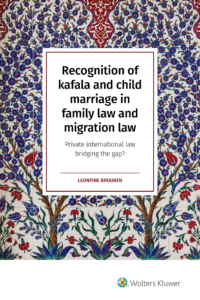
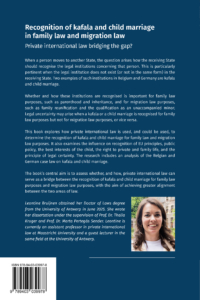
Leontine Bruijnen (Maastricht University) has recently published a book titled Recognition of kafala and child marriage in family law and migration law (Wolters Kluwer, 2025) based on her dissertation written under the supervision of Prof. Dr. Thalia Kruger and Prof. Dr. Marta Pertegás.
According to the publisher’s website, “This book explores how the recognition of kafala and child marriage varies between family law and migration law, and how greater alignment can be achieved.” “It analyzes the role of private international law, EU principles, and legal concepts such as the best interests of the child and legal certainty. Through case studies from Belgium and Germany, the study offers an in-depth perspective on the legal challenges and possibilities for better harmonizing these complex issues. It constitutes a valuable resource for legal scholars and policymakers.”
The book’s blurb reads as follows:
When a person moves to another State, the question arises how the receiving State should recognise the legal institutions concerning that person. This is particularly pertinent when the legal institution does not exist (or not in the same form) in the receiving State. Two examples of such institutions in Belgium and Germany are kafala and child marriage.
Whether and how these institutions are recognised is important for family law purposes, such as parenthood and inheritance, as well as for migration law purposes, such as family reunification and the qualification as an unaccompanied minor. Legal uncertainty may arise when a kafala or child marriage is recognised for family law purposes but not for migration law purposes, or vice versa.
Recognition of kafala and child marriage in family law and migration law: private international law bridging the gap? explores how private international law is used, and could be used, to determine the recognition of kafala and child marriage for family law and migration law purposes. It also examines the influence on recognition of EU principles, public policy, the best interests of the child, the right to private and family life, and the principle of legal certainty. The research includes an analysis of the Belgian and German case law on kafala and child marriage.
The book’s central aim is to assess whether, and how, private international law can serve as a bridge between the recognition of kafala and child marriage for family law purposes and migration law purposes, with the aim of achieving greater alignment between the two areas of law.
The book’s table of contents and an excerpt from the book are available on the publisher’s website.