


Views
The Supreme Administrative Court of Bulgaria’s final decision in the Pancharevo case: Bulgaria is not obliged to issue identity documents for baby S.D.K.A. as she is not Bulgarian (but presumably Spanish)
This post was written bij Helga Luku, PhD researcher at the University of Antwerp.
On 1 March 2023, the Supreme Administrative Court of the Republic of Bulgaria issued its final decision no. 2185, 01.03.2023 (see here an English translation by Nadia Rusinova) in the Pancharevo case. After an appeal from the mayor of the Pancharevo district, the Supreme Administrative Court of Bulgaria ruled that the decision of the court of first instance, following the judgment of the Court of Justice of the European Union (CJEU) in this case, is “valid and admissible, but incorrect”. It stated that the child is not Bulgarian due to the lack of maternal ties between the child and the Bulgarian mother, and thus there is no obligation for the Bulgarian authorities to issue a birth certificate. Hereafter, I will examine the legal reasoning behind its ruling.
UK Supreme Court in Jalla v Shell: the claim in Bonga spill is time barred
The UK Supreme Court ruled that the cause of action in the aftermath of the 2011 Bonga offshore oil spill accrued at the moment when the oil reached the shore. This was a one-off event and not a continuing nuisance. The Nigerian landowners’ claim against Shell was thus barred by the limitation periods under applicable Nigerian law (Jalla and another v Shell International Trading and Shipping Company and another [2023] UKSC 16, on appeal from [2021] EWCA Civ 63).
On 10 May 2023, the UK Supreme Court has ruled in one of the cases in the series of legal battles started against Shell in the English courts in the aftermath of the Bonga spill. The relevant facts are summarized by the UK Supreme Court as follows at [6] and [7]:
Data on Choice-of-Court Clause Enforcement in US
The United States legal system is immensely complex. There are state courts and federal courts, state statutes and federal statutes, state common law and federal common law. When I imagine a foreign lawyer trying to explain this system to a foreign client, my heart fills with pity.
This feeling of pity is compounded when I imagine this same lawyer trying to advise her client as to whether a choice-of-court clause will be enforced by a court in the United States. The law on this subject is complicated. It is, moreover, not easy to determine how it is applied in practice. Are there differences in clause enforcement rates across the states? Across federal circuits? Do state courts enforce these clauses at the same rate as federal courts? Until recently, there was no data that would allow a foreign lawyer – or a U.S. lawyer, for that matter – to answer any of these questions.
Over the past several years, I have authored or co-authored several empirical articles that seek to answer the questions posed above. This post provides a summary of the data gathered for these articles. All of the cases referenced involve outbound choice-of-court clauses, i.e. clauses that select a jurisdiction other than the one where the suit was filed. Readers interested in the data collection process, the caveats to which the data is subject, or other methodological issues should consult the articles and their appendices. This post first describes state court practice. It then describes federal court practice. It concludes with a brief discussion comparing the two.
News
Call for Abstracts – Emerging Voices in Private International Law (Asser Institute)
Post prepared by Eduardo Silva de Freitas, PhD researcher Erasmus University Rotterdam and junior researcher at the Asser Institute
As part of its 60th anniversary celebrations, the T.M.C. Asser Institute invites abstracts for the panel “Emerging Voices in Private International Law”, to be held on 24 October 2025 in The Hague, at the conference Adapting Private International Law in an Era of Uncertainty.
The panel will feature two early-career scholars (PhD candidates or postdoctoral researchers) presenting original work in the field. Selected participants will also contribute to a forthcoming volume in the Short Studies in Private International Law series.
To apply, please submit a 400-word abstract and brief personal details by 15 August 2025 (24:00 CET) to: e.silva.de.freitas@asser.nl
Full call for abstracts: https://www.asser.nl/media/797989/call-for-abstracts_pil_asser.pdf
Revue Critique de droit international privé – issue 2025/1
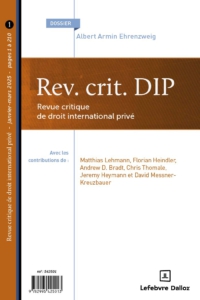 Written by Hadrien Pauchard (assistant researcher and doctoral student at Sciences Po Law School)
The first issue of the Revue Critique de droit international privé of 2025 has just been released. It gathers six contributions honouring Albert Armin Ehrenzweig and his legacy, as well as seven case notes and numerous book reviews.
The doctrinal part of the volume is devoted to the proceedings of the Albert Armin Ehrenzweig Conference organized in June 2024 at the University of Vienna, fifty years after the passing away of the great author. The contributions commemorate both the man and the scientist, testifying to the relevance of Albert A. Ehrenzweig’s scholarship to contemporary private international law. They are published in French in the printed version of the Revue (also available online here), and will be available shortly in English (here).
Out Now: Dickinson, Natural Justice in Recognition and Enforcement of Foreign Judgments, Recueil des cours, Tome 446
Last summer, Andrew Dickinson (Professor of the Conflict of Laws, University of Oxford, and former editor of ConflictofLaws.net) delivered a special course at the summer course of the Hague Academy of International Law entitled ‘Natural Justice in Recognition and Enforcement of Foreign Judgments’. It has now been published as Volume 446 of the Recueil des cours / Collected Courses.
The blurb reads as follows:
This special course assesses the utility of ideas of ‘natural law’ and ‘natural justice’ as tools to explain, rationalise and develop the rules governing the recognition and enforcement of foreign judgments currently applied by the world’s legal orders.
After introducing the topic, the first part of the course consider how influential 17th and 18th century accounts of the law of nature sought to account for the relations existing between all human beings, as well as the creation of political societies with law-making powers, the global ordering of those societies and the role of adjudication as a means of resolving disputes within and among them. This provides the historical and intellectual background for what follows.
The principal part of the course considers how writers on the conflict of laws in this period drew upon and utilised these ideas, as the rules that we apply today to regulate foreign judgments began to take shape. This leads to a study of the further evolution of the legal landscape in the 19th century, highlighting the use of natural law reasoning by judges and commentators to explain and justify the effectiveness of individual exercises of adjudicatory authority beyond their original domains, as well as the later rejection of natural law thinking in favour of models centred on ideas of sovereignty and territoriality, which continue to dominate today.
Having completed this historical survey, the course examines the specific legacy of natural law reasoning in the common law world, involving the use of principles of ‘natural justice’ to deny recognition of unjust foreign judgments, as well as the counterparts of these principles in other legal systems and international treaties.
Drawing on the preceding material, the concluding chapter considers the case for renaturalising the law in this area, and the implications of following this path.
More information on the book can be found here.
It is available to subscribers to the Recueil des cours here.