


Views
Towards an EU Regulation on the International Protection of Adults
On 31 May 2023, the European Commission presented a proposal for a Regulation on jurisdiction, applicable law, recognition and enforcement of measures and cooperation in matters relating to the protection of adults (in the following: EU Adult Protection Regulation – EUAPR). This proposal is a response to significant demographic and social changes in the EU: Many Member States face enormous challenges posed by an increasingly aging population. Due to considerable improvements in medical care in recent decades, people grow much older than they used to, and this lengthening of the average lifespan in turn leads to an increase in age-related illnesses such as Alzheimer’s disease. This demographic change creates problems for private international law, because the mobility of natural persons has increased within the EU where borders may, in principle, be crossed without restrictions. Many people who have left their state of origin in search for work elsewhere in their youth or middle age do not return to their home state after retirement, but rather spend the last part of their lives where they have established a new habitual residence. Besides, more and more people decide to leave their home state once they have reached the age of retirement. Such processes of migration at a late stage in life may have different reasons: Some old-age movers may want to avoid a heavy taxation of their estates that would put a burden on their heirs, some may wish to circumvent other restrictions of domestic inheritance laws (e.g. the right to a compulsory portion), others may simply wish to spend the remaining parts of their lives in milder climates, e.g. the Mediterranean, or look for a place to stay where the cost of living is lower, e.g. in some parts of Eastern Europe. When these persons begin to suffer from an impairment or an insufficiency of their personal faculties which no longer allows them to protect their interests themselves, however, intricate conflict of laws problems may arise: The authorities or courts of which state shall have jurisdiction to take protective measures concerning vulnerable adults or their property? Which law is to be applied to such measures? Under which conditions may protective measures taken in one state be recognised and enforced in other states?
The EUAPR is meant to solve these problems. Read more
Dubai Courts on the Recognition of Foreign Judgments: “Recognition” or “Enforcement”? – that’s the Problem!
“Recognition” and “enforcement” are fundamental concepts when dealing with the international circulation of foreign judgments. Although they are often used interchangeably, it is generally agreed that these two notions have different purposes and, ultimately, different procedures (depending on whether the principle of de plano recognition is accepted or not. See Béligh Elbalti, “Spontaneous Harmonization and the Liberalization of the Recognition and Enforcement of Foreign Judgments, Japanese Yearbook of Private International Law, Vol. 16, 2014, p. 269).
However, in legal systems where this fundamental distinction is not well established, the amalgamation of the two notions may give rise to unnecessary complications that are likely to jeopardize the legitimate rights of the parties. The following case, very recently decided by the Dubai Supreme Court, is nothing but one of many examples which show how misconceptions and confusion regarding the notion of “recognition” would lead to unpredictable results (cf. e.g., Béligh Elbalti, “Perspective of Arab Countries”, in M. Weller et al. (eds.), The 2019 HCCH Judgments Convention – Cornerstones, Prospects, Outlook (Hart, 2023) pp. 1983-184ff).
Van Den Eeckhout on CJEU Case Law in PIL matters
Written by Veerle Van Den Eeckhout, working at the Research and Documentation Directorate of the CJEU
On 29 April 2023, Veerle Van Den Eeckhout gave a presentation on recent case law of the Court of Justice of the European Union. The presentation, now available online, was entitled “CJEU case-law. A Few Observations on Recent CJEU Case Law with Attention for Some Aspects of Logic and Argumentation Theory.” The presentation was given during the Dialog Internationales Familienrecht 2023 at the University of Münster. This presentation builds upon a previous presentation of the Author, “Harmonized interpretation of regimes of judicial cooperation in civil matters?”, which is now also available online.
News
AAPrIL’s June online seminar: The Law of the Arbitration Agreement – Australasian Perspectives
On Wednesday, 11 June 2025, the Australasian Association of Private International Law (AAPrIL) will hold its latest instalment of its online Seminar Series, as Timothy Lindsay of Lindsay Francis & Mangan presents on ‘The Law of the Arbitration Agreement – Australasian Perspectives’.
The topic:
Contracts with international arbitration agreements can engage a complex interaction of different laws: the governing law of the contract, the law of the seat, and the law of the arbitration agreement itself. Parties to international commercial contracts usually address the first two of these issues, but are often silent as to the law of the arbitration agreement. A light has recently shone on this well-known issue by the United Kingdom’s Arbitration Act 2025, which includes a new default rule for determining the law of the arbitration agreement, and similar changes to the Rules of the Singapore International Arbitration Centre, as well as developing case law in other jurisdictions. How might Australian and New Zealand courts react? Read more
Open Position as a Research Associate at Freiburg University
The Institute for Comparative and Private International Law (Department 3) at Freiburg University (Germany) is seeking a Research Associate (m/f/d), 26%, to begin as soon as possible. Read more
ZEuP – Zeitschrift für Europäisches Privatrecht 2/2025
A new issue of ZEuP – Zeitschrift für Europäisches Privatrecht is now available and includes contributions on EU private law, comparative law and legal history, legal unification, private international law, and individual European private law regimes. The full table of content can be accessed here.
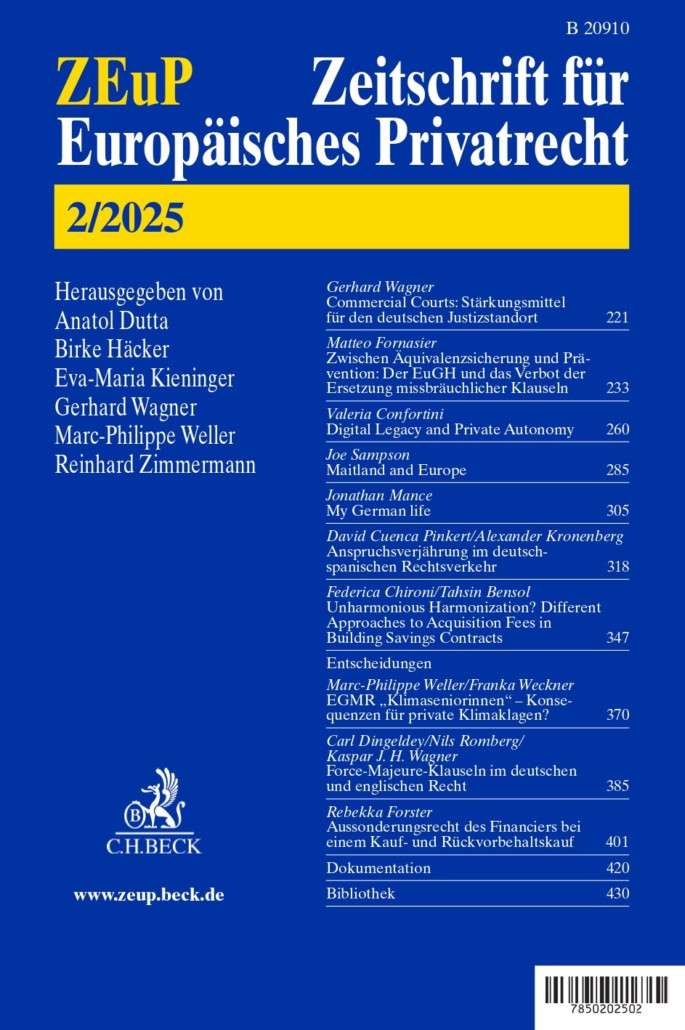
The following contributions might be of particular interest for the readers of this blog:
- Anspruchsverjährung im deutsch-spanischen Rechtsverkehr
David Cuenca Pinkert and Alexander Kronenberg on the statute of limitation in cross-border situations involving Germany and Spain: Against the background of the relevance of the application of foreign law in practice, the article analyses the institute of the statute of limitations under Spanish substantive law and also deals with similarities and differences to German law as well as selective references to conflict of laws and particularities. Due to its practical relevance, the article focuses on the treatment of the limitation period for tortious claims for damages, especially as a result of road traffic accidents. - EGMR „Klimaseniorinnen“ – Konsequenzen für private Klimaklagen?
Marc-Philippe Weller and Franka Weckner comments on the decision by the ECtHR in Klimaseniorinnen and discuss the consequences of this decision for climate litigation brought before civil courts.