


Views
Towards an EU Regulation on the International Protection of Adults
On 31 May 2023, the European Commission presented a proposal for a Regulation on jurisdiction, applicable law, recognition and enforcement of measures and cooperation in matters relating to the protection of adults (in the following: EU Adult Protection Regulation – EUAPR). This proposal is a response to significant demographic and social changes in the EU: Many Member States face enormous challenges posed by an increasingly aging population. Due to considerable improvements in medical care in recent decades, people grow much older than they used to, and this lengthening of the average lifespan in turn leads to an increase in age-related illnesses such as Alzheimer’s disease. This demographic change creates problems for private international law, because the mobility of natural persons has increased within the EU where borders may, in principle, be crossed without restrictions. Many people who have left their state of origin in search for work elsewhere in their youth or middle age do not return to their home state after retirement, but rather spend the last part of their lives where they have established a new habitual residence. Besides, more and more people decide to leave their home state once they have reached the age of retirement. Such processes of migration at a late stage in life may have different reasons: Some old-age movers may want to avoid a heavy taxation of their estates that would put a burden on their heirs, some may wish to circumvent other restrictions of domestic inheritance laws (e.g. the right to a compulsory portion), others may simply wish to spend the remaining parts of their lives in milder climates, e.g. the Mediterranean, or look for a place to stay where the cost of living is lower, e.g. in some parts of Eastern Europe. When these persons begin to suffer from an impairment or an insufficiency of their personal faculties which no longer allows them to protect their interests themselves, however, intricate conflict of laws problems may arise: The authorities or courts of which state shall have jurisdiction to take protective measures concerning vulnerable adults or their property? Which law is to be applied to such measures? Under which conditions may protective measures taken in one state be recognised and enforced in other states?
The EUAPR is meant to solve these problems. Read more
Dubai Courts on the Recognition of Foreign Judgments: “Recognition” or “Enforcement”? – that’s the Problem!
“Recognition” and “enforcement” are fundamental concepts when dealing with the international circulation of foreign judgments. Although they are often used interchangeably, it is generally agreed that these two notions have different purposes and, ultimately, different procedures (depending on whether the principle of de plano recognition is accepted or not. See Béligh Elbalti, “Spontaneous Harmonization and the Liberalization of the Recognition and Enforcement of Foreign Judgments, Japanese Yearbook of Private International Law, Vol. 16, 2014, p. 269).
However, in legal systems where this fundamental distinction is not well established, the amalgamation of the two notions may give rise to unnecessary complications that are likely to jeopardize the legitimate rights of the parties. The following case, very recently decided by the Dubai Supreme Court, is nothing but one of many examples which show how misconceptions and confusion regarding the notion of “recognition” would lead to unpredictable results (cf. e.g., Béligh Elbalti, “Perspective of Arab Countries”, in M. Weller et al. (eds.), The 2019 HCCH Judgments Convention – Cornerstones, Prospects, Outlook (Hart, 2023) pp. 1983-184ff).
Van Den Eeckhout on CJEU Case Law in PIL matters
Written by Veerle Van Den Eeckhout, working at the Research and Documentation Directorate of the CJEU
On 29 April 2023, Veerle Van Den Eeckhout gave a presentation on recent case law of the Court of Justice of the European Union. The presentation, now available online, was entitled “CJEU case-law. A Few Observations on Recent CJEU Case Law with Attention for Some Aspects of Logic and Argumentation Theory.” The presentation was given during the Dialog Internationales Familienrecht 2023 at the University of Münster. This presentation builds upon a previous presentation of the Author, “Harmonized interpretation of regimes of judicial cooperation in civil matters?”, which is now also available online.
News
Virtual Workshop (in English) on April 1: Carlos Esplugues on “Take Domestic Law and Run? The Application of Foreign (Private? State?) Law in Times of Uncertainty”

On Tuesday, April 1, 2025, the Hamburg Max Planck Institute will host its monthly virtual workshop Current Research in Private International Law at 11:00 a.m. – 12:30 p.m. (CEST). Professor Carlos Esplugues (University of Valencia) will speak, in English, about the topic
“Take Domestic Law and Run? The Application of Foreign (Private? State?) Law in Times of Uncertainty”
The possible application of foreign law is one of the features of contemporary private international law, a discipline that is particularly sensitive to the social, political and economic environment in which it operates. However, the redefinition of the role of the State in modern societies, technological changes or the growing wave of intolerance and fear towards what comes from abroad in many parts of the world are creating a new environment that affects this question in a pluralistic way. Beyond the classical issue of the nature of the applicable law and its relationship to the process, questions are being raised about the viability of this possible applicability and the conditions under which it can be established.
The presentation will be followed by open discussion. All are welcome. More information and sign-up here.
If you want to be invited to these events in the future, please write to veranstaltungen@mpipriv.de.
AMEDIP’s upcoming webinar: Circular Economy and Private International Law (27 March 2025 – In Spanish)
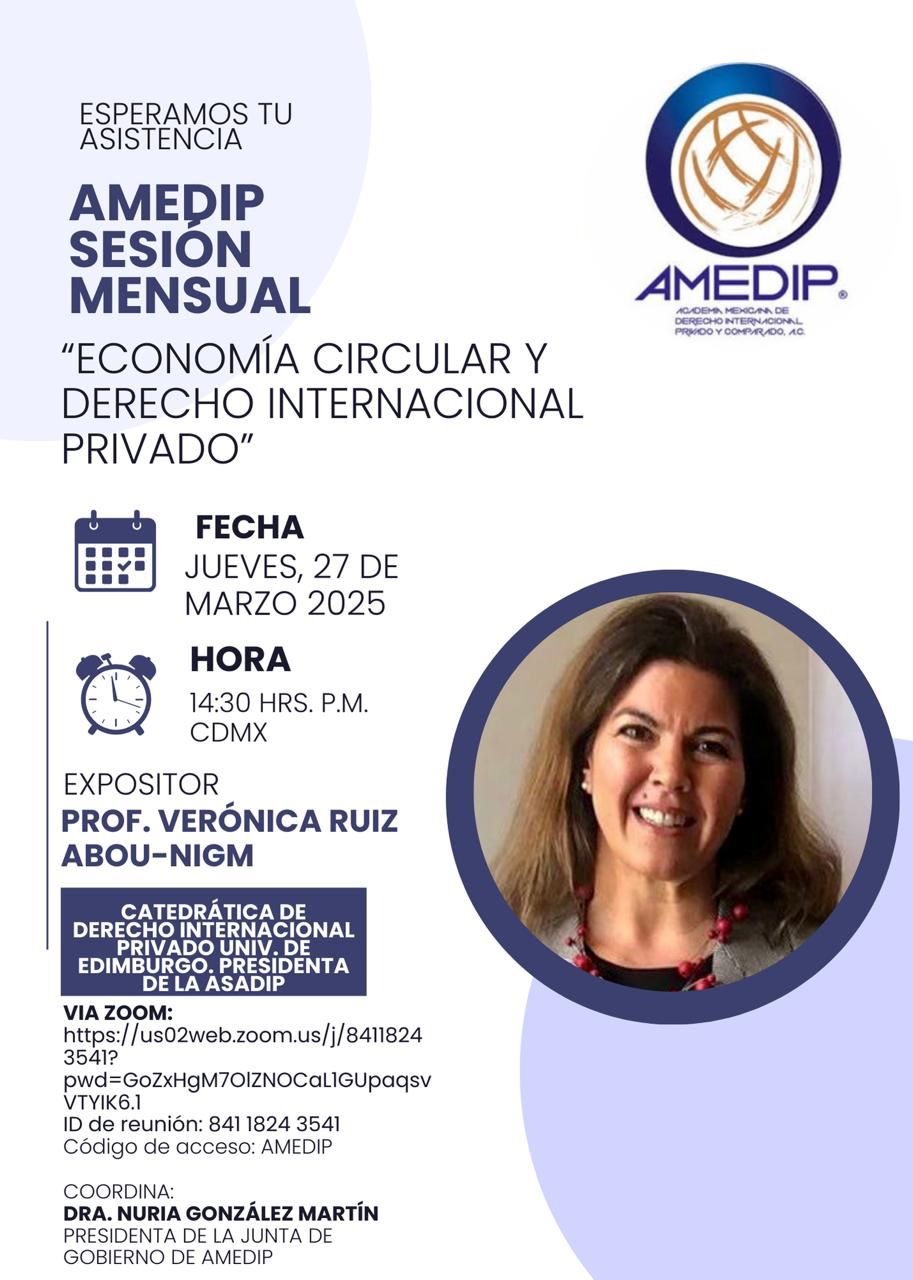
The Mexican Academy of Private International and Comparative Law (AMEDIP) is holding a webinar on Thursday 27 March 2025 at 14:30 (Mexico City time – CST), 21:30 (CET time). The topic of the webinar is ‘Circular Economy and Private International Law’ and will be presented by Prof. Verónica Ruiz Abou-Nigm (in Spanish).
New Canadian Conflicts Text
The Irwin Law “Essentials Series” is a collection of texts about Canadian law aimed at a broad audience: it includes law students and also lawyers, judges and academics. It has been quite successful over the past twenty years. In 2024 Irwin Law was acquired by University of Toronto Press. It has continued the Essentials Series and the use of the Irwin Law imprint.
It has now published the third edition of Conflict of Laws written by Professor Stephen G.A. Pitel of Western University, Canada. The second edition was published in 2016 and so this edition updates almost a decade of activity, mainly from courts across Canada. The major change is that the chapter on declining jurisdiction has been reorganized and updated in light of the Supreme Court of Canada’s decisions in Douez v Facebook, Inc (2017) and Haaretz.com v Goldhar (2018). All chapters have been updated to reflect new decisions, legislative changes and recent scholarship.
More information is available here. For those outside Canada, the book is a clear and accessible source of comparative conflict of laws analysis.