


Views
The jurisdictional hurdles of s 26 of the Trans-Tasman Proceedings Act 2010 (Cth), in the context of interim anti-enforcement relief in aid of New Zealand proceedings
The New Zealand High Court recently granted a permanent anti-enforcement injunction in relation to a default judgment from Kentucky in Kea Investments Ltd v Wikeley Family Trustee Limited [2023] NZHC 3260. The plaintiff, a British Virgin Islands company, claimed that the defendants had committed a tortious conspiracy against it because the Kentucky default judgment was based on fabricated claims intended to defraud it. The defendants were a New Zealand company, Wikeley Family Trustee Ltd (WFTL), and persons associated with the company.
In an undefended judgment, the High Court granted the injunction, awarded damages for the costs incurred in the foreign proceedings (referring to cases such as Union Discount Co Ltd v Zoller [2001] EWCA Civ 1755, [2002] 1 WLR 1517 by analogy), and issued a declaration that the Kentucky judgment would not be recognised or enforceable in New Zealand. As noted previously on this blog (see here), the case is an interesting example of “the fraud exception to the principles of comity” (Kea Investments Ltd v Wikeley (No 2) [2023] QSC 215 at [192]).
Second Act in Dutch TikTok class action on privacy violation: court assesses Third Party Funding Agreements
Written by Eduardo Silva de Freitas (Erasmus University Rotterdam), Xandra Kramer (Erasmus University Rotterdam/Utrecht University) & Jos Hoevenaars (Erasmus University Rotterdam), members of the Vici project Affordable Access to Justice, financed by the Dutch Research Council (NWO), www.euciviljustice.eu.
Introduction
Third Party Litigation Funding (TPLF) has been one of the key topics of discussion in European civil litigation over the past years, and has been the topic of earlier posts on this forum. Especially in the international practice of collective actions, TPLF has gained popularity for its ability to provide the financial means needed for these typically complex and very costly procedures. The Netherlands is a jurisdiction generally considered one of the frontrunners in having a well-developed framework for collective actions and settlements, particularly since the Mass Damage Settlement in Collective Actions Act (WAMCA) became applicable on 1 January 2020 (see also our earlier blogpost). A recent report commissioned by the Dutch Ministry of Justice and Security found that most collective actions seeking damages brought under the (WAMCA) have an international dimension, and that all of these claims for damages are brought with the help of TPLF.
Is this a Conflicts Case?
In Sharp v Autorité des marchés financiers, 2023 SCC 29 (available here) the Supreme Court of Canada has held that a Quebec administrative tribunal, the Financial Markets Administrative Tribunal, can hear a proceeding brought by the administrative agency that regulates Quebec’s financial sector, the Autorité des marchés financiers, against four defendants who reside in British Columbia. The AMF alleged in the proceedings that the defendants had contravened the Quebec Securities Act.
The courts below, including a majority of the Quebec Court of Appeal, focused the analysis on s. 93 of the Act respecting the Autorité des marchés financiers, CQLR, c. A-33.2, which grants the FMAT jurisdiction to make determinations under the Securities Act. They interpreted and applied this provision in light of Unifund Assurance Co. v Insurance Corp. of British Columbia, 2003 SCC 40, a leading decision on the scope of application of provincial law, which held that a provincial regulatory scheme constitutionally applies to an out-of-province defendant when there is a “real and substantial connection”, also described as a “sufficient connection”, between the province and the defendant. This test was met on the facts [see para 22] and so the FMAT had jurisdiction. This analysis is not generally understood as being within the field of conflict of laws. Indeed, the majority of the Court of Appeal “saw no conflict of jurisdiction or any conflict of laws that would require the application of private international law rules to this case” [see para 29].
News
Asser Institute Conference: Adapting Private International Law in an Era of Uncertainty
Announcement prepared by Eduardo Silva de Freitas (Asser Institute and Erasmus University Rotterdam)
The T.M.C. Asser Institute is organising the conference “Adapting Private International Law in an Era of Uncertainty” as part of its 60 Years Series. The event will take place in The Hague (The Netherlands) on Friday, 24 October 2025, and will gather academics, practitioners, and early career researchers who will address current topics in Private International Law, including developments in the digital age and the protection of weaker parties.
The programme is available by clicking here: asser-institute-60-years-series_final.pdf
To register for the conference, please visit: T.M.C. Asser Instituut Registration Form
For more information you can contact the organisers at: E.Silva.de.Freitas@asser.nl or V.Lazic@asser.nl
New book and webinar Sustaining Access to Justice – 5 September
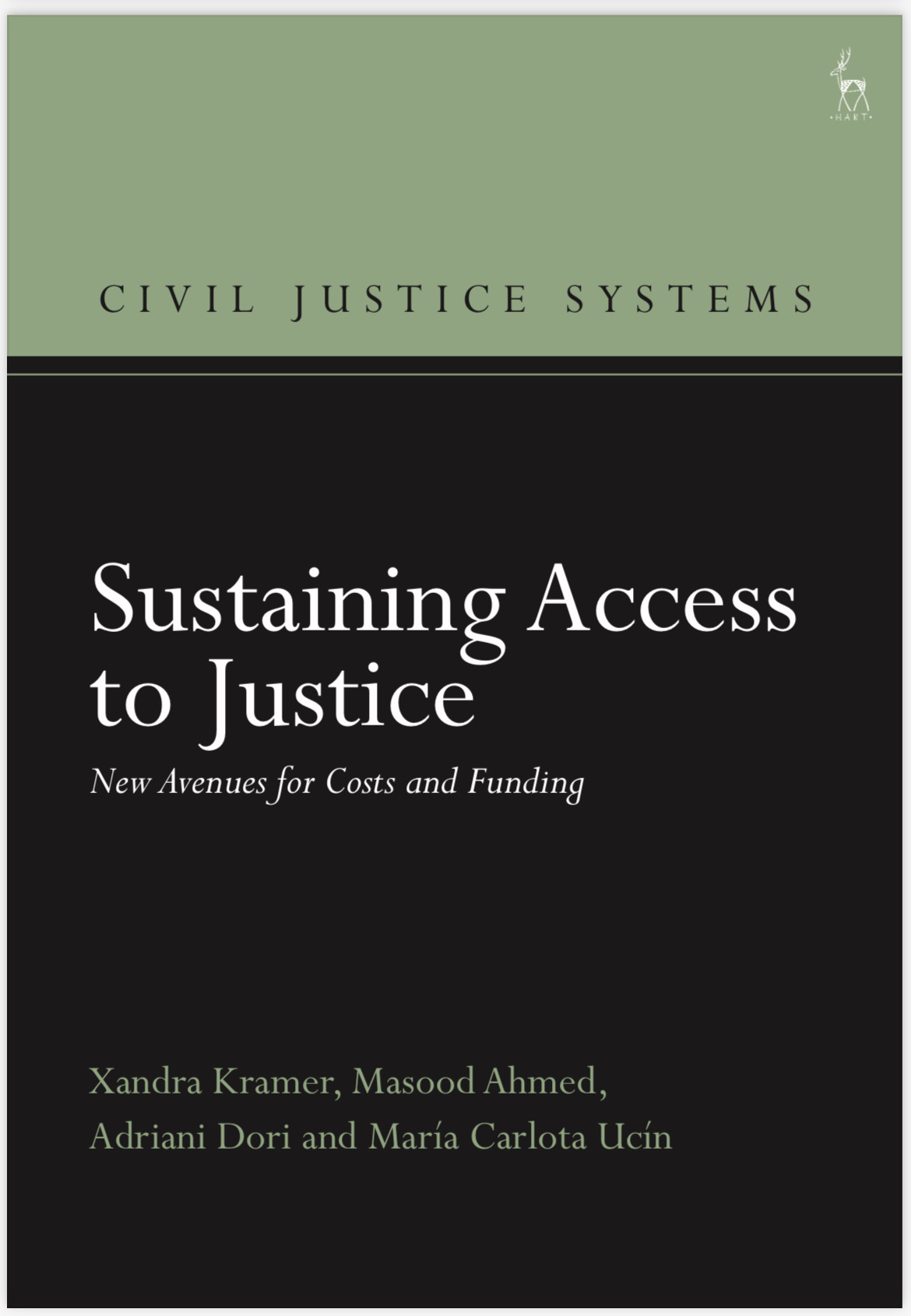 In June the volume “Sustaining Access to Justice: New Avenues for Costs and Funding” was published in the Civil Justice Systems series of Hart Publishing (2025). The book is edited by Xandra Kramer, Masood Ahmed, Adriani Dori and Maria Carlota Ucín. This edited volume results from a conference held at Erasmus University Rotterdam, as part of the Vici project on Affordable Access to Justice funded by the Dutch Research Council (NWO). It contains contributions on access to justice themes, in particular costs and funding of litigation, by key experts across Europe, Latin America and Asia. More information, including the table of contents is available at the Bloomsbury website here.
The book explores the dynamic landscape of legal costs and financing from three perspectives: regulatory frameworks in public and private funding; new trends and challenges in contemporary legal financing; and the transformative potential of alternative dispute resolution (ADR) and online dispute resolution (ODR) procedures to streamline civil justice processes and expand access to justice.
By addressing the intersectionality of legal, economic, political, market and social dynamics, the book aims to provide an encompassing understanding of the inherent complexity of costs and funding of litigation, and their implications for access to justice.
A seminar on the ocassion of launching the book will take place on 5 September 2025, from 10-12.15 CET.
Program
10.00 Introduction Xandra Kramer, Masood Ahmed, Carlota Ucin, Adriani Dori
10.15 Jacek Garstka (European Commission) – EC perspective on the access to justice and the role of litigation funding
10.25 Maria Jose Azar-Baud – Trends in Funding of Collective Litigation
10.35 Alexandre Biard – Enforcing Consumer Rights: Costs and Funding
10.50 Discussion
11.10 Eduardo Silva de Freitas – Justice for a Price: Funders, Fees and the RAD
11.20 Marcel Wegmüller – ESG and Litigation Funding: A Practitioner’s View
11.35 Adrian Cordina – Regulating Litigation Funding: A Law and Economics View
11.45 Stefaan Voet/Masood Ahmed – Beyond Litigation: Cost-Effective Strategies for ADR and ODR
12.00 Discussion and Conclusion
More information and (free) registration here.
Webinar: Beyond State Borders, Beyond the Situs Rule? Private International Law Issues of Resource Extraction in Antarctica, the Deep Seabed, and Outer Space
The Aberdeen Centre for Private International Law & Transnational Governance (CPILTG) will be hosting a webinar by Professor Caroline Rapatz (University of Kiel, Germany) on 20 August 2025, 11am – 12pm noon.
More information is available here.