
[Out Now!] Teramura on Cambodian Private International Law (Hart, 2025)


After Indonesia, China, Japan, India and recently Hong Kong, the prestigious Hart series “Studies in Private International Law – Asia” has released a new volume on Cambodian Private International Law, authored by Nobumichi Teramura (Associate Professor, Keio University Law School; Affiliate, Centre for Asian and Pacific Law in the University of Sydney).
This book is the 14th volume in this outstanding series, which, in only six years of existence, has successfully manages to transform the “little attention” once paid to developments in private international law in Asia into an explosion of Asian scholarship and a growing and dynamic field of study.
This new volume, however, is somewhat different from the other abovementioned volumes that comprehensively cover private international law in a specific jurisdiction. As rightfully stated in the Series Editors’ Preface, “[o]f those six volumes, this is possibly the most challenging.” This is because, as the author points out, Cambodia “still does not have a comprehensive legal framework that addresses conflict of laws issues, and research on Cambodian private international law is still in its infancy.” Cambodian law “does not yet contain rules on international jurisdiction,” nor does it have “any special statutory body of law dealing specifically with the conflict of laws.” Moreover, Cambodian courts “have never recognised and enforced judgments issued abroad.”
In this regard, the Series Editors posed in their preface the question of whether, under such circumstances, “it is too early to speak of, much less write about, a coherent body of Cambodian private international law.” But this is precisely what makes this volume particularly interesting and unique. It proposes a striking approach: the development of principles of Cambodian private international law by reference to Japanese legal principles and experiences. This is explained by the long-standing involvement of Japanese scholars and agencies in Cambodia’s legal development through technical assistance, and by the fact that Cambodian law “borrow[s] heavily from Japanese law.”
In pursuing this undertaking, the author has relied “mostly…on English and Japanese literature on Cambodian law and society,” given the “significant volume” of materials available in those languages, particularly in Japanese, on Cambodian law. The author himself acknowledges that his “research approach to Cambodian private international law is experimental and will inevitably attract criticism.” Nevertheless, while engaging in this Sisyphus-like endeavor, he humbly “hopes that the discussion in this book can serve as a starting point for a dialogue among legal experts in Cambodian law for considering the next reform of Cambodian private international law, regardless of whether the experts agree or disagree with the suggestions made” therein.
One thing is certain: as the first (and so far the only) comprehensive contribution on Cambodian private international law in English, and probably in any language, it provides valuable access to the first sustained and systematic reflection on this subject. By doing so, the book fills a significant gap in the literature, opens new avenues for scholarly debate, and lays a foundation not only for discussion and critical reflection but also for future reforms in this field. From this perspective, the book’s objective can be said to have been fully achieved.
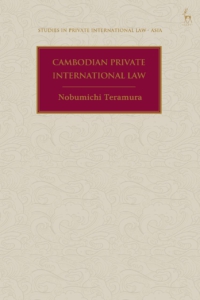 The description of the book reads as follows:
This book is the leading reference on Cambodian private international law in English.
The chapters systematically cover the whole of Cambodian private international law, including commercial matters, family law, succession, intellectual property, competition (antitrust), and environmental disputes.
The chapters do not merely cover the traditional conflict of law areas of jurisdiction, applicable law (choice of law) and enforcement. They also look into conflict of law questions arising in arbitration and assess Cambodia’s involvement in the harmonisation of private international law globally and regionally within the Association of Southeast Asian Nations (ASEAN).
Similarly to the other volumes in the Studies in Private International Law – Asia series, this book presents the Cambodian conflict of laws through a combination of common and civil law analytical techniques and perspectives, providing readers worldwide with a more profound and comprehensive understanding of the subject.
Table of Contents includes the following:
1. Introduction
Part I: Foundations of Cambodian Private International Law
2. Status of Private International Law in Cambodia and Preliminary Matters
3. Treatment of Foreign Law
Part II: Jurisdiction
4. Direct Jurisdiction
Part III: Choice of Law
5. Choice of Law for Contractual Obligations
6. Choice of Law for Non-Contractual Obligations
7. Choice of Law for Property Issues
8. Family Law
9. Law of Corporations, Insolvency, Antitrust and Unfair Competition
Part IV: Recognition and Enforcement
10. Recognition and Enforcement of Foreign Judgments
Part V: Arbitration
11. International Arbitration
12. The Harmonisation of Private International Law