


Views
Choice of law in commercial contracts and regulatory competition: new steps to be made by the EU?
The recently published study titled ‘European Commercial Contract Law’, authored by Andrea Bertolini, addresses the theme of regulatory competition. It offers new policy recommendations to improve EU legal systems’ chances of being chosen as the law governing commercial contracts.
The Study’s main question
The European Parliament’s Committee on Legal Affairs has published a new study authored by Andrea Bertolini, titled ‘European Commercial Contract Law’ (the ‘Study’). The Study formulates the main question as follows: ‘why the law chosen in commercial contracts is largely non-European and non-member state law’. The expression ‘non-European and non-member state’ law is specified as denoting the legal systems of England and Wales, the United States, and Singapore, and more generally, common law legal systems. The Study states:
It is easily observed how most often international contracts are governed by non-European law. The reasons why this occurs are up to debate and could be quite varied both in nature and relevance. Indeed, a recent study by Singapore Academy of Law (SAL) found that 43 per cent of commercial practitioners and in-house counsel preferred English law as the governing law of the contracts. Read more
Financial Hardship and Forum Selection Clauses
The U.S. Supreme Court has long held that a forum selection clause should not be enforced when “trial in the contractual forum will be so gravely difficult and inconvenient” that the plaintiff “will for all practical purposes be deprived of his day in court.” The financial status of the plaintiff is obviously a factor that should be considered as part of this inquiry. Large corporations can usually afford to litigate cases in distant courts. Individual plaintiffs frequently lack the resources to do so. Nevertheless, the lower federal courts in the United States have repeatedly held that financial hardship on the part of the plaintiff is not enough to make an otherwise valid forum selection clause unenforceable. Read more
Revised Canadian Statute on Judgment Enforcement
Two years ago, the Uniform Law Conference of Canada (ULCC) released a revised version of the Court Jurisdiction and Proceedings Transfer Act (CJPTA), model legislation putting the taking of jurisdiction and staying of proceedings on a statutory footing. The statute is available here.
The ULCC has now released a revised version of another model statute, the Enforcement of Canadian Judgments Act (ECJA). The original version of this statute was prepared in 1998 and had been amended four times. It has now been consolidated and substantially revised. It is available here and background information is available here and here.
News
2026 applications for a 6-month internship in The Hague, Netherlands
The Australian Institute of International Affairs and the Australian Branch of the International Law Association call for applications for the 2026 Peter Nygh Hague Conference Internship.
New Journal: Perspectives contentieuses internationales (PCI)
The following announcement was kindly shared with us by Fabienne Jault-Seseke
Created with the support of LexisNexis, the Review Perspectives contentieuses internationales (PCI) is a biannual academic journal dedicated to the globalization of international litigation in both its public and private aspects. Each issue features a thematic dossier, complemented by several articles outside the main topic (Varia), as well as brief focus pieces addressing current events relevant to political or regulatory developments impacting international disputes (Focus).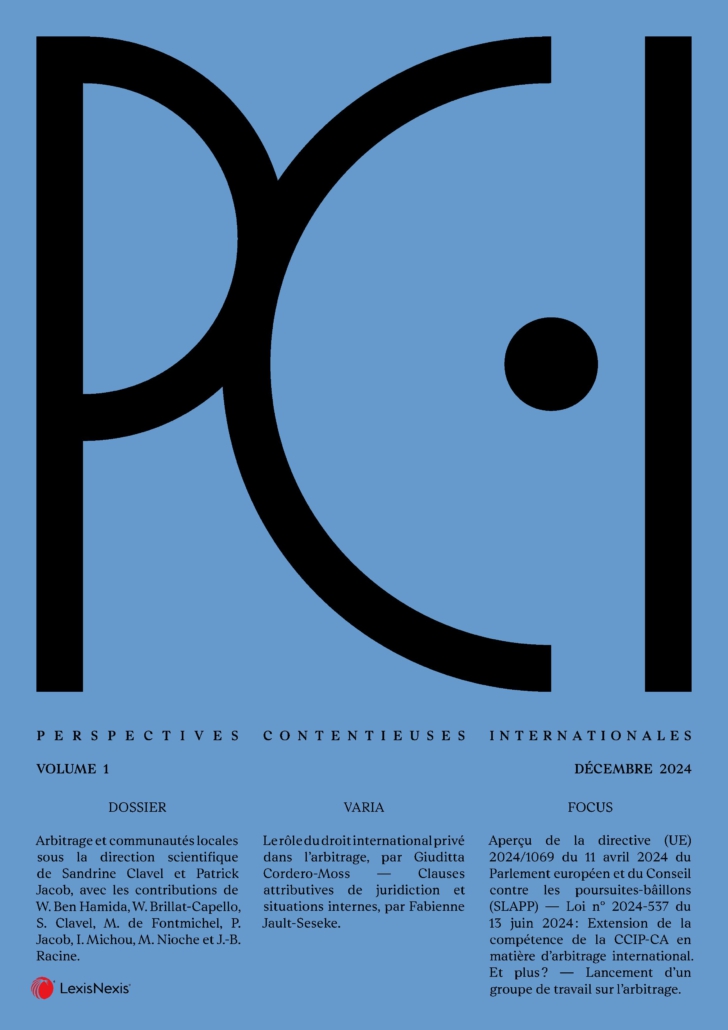
The editorial committee, which ensures the scientific and operational direction of the Review, is composed of Sandrine Clavel, Patrick Jacob, and Fabienne Jault-Seseke (professors at Université Paris-Saclay, UVSQ).
Three issues have already been published and are available open access.
Out Now (Open Access): Heiderhoff/Queirolo (eds), EU and Private International Law: Oper Questions in Family Law, Contracts, and Torts
A new volume coming out of the Programme in European Private Law for Postgraduates (PEPP) has just been published as part of the Scritti di diritto privato europeo ed internazionale series.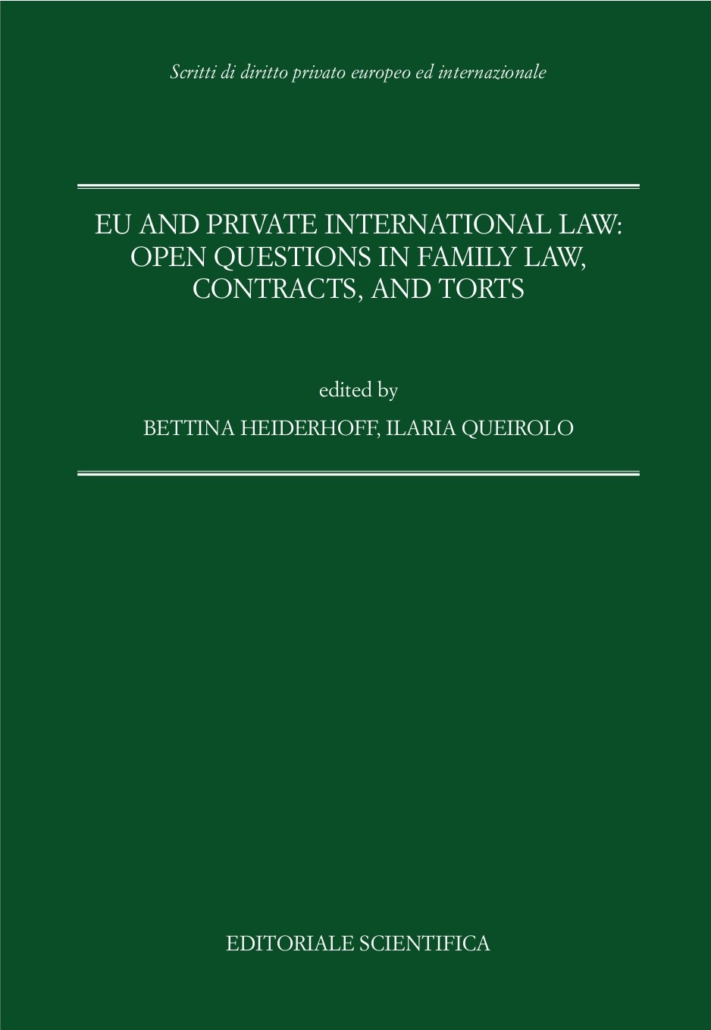
The table of contents can be found here; the full volume is available open access here.