


Views
Colonialism and German Private International Law – Introduction to a Post Series
In March 2023 I gave a talk at the conference of the German Society of International Law. The conference had the title “Colonial Continuities in International Law“ and my presentation focused on “Continuation of colonialism in contemporary international law? – Foundations, structures, methods from the perspective of PIL“. Thus, I was exploring those foundations, basic structures, and fundamental methods of mainly German Private International Law (PIL) and whether and how they have been influenced by colonialism.
French Cour de cassation rules (again) on duty of domestic courts to apply European rules of conflict on their own motion
 In the Airmeex case (Civ. 1re 27 septembre 2023, n°22-15.146, available here), the French Cour de cassation (première chambre civile) had the opportunity to rule on the duty of domestic courts to apply European rules of conflict on their own motion. The decision is a great opportunity to discuss the French approach to the authority of conflict-of-laws rules.
Postmodernism in Singapore private international law: foreign judgments in the common law
Guest post by Professor Yeo Tiong Min, SC (honoris causa), Yong Pung How Chair Professor of Law, Yong Pung How School of Law, Singapore Management University
Merck Sharp & Dohme Corp (formerly known as Merck & Co, Inc) v Merck KGaA (formerly known as E Merck) [2021] 1 SLR 1102, [2021] SGCA 14 (“Merck”), noted previously, is a landmark case in Singapore private international law, being a decision of a full bench of the Court of Appeal setting out for the first time in Singapore law the limits of transnational issue estoppel. It was also the beginning of the deconstruction of the common law on the legal effect to be given to foreign judgments. Without ruling on the issue, the court was not convinced by the obligation theory as the rationale for the recognition of foreign in personam judgments under the common law, preferring instead to rest the law on the rationales of transnational comity and reciprocal respect among courts of independent jurisdictions. There was no occasion to depart from the traditional rules of recognition of in personam judgments in that case, and the court did not do so. However, the shift in the rationale suggested that changes could be forthcoming. While this sort of underlying movements have generally led to more expansive recognition of foreign judgments (eg, in Canada’s recognition of foreign judgments from courts with real and substantial connection to the underlying dispute), the indications in the case appeared to signal a restrictive direction, with the contemplation of a possible reciprocity requirement as a necessary condition for recognition of a foreign judgment, and a possible defence where the foreign court had made an error of Singapore domestic law.
News
The White Paper on Digital Product Passports and Critical Raw Materials for Batteries: Legal Conflicts and Principles for Cross-Border Cooperation
The White Paper on “Digital Product Passports and Critical Raw Materials for Batteries: Legal Conflicts and Principles for Cross-Border Cooperation” is now formally published on the UNECE website!
The United Nations Economic Commission for Europe White Paper identifies and analyses the critical legal challenges in implementing Digital Product Passports (DPPs) for Critical Raw Materials (CRMs), including cobalt, copper, lithium, and nickel. These materials are essential for Energy Transition, for example, electric vehicles.
Yet, tracing their journey from mines to markets to recycling is legally complex and globally inconsistent. This fragmentation hinders sustainability and transition to circular economy.
The White Paper provides policymakers and businesses with: An analysis of conflicting legal frameworks in implementing DPPs; Guiding principles for cross-border cooperation in CRM-Battery value chains.
Read the full White Paper here.
AMEDIP’s upcoming webinar: A radical change in German Private International Law, the example of the naming law (in Spanish)
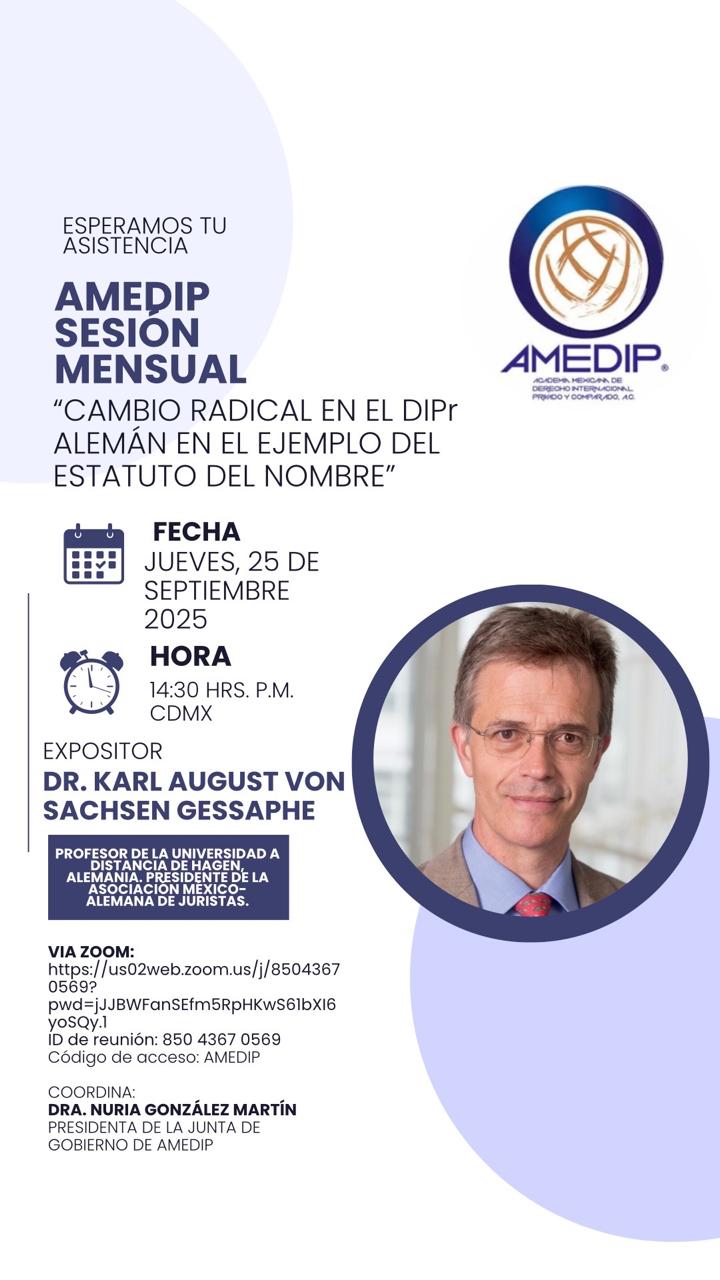
The Mexican Academy of Private International and Comparative Law (AMEDIP) is holding a webinar on Thursday 25 September 2025 at 14:30 (Mexico City time – CST), 22:30 (CEST time). The topic of the webinar is: A radical change in German Private International Law, the example of the naming law, which will be presented by Prof. Dr. Karl August von Sachsen Gessaphe (in Spanish).
Giustizia consensuale No 1/2025: Abstracts
 The first issue of 2025 of Giustizia consensuale (published by Editoriale Scientifica) has been released, and it features:
Cesare Cavallini (Professor at Bocconi University, Milan), L’arbitrato come processo e giustizia consensuale (Arbitration as a Process and Consensual Justice; in Italian).
The essay aims to analyze the phenomenon of private autonomy and consensual justice in arbitration as it has evolved through various reforms. The goal is to highlight arbitration as a process and a form of consensual justice that is alternative yet distinct from ordinary judicial proceedings and fully aligned with constitutional principles. This objective becomes even more significant when compared to the very different and controversial issues discussed in American legal doctrine, which instead point to an unceasing erosion of rights through a blending of public interferences in arbitration and private ones in ordinary justice, raising concerns about the legitimacy of private autonomy within the framework of civil protections under constitutional scrutiny. Read more