


Views
Measure twice, cut once: Dutch case Presta v VLEP on choice of law in employment contracts
Presta v VLEP (23 june 2023) illustrates the application of the CEJU’s Gruber Logistics (Case C-152/20, 15 July 2021) by the Dutch Supreme Court. In order to determine the law applicable to an individual employment contract under article 8 Rome I, one must compare the level of protection that would have existed in the absence of a choice of law (in this case, Dutch law) with the level of protection offered by the law chosen by the parties in the contract (in this case, the laws of Luxembourg), thereafter, the law of the country offering the highest level of employee protection should be applied.
U.S. Supreme Court Renders Personal Jurisdiction Decision
This post is by Maggie Gardner, a professor of law at Cornell Law School. It is cross-posted at Transnational Litigation Blog.
The U.S. Supreme Court yesterday upheld the constitutionality of Pennsylvania’s corporate registration statute, even though it requires out-of-state corporations registering to do business within the state to consent to all-purpose (general) personal jurisdiction. The result in Mallory v. Norfolk Southern Railway Co. re-opens the door to suing foreign companies in U.S. courts over disputes that arise in other countries. It may also have significant repercussions for personal jurisdiction doctrine more broadly. Read more
The New Saudi Civil Transaction Act and its Potential Impact on Private International Law in Saudi Arabia
The Kingdom of Saudi Arabia (KSA) has recently enacted a new Civil Transactions Law (Royal Decree No. M/199, dated June 16, 2023). The law will enter into force on December 16, 2023, 180 days after its enactment (hereinafter referred to as “the new law”). This law has been rightly described as “groundbreaking” because, prior to the enactment of the new law, there has been no codification of civil law in the Kingdom, and civil law issues have traditionally been governed by the classical rules of Islamic Sharia according to the teachings of the prevailing school of fiqh (religio-legal jurisprudence) in the Kingdom (Hanbali School). Like most of the civil law codifications in the region, the new law focuses mainly on the so-called “patrimonial law,” i.e., property rights and obligations (contractual and non-contractual). Family relations and successions are dealt with in a separate law, which was previously enacted in 2022 and entered into force the same year (Personal Status Act, Royal Decree No. M/73 of 9 March 2022, entered into force on June 18, 2022).
News
Reciprocity in the Recognition and Enforcement of Foreign Judgments: Two Recent Contributions
Reciprocity in the field of recognition and enforcement of foreign judgments has long been a subject of passionate debate. While some scholars question its desirability, others firmly defend it as a legitimate legal requirement. What remains undeniable is that the topic continues to spark intense discussion and scholarly interest.
A clear illustration of this ongoing debate is provided by two recent publications addressing the issue from different perspectives and jurisdictions.
The first is an enlightening open-access article by Eszter PAPP and Nobumichi TERAMURA, titled “Enforcing Singapore Judgments in Cambodia: Reciprocity Under the Loupe“. The paper explores the practical and legal challenges related to the enforcement of Singaporean money judgments in Cambodia, with a specific focus on the requirement of reciprocity. Read more
Out Now: Gridel, Financial Markets and Instruments in Private International Law. A European and French Perspective A European and French Perspective
The multiple-award-winning book by Augustin Gridel (Université de Lorraine), Marchés et instruments financiers en droit international privé (Bruylant 2023), has just been published in English under the title Financial Markets and Instruments in Private International Law. A European and French Perspective. It features a preface by Louis D’Avout and a foreword by Christine Lagarde.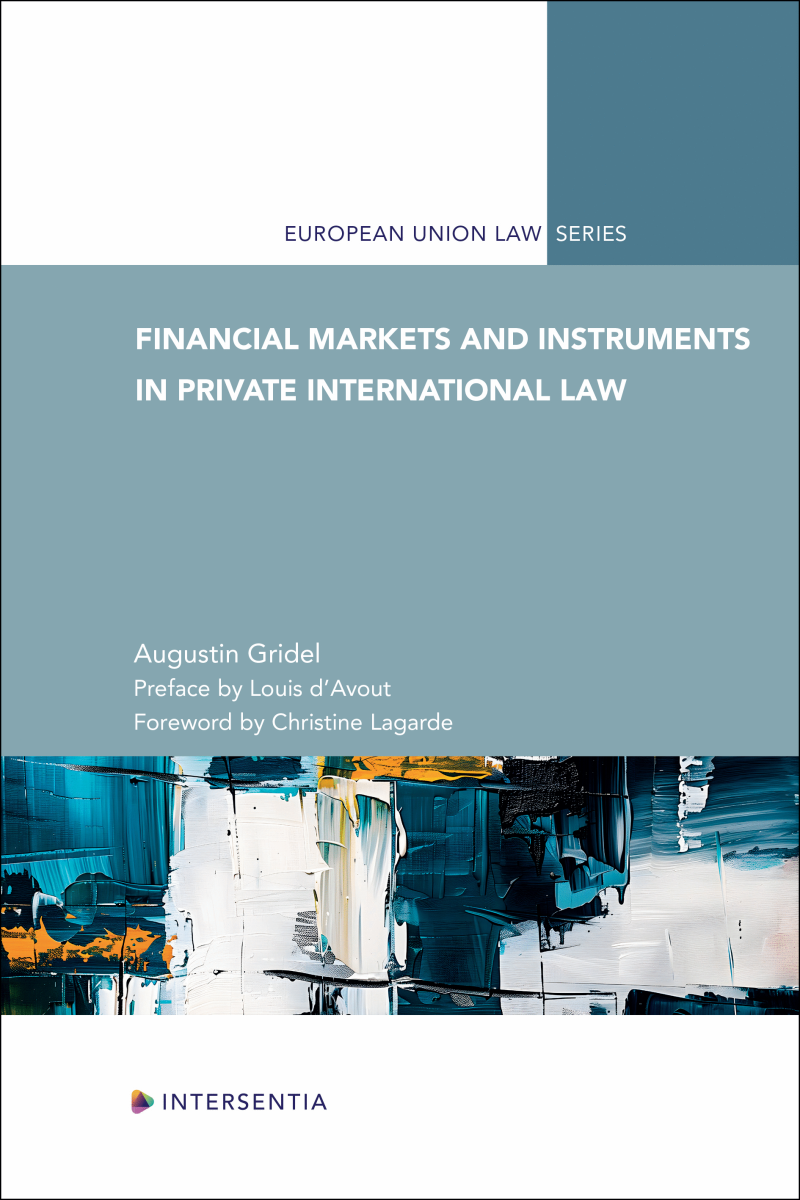
Report of the Oxford Conference on “Characterisation in the Conflict of Laws”

The author of this report is Meltem Ece Oba (Koç University, Istanbul). The post is being published simultaneously on Conflictoflaws.net and on the EAPIL blog.
On 20-21 March 2025, a conference on “Characterisation in the Conflict of Laws” was convened at St Hilda’s College, Oxford. Under the auspices of the Institute of European and Comparative Law in the Law Faculty of the University of Oxford, the conference was jointly organised by Dr Johannes Ungerer (University of Oxford and Notre Dame University in England), Dr Caterina Benini (Catholic University of Sacred Heart, Milan) and PD Dr Felix Berner (University of Tübingen). The conference brought together scholars and practitioners from several jurisdictions around the world.