


Views
This week begins the Special Commission on the 1980 Child Abduction Convention and the 1996 Child Protection Convention
Written by Mayela Celis
The eighth meeting of the Special Commission on the Practical Operation of the 1980 Child Abduction Convention and the 1996 Child Protection Convention will be held from 10 to 17 October 2023 in The Hague, the Netherlands. For more information, click here.
One of the key documents prepared for the meeting is the Global Report – Statistical study of applications made in 2021 under the 1980 Child Abduction Convention, where crucial information has been gathered about the application of this Convention during the year 2021. However, these figures were perhaps affected by the Covid-19 pandemic as indicated in the Addendum of the document (see paragraphs 157-167, pp. 33-34). Because it refers to a time period in the midst of lockdowns and travel restrictions, it is not unrealistic to say that the figures of the year 2021 should be taken with a grain of salt. For example, the overall return rate was the lowest ever recorded at 39% (it was 45% in 2015). The percentage of the combined sole and multiple reasons for judicial refusals in 2021 was 46% as regards the grave risk exception (it was 25% in 2015). The overall average time taken to reach a final outcome from the receipt of the application by the Central Authority in 2021 was 207 days (it was 164 days in 2015). While statistics are always useful to understand a social phenomenon, one may only wonder why a statistical study was conducted with regard to applications during such an unusual year – apart from the fact that a Special Commission meeting is taking place and needs recent statistics -, as it will unlikely reflect realistic trends (but it can certainly satisfy a curious mind).
Judicial Application of the 1980 HCCH Convention in Morocco
The question of the accession (or reluctance to accede) of Muslim countries to the 1980 HCCH Convention has attracted the interest of scholars from Muslim countries and abroad. Scholars who have addressed this issue have come to different (sometimes contradictory) conclusions, especially when it comes to the influence of classical Islamic rules and principles on the attitudes and policies of Muslim states. Unfortunately, it is not uncommon that the available studies on this subject do not take into account the actual judicial practice of Muslim jurisdictions and focus more on the (theoretical) compatibility (or not) of Islamic rules and principles underlying the 1980 HCCH Convention. This post briefly presents some decisions dealing with the issue of cross-border child abduction under the 1980 HCCH Convention in a Muslim state, Morocco, but without going into too much into details or assessment, as this deserves to be done properly in a dedicated article.
Overview of the 2023 Amendments to Chinese Civil Procedure Law
Written by NIE Yuxin, Wuhan University Institute of International Law
1. Background
China’s Civil Procedure Law was enacted in April 1991 by the Fourth Session of the Seventh National People’s Congress. Since then, it had undergone four revisions in 2007, 2012, 2017, and 2021. However, no substantial revisions were made to the provisions concerning foreign-related civil litigation. The latest amendments to the Civil Procedure Law in 2023, referred to as the new CPL, involve 26 amendments, including 14 modified articles and 15 new additions. Notably, 19 changes deal with the special provisions on cross-border procedures.
News

Report from the inaugural conference of the Australasian Association of Private International Law (AAPrIL)
On 16 and 17 April 2025, the Australasian Association of Private International Law (AAPrIL) held its inaugural conference in Brisbane, Australia. Hosted by Griffith University—the home of AAPrIL President Mary Keyes—the conference featured stimulating panel presentations from speakers from around Australia and abroad.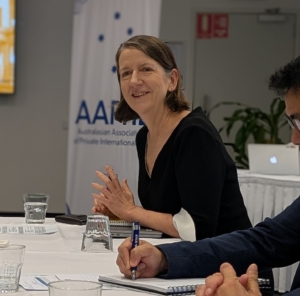
The conference started with a panel on jurisdiction and judgments, chaired by Richard Garnett of Melbourne Law School. Reid Mortensen of USQ kicked things off with a presentation on Australia’s cross-vesting scheme. Priskila Penasthika of the Universitas Indonesia then spoke on ‘The Indonesian Language Contract Requirements versus Arbitration as a Choice of Forum’. Read more
Workshops on Addressing Conflict of Laws and Facilitating Digital Product Passports (DPPs) in Cross-border Value Chains
UN/CEFACT would like to invite you to attend:
New Article on Public Policy Exception
In every private international law system, the forum state reserves the right to reject the application of a foreign rule that deeply offends the forum’s fundamental sense of justice and fairness. In all systems, this “public policy reservation” (ordre public) operates as an exception to the forum’s choice-of-law rules, not its rules on jurisdiction or access to courts. Surprisingly, the First and Second Conflicts Restatements in the United States deviate from this international consensus by narrowly phrasing the exception as a ground for denying a forum to foreign causes of action rather than as a ground for refusing to apply other foreign rules, including those raised as defenses.
A forthcoming article by Symeon Symeonides titled The Public Policy Exception in Choice of Law: The American Version discusses the origins of this unique formulation in Judge Cardozo’s classic but misinterpreted decision in Loucks v. Standard Oil Co. of New York, the problems it creates, its tacit rejection by most American courts, and the new flexible formulation of the exception in the proposed Third Conflicts Restatement.
The article will be published in Praxis des Internationalen Privat- und Verfahrensrechts (IPRax), as well as in a special issue of the Emory Journal of International Law dedicated to the renowned conflicts scholar Peter Hay.