


Views
International Jurisdiction between Nationality and Domicile in Tunisian Private International Law – Has the Perennial Debate Finally been Resolved?
I would like to thank Prof. Lotfi Chedly for providing me with the text of the decision on which this post is based.
I. Introduction
Scholars of private international law are well familiar with the classic debate on nationality and domicile as connecting factors in the choice of applicable law (see, for example, L. I. de Winter, “Nationality or Domicile? The Present State of Affairs” 128 Collected Courses III (1969) pp. 357 ff). In Tunisian private international law, this controversy has been particularly pronounced with regard to the role of nationality as a ground for the international jurisdiction of Tunisian courts. Since the enactment of the Tunisian Private International Law Code (“PILC”) in 1998 (for an English translation, see J. Basedow et al. (eds.) Encyclopedia of Private International Law – Vol. IV (Elgar Editions, 2017) 3895 and my own translation of the provisions dealing with international jurisdiction and the enforcement of foreign judgments in 8 Journal of Private International Law 2 (2012) pp. 221 ff)), the debate between opponents and proponents of nationality as a ground for international jurisdiction, especially in family law matters, has never ceased to be intense (for detailed analyses, see eg. Salma Triki, “La compétence internationale tunisienne et le critère de nationalité” in Ben Achour/Triki (eds.), Le Code de droit international privé – Vingt ans d’application (1998-2018) (Latrach edition, 2020) 119ff). This divergence in academic opinion is also reflected in the judicial practice of the courts, with the emergence of two opposing trends: one extends the international jurisdiction of the Tunisian courts when the dispute involves a Tunisian party, in particular as a defendant even when domiciled abroad. The other firmly rejects nationality as a ground for international jurisdiction.
An Answer to the Billion-Dollar Choice-of-Law Question
On February 20, 2024, the New York Court of Appeals handed down its opinion in Petróleos de Venezuela S.A. v. MUFG Union Bank, N.A. The issue presented—which I described in a previous post as the billion-dollar choice-of-law question—was whether a court sitting in New York should apply the law of New York or the law of Venezuela to determine the validity of certain bonds issued by a state-owned oil company in Venezuela. The bondholders, represented by MUFG Union Bank, argued for New York law. The oil company, Petróleos de Venezuela, S.A. (“PDVSA”), argued for Venezuelan law.
In a victory for PDVSA, the New York Court of Appeals unanimously held that the validity of the bonds was governed by the law of Venezuela. It then sent the case back to the federal courts to determine whether the bonds are, in fact, invalid under Venezuelan law.
Read more
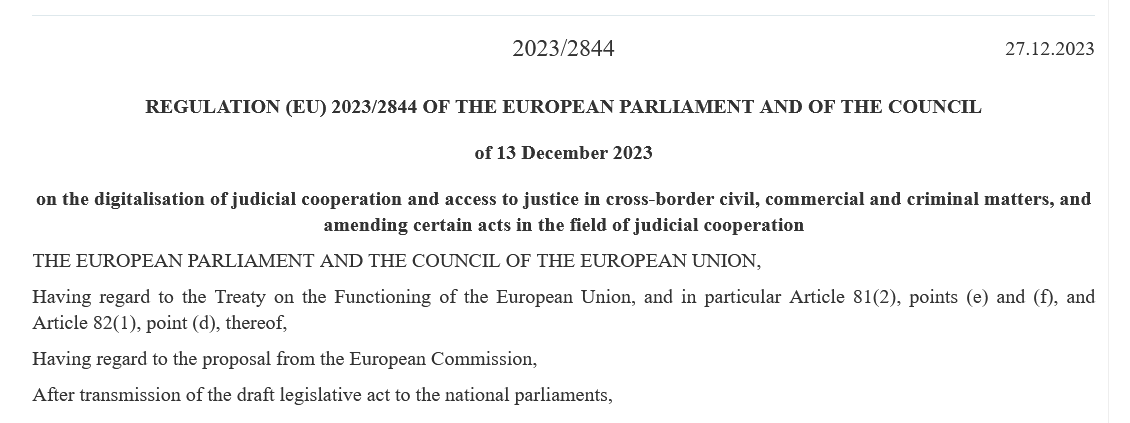
New EU Digitalisation Regulation: A Stepping Stone to Digitalised EU?
Author: Martina Ticic, assistant at the University of Rijeka, Faculty of Law and doctoral student funded by the Croatian Science Foundation (Hrvatska zaklada za znanost – HRZZ)
On 13 December 2023, two years after the first legislative proposal has been published, the new Regulation (EU) 2023/2844 of the European
Parliament and of the Council of 13 December 2023 on the digitalisation of judicial cooperation and access to justice in cross-border civil, commercial and criminal matters, and amending certain acts in the field of judicial cooperation (Digitalisation Regulation) has been adopted. While the process of digitalisation of judicial cooperation and cross-border procedures in the EU has been ongoing for some time already, the new Digitalisation Regulation represents a major step for advancing digitalisation practices in the EU.
News
Publication of the fifth editions of the Practical Handbooks on the Operation of the 1965 Service and 1970 Evidence Conventions


The Permanent Bureau of the HCCH is pleased to announce that the fifth editions of the Practical Handbooks on the Operation of the 1965 Service and 1970 Evidence Conventions are now available for purchase in both paper and e-book format.
The 1965 Service and 1970 Evidence Conventions establish uniform frameworks of cooperation mechanisms to streamline, respectively, the transmission of documents for service abroad and the taking of evidence abroad. The Service and Evidence Handbooks are intended to assist users of the Conventions, including Central Authorities, government officials, courts, counsel and legal practitioners, by providing practical guidance on their implementation and operation.
The Practical Handbook on the 1965 Service Convention is designed first and foremost to assist users with the operation of the main and alternative channels of transmission and the provisions regarding adequate protection of the defendant. As for the Practical Handbook on the 1970 Evidence Convention, it is designed to assist users with the operation of the two systems of taking evidence that are provided by the Convention, namely (1) Letters of Request and (2) Consuls and Commissioners. The Practical Handbooks also explain how information technology is and may be used to further enhance the operation of the Conventions, including by incorporating, for the 1970 Evidence Convention, relevant information from the HCCH Guide to Good Practice on the Use of Video-Link.
Incorporating recent developments, court decisions, and practical examples provided by experts from around the world, as well as updates from the meeting of the Special Commission held in July 2024, the fifth editions of the Handbooks are essential resources for anyone involved in the implementation and operation of the 1965 Service and 1970 Evidence Conventions.
More information on how to purchase hard copies and/or e-book copies is available on the Publications section of the HCCH website (for the general public). Specific instructions for HCCH National and Contact Organs and Member Central Authorities designated under the Service and Evidence Conventions are also provided on the Publications section of the HCCH website.
This post is published by the Permanent Bureau of the Hague Conference of Private International Law (HCCH).
Extended Deadline – Call for Papers: “Tariffs: Emerging challenges in global trade” by the Journal of Law, Market & Innovation (JMLI)
We have recently shared the call for papers by the Journal of Law, Market & Innovation (JLMI) for its first issue of 2026. The deadline has now been moved to 20 July 2025.
For further information, we are again referring to the editors who can be reached at editors.jlmi@iuse.it.
Call for Papers: Special Issue of the Akdeniz University Faculty of Law Journal in Honor of Peter Hay
Necla Ozturk (Editor of the Akdeniz University Faculty of Law Journal) has kindly shared the following call for papers with us:
On the occasion of the 90th birthday of distinguished legal scholar Professor Dr. Peter Hay, Akdeniz University Faculty of Law Journal is preparing a special issue to be published in 2025, dedicated to his outstanding contributions to Private International Law and Comparative Law.
Throughout his illustrious academic career, Professor Hay has profoundly influenced the field through his pioneering work on the relationships between American, German, and European Private Law systems. His publications, teaching, and international engagements have left a lasting mark on the legal world.
We would be honored to receive a contribution from you for this commemorative issue. We especially welcome articles that address topics aligned with Professor Hay’s areas of expertise or offer critical reflections inspired by his scholarly legacy.
Suggested Topics Include:
• Private International Law
• Comparative Law
• Convergence/Divergence of Legal Systems
• American And European Private Law
• Critical Assessments of Professor Hay’s WorkSubmission Deadline: November 15, 2025
Languages Accepted: Turkish, English, German, French.
Submission Guidelines: https://dergipark.org.tr/en/pub/akdhfd/writing-rulesPlease submit your article via https://dergipark.org.tr/en/pub/akdhfd or hukukdergi@akdeniz.edu.tr by the deadline indicated above.
We look forward to your valuable contribution to this special issue that pays tribute to Professor Peter Hay’s scholarly achievements and influence.