


Views
Brazil’s New Law on Forum Selection Clauses: Throwing the Baby out with the Bathwater?
This post was written by Luana Matoso, a PhD candidate and research associate at Max Planck Institute for Comparative and International Private Law in Hamburg, Germany.
Brazil has changed its law on international forum selection clauses. In June this year, a new statutory provision came into force, adding, unexpectedly, new requirements for their enforceability. In this attempt to redistribute domestic litigation, the Brazilian legislator may well have thrown out the baby, international forum selection clauses, with the bathwater.
Improving the settlement of (international) commercial disputes in Germany
This post was written by Prof. Dr. Giesela Rühl, LL.M. (Berkeley), Humboldt University of Berlin, and is also available via the EAPIL blog.
As reported earlier on this blog, Germany has been discussing for years how the framework conditions for the settlement of (international) commercial disputes can be improved. Triggered by increasing competition from international commercial arbitration as well as the creation of international commercial courts in other countries (as well as Brexit) these discussions have recently yielded a first success: Shortly before the German government coalition collapsed on November 6, the federal legislature adopted the Law on the Strengthening of Germany as a Place to Settle (Commercial) Disputes (Justizstandort-Stärkungsgesetz of 7 October 2024)[1]. The Law will enter into force on 1 April 2025 and amend both the Courts Constitution Act (Gerichtsverfassungsgesetz – GVG) and the Code of Civil Procedure (Zivilprozessodnung – ZPO)[2] with the aim of improving the position of Germany’s courts vis-à-vis recognized litigation and arbitration venues – notably London, Amsterdam, Paris and Singapore. Specifically, the new Law brings three innovations. Read more
New Zealand Court of Appeal allows appeal against anti-enforcement injunction
Introduction
The New Zealand Court of Appeal has allowed an appeal against a permanent anti-suit and anti-enforcement injunction in relation to a default judgment from Kentucky, which the plaintiff alleged had been obtained by fraud: Wikeley v Kea Investments Ltd [2024] NZCA 609. The Court upheld the findings of fraud. It also did not rule out the possibility of an injunction being an appropriate remedy in the future. However, the Court concluded that an injunction could only be granted as a step of last resort, which required the plaintiff to pursue its right of appeal against the Kentucky judgment.
The background to the case is set out in a previous post on this blog (see also here). In summary, the case involved allegations of “a massive worldwide fraud” perpetrated by the defendants — a New Zealand company (Wikeley Family Trustee Ltd), an Australian resident with a long business history in New Zealand (Mr Kenneth Wikeley), and a New Zealand citizen (Mr Eric Watson) — against the plaintiff, Kea Investments Ltd (Kea), a British Virgin Islands company owned by a New Zealand businessman. Kea alleged that the US default judgment obtained by WFTL was based on fabricated claims intended to defraud Kea. Kea claimed tortious conspiracy and sought a world-wide anti-enforcement injunction, which was granted by the High Court, first on an interim and then on a permanent basis. Wikeley, the sole director and shareholder of WFTL, appealed to the Court of Appeal.
The Court of Appeal allowed the appeal against the grant of the injunction. At the same time, it upheld the High Court’s declarations that the Kentucky default judgment was obtained by fraud and that it was not entitled to recognition or enforcement in New Zealand. It also upheld the High Court’s damages award (for legal costs incurred in overseas proceedings in defence of the tortious conspiracy). Read more
News
Perspectives Contentieuses Internationales (PCI), Volume 4
by Fabienne Jault-Seseke
Volume 4 of the Revue Perspectives Contentieuses Internationales (PCI) has been published. Available in open access here.

It includes a special feature on ‘the International Commercial Chamber of the Paris Court of Appeal’ edited by Sandrine Clavel and Daniel Barlow. This feature provides an insight into the history of the chamber, its specific characteristics, its place in the European market for justice, and how it operates. It also includes a presentation of its case law in private international law by Marie-Elodie Ancel and François Mailhé. Case law in arbitration is the subject of three articles by Malik Laazouzi.
Widiez on Specialisation of Private International Law
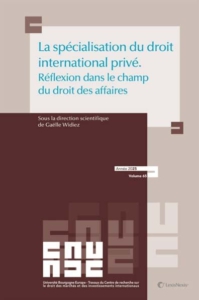
Gaëlle Widiez (Bourgogne University) has recently edited a volume entitled The Specialization of Private International Law: Reflections from the Perspective of Business Law (La spécialisation du droit international privé : Réflexion dans le champ du droit des affaires), published by LexisNexis. Read more
Virtual Workshop (in German) on January 13, 2026: Jens Kleinschmidt on “Zehn Jahre Europäische Erbrechtsverordnung – Stand und Perspektiven”

On Tuesday, January 13, 2026, the Hamburg Max Planck Institute will host its monthly virtual workshop Current Research in Private International Law at 11:00 a.m. – 12:30 p.m. (CEST). Jens Kleinschmidt (Trier University) will speak, in German, about the topic
“Zehn Jahre Europäische Erbrechtsverordnung – Stand und Perspektiven”
Seit zehn Jahren bestimmt die Europäische Erbrechtsverordnung die Planung und Abwicklung grenzüberschreitender Erbfälle in der EU. Eine Überprüfungsklausel (Art. 82 EuErbVO) sieht nach diesem Zeitraum einen Bericht über die Anwendung der Verordnung vor. Dies nimmt der Vortrag zum Anlass, aufbauend auf den Erfahrungen mit dem Rechtsakt über Zukunftsperspektiven nachzudenken. Den Ausgangspunkt bildet dabei das Europäische Nachlasszeugnis, dessen effet utile in der Rechtsprechung des EuGH wiederholt die Auslegung der gesamten Verordnung geleitet hat.
The presentation will be followed by open discussion. All are welcome. More information and sign-up here.
If you want to be invited to these events in the future, please write to veranstaltungen@mpipriv.de.