


Views
Chinese Judicial Practice on Asymmetric Choice of Court Agreements in International Civil & Commercial Disputes
By Yuchen Li, a PhD student at Wuhan University.
A. Introduction
An asymmetric choice of court agreement is commonly used in international commercial transactions, especially in financial agreements, which usually allows one party (option holder) an optional choice about the forum in which proceedings may be brought but the other (non-option holder) an exclusive choice to sue in a designated court.[1] A typical example is as follows:
‘(A) The courts of England have exclusive jurisdiction to settle any disputes ….
(B) The Parties agree that the courts of England are the most appropriate and convenient courts … to settle Disputes and accordingly no Party will argue to the contrary.
(C) This Clause is for the benefit of the Finance Parties only. As a result, no Finance Party shall be prevented from taking proceedings relating to a Dispute in any other courts with jurisdiction. To the extent allowed by law, the Finance Parties may take concurrent proceedings in any number of jurisdictions.’ [2]
In recent years, issues concerning asymmetric choice of court agreements have been controversial in cases within some jurisdictions.[3] Despite the significant amount of research on asymmetric choice of court agreements, little attention has been paid to Chinese stance on this topic. With Chinese private parties actively engaging in international transactions, Chinese attitude towards such clauses is important for commercial parties and academic researchers. This article gives a glimpse of how Chinese courts handle asymmetric choice of court agreements in international and commercial civil litigations.[4] Read more
China’s New Civil Procedure Law and the Hague Choice of Court Convention: One Step Forward, Two Steps Back?
By Sophia Tang, Wuhan University
China’s New Civil Procedure Law adopted in 2023 and taking effect from 1 Jan 2024 introduces significant changes to the previous civil procedure law regarding cross-border litigation. One of the key changes pertains to choice of court agreements. In the past, Chinese law on choice of court agreements has been criticized for being outdated and inconsistent with international common practice, particularly because it requires choice of court clauses to be in writing and mandates that the chosen court must have “practical connections” with the dispute. After China signed the Hague Choice of Court Convention, there was hope that China might reform its domestic law to align with the Hague Convention’s terms and eventually ratify the Convention.
The New Civil Procedure Law retains the old provision on choice of court agreements, stating that parties can choose a court with practical connections to the dispute in writing (Article 35). This provision is included in the chapter dealing with jurisdiction in domestic cases, but traditionally, Chinese courts have applied the same requirements to choice of court clauses in cross-border cases.
The problematic exclusivity of the UPC on provisional measures in relation with PMAC arbitrations
Guest post by Danilo Ruggero Di Bella (Bottega Di Bella)
This post delves into the issues stemming from the exclusive jurisdiction of the Unified Patent Court (UPC) on interim relief in relation with the judicial support of the arbitrations administered by the Patent Mediation and Arbitration Centre (PMAC).
Risks of divesting State courts of competence on interim measures
On one hand, article 32(1)(c) UPC Agreement (UPCA) provides for the exclusive jurisdiction of the UPC to issue provisional measures in disputes concerning classical European patents and European patents with unitary effect. Under article 62 UPCA and Rules 206 and 211 of the UPC Rules of Procedure (UPC RoP), the UPC may grant interim injunctions against an alleged infringer or against an intermediary whose services are used by the alleged infringer, intended to prevent any imminent infringement, to prohibit the continuation of the alleged infringement under the threat of recurring penalties, or to make such continuation subject to the lodging of guarantees intended to ensure the compensation of the patent holder. The UPC may also order the provisional seizure or delivery up of the products suspected of infringing a patent so as to prevent their entry into, or movement, within the channels of commerce. Further, the UPC may order a precautionary seizure of the movable and immovable property of the defendant (such its bank accounts), if an applicant demonstrates circumstances likely to endanger the recovery of damages, as well as an interim award of costs. Additionally, under article 60 UPCA, the UPC may order provisional measures to preserve evidence in respect of the alleged infringement and to inspect premises.
News
Open Online Conference: “Cross-Border Enforcement of Child Support: Pros and Cons of the Different National Systems” on January 28th, 2026 3-5:30pm CET
The Child Support Forum in cooperation with the International Union of Judicial Officers is pleased to invite every interested stakeholders of the cross border child support recovery to an open conference on January 28th, 2026 from 3 to 5:30 pm (CET).
According to Art. 41 of Regulation (EC) No. 4/2009 and Art. 32 of the 2007 Child Support Convention, the enforcement procedure shall be governed by the law of the state of enforcement. But in practice, the prospects of successfully initiating cross-border enforcement proceedings are not always easy to assess. In order to enforce successfully, it is necessary to know the specifics of the legal system of the state of enforcement (the Requested state).
Key questions in this context are:
- What does the process of enforcement of child support looks like in different states?
- Are maintenance claims given a degree of priority?
- How do Central Authorities facilitate the ongoing enforcement of maintenance decisions?
- What are the conditions for children to be exempted from costs?
The meeting aims to review the international legal framework and provide an overview of the various national enforcement systems. Finally, the advantages and disadvantages of the different systems from a legal policy perspective shall be discussed.
The participation is free of charge but registration is required.
To register, click here.
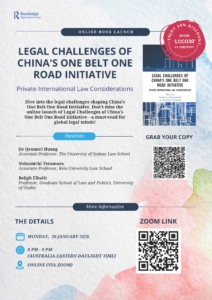
Online Book Launch – Legal Challenges of China’s One Belt One Road Initiative: Private International Law Considerations
Following the successful release of Legal Challenges of China’s One Belt One Road Initiative: Private International Law Considerations late last year, as previously announced on this blog, co-editors Dr Poomintr Sooksripaisarnkit (University of Tasmania) and Dr Sai Ramani Gariimella (South Asian University) are pleased to invite you to an upcoming online book launch.
This virtual event will feature insights from three distinguished contributors:
- Dr Jie (Jeanne) Huang (University of Sydney)
- Dr Nobumichi Teramura (Keio University Law School)
- Professor Beligh Elbalti (The University of Osaka)
Presentations will be followed by a moderated Q & A and discussion session.
This event is open to the public; please refer to the attached flyer to scan the QR Code for Zoom access.
Supreme Court of Canada to Hear Jurisdiction Appeal
Canada’s highest court does not grant leave to appeal in many cases involving private international law. In November 2025 it granted leave to appeal from NHK Spring Co., Ltd. v Cheung, 2024 BCCA 236, in which the British Columbia Court of Appeal agreed with the court below in holding that it had jurisdiction to hear a price fixing class action. The action is interesting because it involves what could be described as a “foreign” conspiracy that had effects within Canada.
The defendants are Japanese entities and the claim alleges that they conspired to fix the price of “suspension assemblies” which are a component of hard disk drives which are in turn a component of things like computers. The claim alleges that Canadians purchased products that contained these assemblies and because of the price fixing they paid more than they otherwise would have done.