


Views
Enforcing Foreign Judgments in Egypt: A Critical Examination of Two Recent Egyptian Supreme Court Cases
 I. Introduction
The recognition and enforcement of foreign judgments in the MENA region can sometimes be challenging, as it often involves navigating complex legal frameworks (domestic law v. conventions). In addition, case law in this field has encountered difficulties in articulating the applicable guiding principles and is sometimes ambiguous, inconsistent, or even contradictory. Two recent decisions rendered by the Egyptian Supreme Court highlight this issue, alhoutgh – it must be admitted – the Court did provide some welcome clarifications. In any event, the cases reported here highlight some key issues in the recognition and enforcement of foreign judgment and offer valuable insights into the evolving landscape of this area of law in Egypt.
Toothless vs. Shark-Teeth: How Anti-Suit Injunctions and Anti-Anti-Suit Orders Collide in the UniCredit Saga
by Faidon Varesis, University of Cambridge
Background
The dispute in the UniCredit v. RusChem saga arose from bonds issued by UniCredit to guarantee performance under contracts for Russian construction projects, where RusChem, after terminating the contracts due to EU sanctions, initiated Russian proceedings for payment in breach of an English-law governed arbitration agreement that mandates resolution in Paris under ICC rules.
UniCredit sought an anti-suit injunction in the UK to stop these Russian proceedings, arguing that the arbitration clause must be enforced under English law. Teare J at first instance held that the English court lacked jurisdiction—finding that the arbitration agreements were governed by French substantive rules and that England was not the appropriate forum—whereas the Court of Appeal reversed this decision by granting a final anti-suit injunction requiring RCA to terminate its Russian proceedings.
CJEU in Albausy on (in)admissibility of questions for a preliminary ruling under Succession Regulation

In a recent ruling, the CJEU adds another layer to the ongoing discussion on which national authorities can submit questions for preliminary rulings under the Succession Regulation, and its nuanced interpretation of what constitutes a ‘court.’
Albausy (Case C-187/23, ECLI:EU:C:2025:34, January 25, 2025) evolves around the question of competence to submit a request for preliminary ruling under the Succession Regulation (Regulation 650/2012 on matters of succession and the creation of a European Certificate of Succession).
Although the CJEU finds that the request in that case is inadmissible, the decision is noteworthy because it confirms the system of the Succession Regulation. Within the regulation, the competence to submit questions for preliminary ruling is reserved for national courts that act as judicial bodies and are seized with a claim over which they have jurisdiction based on Succession Regulation’s rules on jurisdiction.
The opinion of Advocate General Campos Sánchez-Bordona is available here.
News
Quick and easy access to German case law in private international law – One year of ‘IPRspr 2.0’ (and almost 100 years of ‘IPRspr’)
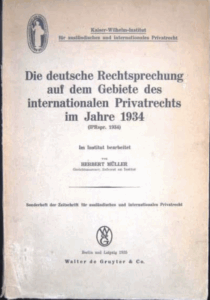

Quick and easy access to German case law in private international law – One year of ‘IPRspr 2.0’ (and almost 100 years of ‘IPRspr’)
A comprehensive and carefully curated database providing free access to German court decisions on private international law – www.iprspr.de
Ralf Michaels/Jan Peter Schmidt
Perspectives Contentieuses Internationales (PCI), Volume 4
by Fabienne Jault-Seseke
Volume 4 of the Revue Perspectives Contentieuses Internationales (PCI) has been published. Available in open access here.

It includes a special feature on ‘the International Commercial Chamber of the Paris Court of Appeal’ edited by Sandrine Clavel and Daniel Barlow. This feature provides an insight into the history of the chamber, its specific characteristics, its place in the European market for justice, and how it operates. It also includes a presentation of its case law in private international law by Marie-Elodie Ancel and François Mailhé. Case law in arbitration is the subject of three articles by Malik Laazouzi.
Widiez on Specialisation of Private International Law
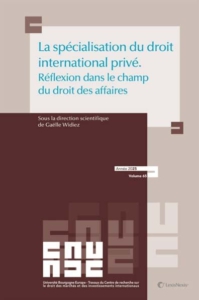
Gaëlle Widiez (Bourgogne University) has recently edited a volume entitled The Specialization of Private International Law: Reflections from the Perspective of Business Law (La spécialisation du droit international privé : Réflexion dans le champ du droit des affaires), published by LexisNexis. Read more