


Views
The Justice Initiative Frankfurt am Main 2017
Written by Prof. Dr. Dres. h.c. Burkhard Hess, Executive Director Max Planck Institute Luxembourg for Procedural Law
Against the backdrop of Brexit, an initiative has been launched to strengthen Frankfurt as a hot spot for commercial litigation in the European Judicial Area. On March 30, 2017, the Minister of Justice of the Federal State Hessen, Ms Kühne-Hörmann, organized a conference at which the Justice Initiative was presented. More than 120 stakeholders (lawyers, judges, businesses) attended the conference. The original paper was elaborated by Professors Burkhard Hess (Luxembourg), Thomas Pfeiffer (Heidelberg), Christian Duve (Heidelberg) and Roman Poseck (President of the Frankfurt Court of Appeal). Here, we are pleased to provide an English translation of the position paper with some additional information on German procedural law for an international audience. The proposal has, as a matter of principle, been endorsed by the Minister of Justice. Its proposals are now being discussed and shall be implemented in the next months to come. The paper reads as follows: Read more
Paris, the Jurisdiction of Choice?
 On January 17th, the President of the Paris Commercial Court (Tribunal de commerce) inaugurated a new international division.
The new division, which is in fact the 3rd division of the court (3ème Chambre), is to be staffed with nine judges who speak foreign languages, and will therefore be able to assess evidence written in a foreign language. For now, the languages will be English, German and Spanish, as one juge speaking Spanish and two speaking German are currently on the court.
In an interview to the Fondation de droit continental (Civil law initiative), the President of the Court explained that the point was to make French justice more competitive and attract international cases. It also made clear that France was following Germany’s lead, where several international divisions were established in 2009 in Hamburg and Cologne.
French Commercial Courts
It should be pointed out to readers unfamiliar with the French legal system that French commercial courts are not staffed with professional judges, but with members of the business community working part-time at the court (and for free). In Paris, however, many of these judges work in the legal department of their company, and are thus fine lawyers.
Also, French commercial courts (and French civil courts generally) virtually never hear witnesses, so the issue of the language in which they may address the court does not arise.
Some issues
So, the new international division will be able to read documents in several foreign languages. However, nothing suggests that parties or lawyers will be able either to speak, or to write pleadings, in any other language than French. Lawyers arguing these cases will still need to file their pleadings in French, and thus to translate them in English beforehand for their clients. Furthermore, the interview of the Court’s President seems to suggest that using a foreign language will not be a right for the parties. Quite to the contrary, it seems that it will not be possible if one of the parties disagrees, and demands documents be translated in French.
Will that be enough to attract additional commercial cases to Paris?
I wonder whether introducing class actions in French civil procedure would have been more efficient in this respect.
For the full interview of the Court’s President, see after the jump.
News
Review of: Recognition and Enforcement of Foreign Arbitral Awards (Ferrari, Rosenfeld, & Kotuby Jr.)
Franco Ferrari, Friedrich Rosenfeld, & Charles T. Kotuby Jr., Recognition and Enforcement of Foreign Arbitral Awards: A Concise Guide to the New York Convention’s Uniform Regime
Cheltenham, Edward Elgar, 2023
178 pp. Hardback : £72 eBook: £20

Out Now: The Brussels I-bis Regulation (Lazic & Mankowski)
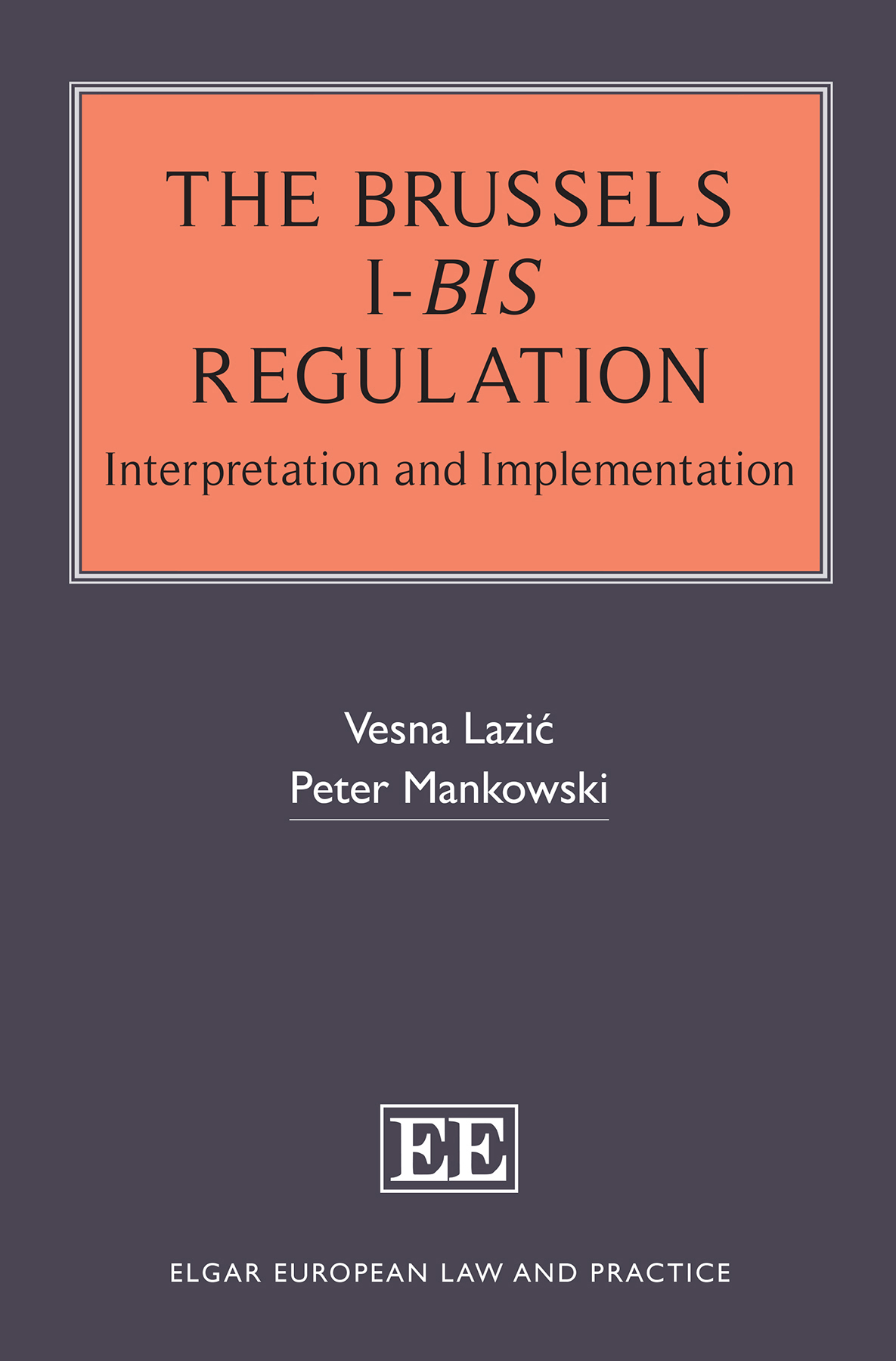
Vesna Lazic and Peter Mankowski, The Brussels I-bis Regulation: Interpretation and Implementation, Edward Elgar 2023 (602 pp)
This impressive book on the Brussels I-bis Regulation has just been published. It results from a project headed by Vesna Lazic (Utrecht University/T.M.C. Asser Institute) and the late Peter Mankowski (formerly University of Hamburg), in co-operation with Lucia Pein (Hamburg University), entitled ‘Regulation Brussels Ia: a standard for free circulation of judgments and mutual trust in the European Union’ (JUDGTRUST) funded by the European Commission’s Justice Programme (JUST-AG-2017/JUST-JCOO-AG-2017). The research for this project consisted among others of a questionnaire and national reports from all the Member States on the application of the Regulation. This book provides an extensive overview of the CJEU rulings and analysis of case law, which will be of great importance for future reference and the ongoing evaluation and revision of the Brussels I-bis Regulation.
Anchor defendants and exclusive distribution agreements under Article 8(1) of the Bru I bis Regulation – CJEU in Beverage City Polska, C-832/21
How does the anchor defendant mechanism operate in the realm of EU trade marks and actions on trade mark infringement? Is the existence of an exclusive distribution agreement between the defendants sufficient to rely on this mechanism? Those are the questions that the Court of justice addresses in its judgment handed down this morning in the case Beverage City Polska, C-832/21.