


Views
Compensation, y nada más – CJEU decides against Real Madrid in Case C-633/22
Just two days after losing to LOSC Lille in the Champions League, Real Madrid suffered another defeat against a French opponent. Among the 44 (!) judgments published this Friday by the CJEU – a flurry of decisions reminiscent of the madness that is the current Champions League format –, the Court decided a true ‘clásico’ of European private international law in Case C-633/22 Real Madrid Club de Fútbol.
The Dubai Supreme Court on Indirect Jurisdiction – A Ray of Clarity after a Long Fog of Uncertainty?
I. Introduction
It is widely acknowledged that the recognition and enforcement of foreign judgments depend, first and foremost, on whether the foreign court issuing the judgment was competent to hear the dispute (see Béligh Elbalti, “The Jurisdiction of Foreign Courts and the Enforcement of Their Judgments in Tunisia: A Need for Reconsideration”, 8 Journal of Private International Law 2 (2012) 199). This is often referred to as “indirect jurisdiction,” a term generally attributed to the renowned French scholar Bartin. (For more on the life and work of this influential figure, see Samuel Fulli-Lemaire, “Bartin, Etienne”, in J. Basedow et al. (eds.), Encyclopedia of Private International Law – Vol. I (2017) 151.)
Delhi High Court Grants Rare Anti-Enforcement Injunction: Implications for International Disputes
By Ananya Bhargava, Jindal Global Law School, OP Jindal Global University, India.
Recently, the Delhi High Court in the case of Honasa Consumer Limited v RSM General Trading LLC granted an anti-enforcement injunction against the execution proceedings instituted in the Dubai Court on the ground that it threatened the arbitral process in India. The Court deemed the proceedings before the Dubai Court as an attempt to frustrate a possible arbitration envisaged by the contract between the parties. The injunction was granted under S.9 of the Indian Arbitration and Conciliation Act 1996 as an “interim measure.” This is a significant turning point in the intersection of arbitration and cross-border litigation in India since the remedy of anti-enforcement injunction is rarely granted by judicial authorities across jurisdictions.
News
The White Paper on Digital Product Passports and Critical Raw Materials for Batteries: Legal Conflicts and Principles for Cross-Border Cooperation
The White Paper on “Digital Product Passports and Critical Raw Materials for Batteries: Legal Conflicts and Principles for Cross-Border Cooperation” is now formally published on the UNECE website!
The United Nations Economic Commission for Europe White Paper identifies and analyses the critical legal challenges in implementing Digital Product Passports (DPPs) for Critical Raw Materials (CRMs), including cobalt, copper, lithium, and nickel. These materials are essential for Energy Transition, for example, electric vehicles.
Yet, tracing their journey from mines to markets to recycling is legally complex and globally inconsistent. This fragmentation hinders sustainability and transition to circular economy.
The White Paper provides policymakers and businesses with: An analysis of conflicting legal frameworks in implementing DPPs; Guiding principles for cross-border cooperation in CRM-Battery value chains.
Read the full White Paper here.
AMEDIP’s upcoming webinar: A radical change in German Private International Law, the example of the naming law (in Spanish)

The Mexican Academy of Private International and Comparative Law (AMEDIP) is holding a webinar on Thursday 25 September 2025 at 14:30 (Mexico City time – CST), 22:30 (CEST time). The topic of the webinar is: A radical change in German Private International Law, the example of the naming law, which will be presented by Prof. Dr. Karl August von Sachsen Gessaphe (in Spanish).
Giustizia consensuale No 1/2025: Abstracts
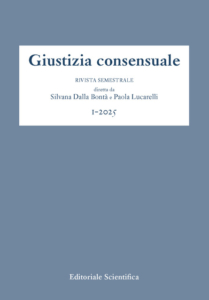 The first issue of 2025 of Giustizia consensuale (published by Editoriale Scientifica) has been released, and it features:
Cesare Cavallini (Professor at Bocconi University, Milan), L’arbitrato come processo e giustizia consensuale (Arbitration as a Process and Consensual Justice; in Italian).
The essay aims to analyze the phenomenon of private autonomy and consensual justice in arbitration as it has evolved through various reforms. The goal is to highlight arbitration as a process and a form of consensual justice that is alternative yet distinct from ordinary judicial proceedings and fully aligned with constitutional principles. This objective becomes even more significant when compared to the very different and controversial issues discussed in American legal doctrine, which instead point to an unceasing erosion of rights through a blending of public interferences in arbitration and private ones in ordinary justice, raising concerns about the legitimacy of private autonomy within the framework of civil protections under constitutional scrutiny. Read more