


Views
Anti-Suit Injunctions and Dispute Resolution Clauses
By Adeline Chong, Singapore Management University
- Introduction
In two decisions decided within a fortnight of each other, the Singapore Court of Appeal considered anti-suit injunctions pursued to restrain proceedings allegedly brought in breach of arbitration agreements. The first case, Asiana Airlines, Inc v Gate Gourmet Korea Co, Ltd (‘Asiana Airlines’)[1] dealt with whether A could rely on an arbitration agreement between A and B to restrain B’s proceedings against C, a third party. The second case, COSCO Shipping Specialized Carriers Co, Ltd v PT OKI Pulp & Paper Mills (‘COSCO Shipping’)[2] considered whether an arbitration agreement covered a tortious claim. To put it in another way, Asiana Airlines mainly concerned the ‘party scope’ of an arbitration agreement while COSCO Shipping concerned the ‘subject matter’ scope of an arbitration agreement.[3] Where the anti-suit application is to restrain foreign proceedings brought in breach of an arbitration or choice of court agreement, ordinarily it would be granted unless ‘strong cause’ is shown by the respondent.[4] This provides an easier path for the anti-suit claimant compared to the alternative requirement of establishing that the foreign proceedings are vexatious or oppressive in nature. Read more
Trending Topics in German PIL 2024 (Part 2 – Online Marriages, Gender Afiliation and Name Law)
As already mentioned in my previous post, at the end of each year I publish an article (in German) about the Conflict of Laws developments in Germany of the last twelve months, covering more or less the year 2024 and the last months of 2023. This post is the second with an overview over those topics that seem to be most trending.
The two parts focus on the following topics (part 1 contained 1. and 2.):
- Restitution of Money lost in Illegal Gambling
- Applicable Law in the Dieselgate litigation
- The (Non-)Valitidy of Online Marriages
- New German conflict-of-law rules regarding gender afiliation / identity
- Reforms in international name law
I will now give attention to the last three topics that focus on the three areas that are not harmonized by EU law (yet) and are mainly questions of family law.
The FSIA’s Direct Effects Problem
Post authored by Lance Huckabee, JD candidate and Global Legal Scholar at the University of Pittsburgh School of Law
When a foreign sovereign breaches a commercial contract with a private entity, what recourse does the wronged party have? In the United States, the Foreign Sovereign Immunities Act (FSIA) governs such disputes, providing an exception for commercial activity that causes a “direct effect” in the U.S. Yet, the definition of “direct effect” has remained elusive, leading to decades of judicial inconsistency and a deepening circuit split.
At the heart of this legal uncertainty is the Supreme Court’s decision in Republic of Argentina v. Weltover (1992), which sought to clarify the issue but instead left room for widely divergent interpretations. Some circuits have adopted a flexible, causation-based approach, analyzing whether a foreign state’s breach had an immediate consequence in the U.S. Others, like the recent D.C. Circuit decision in Wye Oak Tech., Inc. v. Republic of Iraq, have imposed rigid bright-line rules—specifically requiring that the contract contemplate the U.S. as a place of performance. This formalistic approach creates a dangerous loophole, allowing foreign states to structure agreements in a way that insulates them from jurisdiction. As a result, a U.S. business may suffer substantial financial harm from a foreign sovereign’s breach but find itself without legal recourse simply because the contract was silent on where payments were to be made.
This restrictive interpretation undermines the FSIA’s core purpose: to hold foreign sovereigns accountable when their commercial activities impact U.S. businesses. By prioritizing contractual language over economic reality, decisions like Wye Oak erode the ability of American companies to seek redress, making sovereign breaches effectively consequence-free. A proper interpretation of the FSIA should align with Weltover’s focus on causation, ensuring that foreign states cannot exploit technicalities to evade liability. If left uncorrected, the current trend risks turning the FSIA into little more than a paper shield—one that protects sovereigns rather than those they harm.
The Wye Oak decision exacerbates both intra- and inter-circuit inconsistencies, further complicating the FSIA’s application and weakening the commercial activity exception in breach-of-contract cases. By imposing a rigid bright-line rule, it unduly narrows the scope of what qualifies as a “direct effect,” creating uncertainty for U.S. businesses engaged in international commerce. With Wye Oak’s attorneys petitioning for certiorari in January 2025, the case presents a critical opportunity for the Supreme Court to resolve the longstanding circuit split on the FSIA’s direct effects clause.
News
Revisiting the Internationality of Contracts: Conference in Paris, 9 February 2026
The international character of contracts is currently undergoing significant transformations. Whether deliberately chosen by the parties, rejected by domestic courts, endured in certain regulatory contexts, or even rendered obsolete, the notion of internationality – long considered a cornerstone of private international law – calls for renewed analysis. Against this background, a conference entitled “Revisiting the Internationality of Contracts” will be held on Monday, 9 February 2026 from 9:00 a.m. to 6:00 p.m. in the Grand Chamber of the French Court of Cassation.
List of China’s Cases on Recognition of Foreign Judgments [2025 Update]


As the new year begins, it’s a good time for a fresh start. One timely occasion to do so is the release, on 31 December 2025, of the annual update of the List of China’s Cases on Recognition of Foreign Judgments (Case List), prepared since 2019 by China Justice Observer (CJO), founded by Guodong Du and Meng Yu (updates for the years 2020, 2022, 2023, and 2024 were also previously posted on this blog).
The Case List is compiled on the basis of a collection of “all Chinese court decisions involving the recognition and enforcement of foreign judgments (REFJ), as well as foreign decisions concerning the recognition and enforcement of Chinese judgments.” The stated intention behind this endeavor is to “build reasonable expectations on REFJ in China.”
The Case List constitutes a particularly valuable source of information on judicial practice relating to the recognition and enforcement of foreign judgments in China, both under international treaties concluded by China (for a full list, see here) and under domestic law, namely the Civil Procedure Law of the People’s Republic of China (2023 Amendment), Articles 298–303.
According to the 2025 update, a total of 120 cases involving China and 26 foreign States and regions, excluding foreign divorce judgments, have now been collected. This represents an increase of 11 cases compared to the previous update (109 cases in the 2024 update).
Key features of the 2025 update include the following:
-
The List comprises 26 concise reports for each jurisdiction, together with a chart of bilateral judicial assistance treaties which China has concluded with 39 States, of which 35 bilateral treaties include judgment enforcement clauses.
-
A total of eleven newly added cases involve one treaty jurisdiction – Uzbekistan (one case), and five non-treaty jurisdictions, namely, Australia (one case), New Zealand (four cases), Singapore (two cases), South Korea (two cases), and the United States (one case).
-
Please note that Tian v Xu [2023] NZHC 3259 marks the first reported instance of a New Zealand court recognizing and enforcing a Chinese civil settlement statement (also known as a mediation judgment). By treating such instruments as equivalent to consent judgments, the New Zealand High Court has adopted a pro-enforcement approach consistent with precedents in Canada (Wei v Li 2019 BCCA 114) and Australia (Bank of China Limited v Chen [2022] NSWSC 749), providing a clear contrast to the earlier restrictive view expressed in Singapore (Shi Wen Yue v Shi Minjiu & Anor [2016] SGHC 137).
-
Another noteworthy case is Sunvalley Solar Inc. v Baoding Tianwei Solarfilms Co. Ltd. (2019) Ji 01 Xie Wai Ren No. 3, where a Chinese court refused to enforce a U.S. default judgment rendered in breach of a valid arbitration agreement. By holding that a defendant’s absence does not constitute an implied waiver, the Chinese court shielded arbitration clauses from being bypassed via foreign default judgments.
-
Other newly added cases, be it foreign judgments to be enforced in China or Chinese judgments to be enforced in foreign jurisdictions, provide a valuable comparative perspective on key issues in the eyes of courts from different jurisdictions, such as reciprocity ( e.g., the de jure reciprocity applied by a Beijing court in enforcing a South Korean IP judgment, the reciprocal consensus confirmed by a Shanghai court in enforcing a Singapore monetary judgment), natural justice (New Zealand), ascertainment and interpretation of foreign law (Singapore, Australia).
-
Each case has been reviewed, and more details, such as the grounds, the case numbers, and causes of action, have been added.
-
Case analyses have been aggregated under the country tags since 2022, so it is now easier to track down relevant cases, together with their information and analyses, in each country/region report. For example, under the tag ‘US-China Judgments Recognition and Enforcement’, one can find relevant case analyses involving mutual recognition and enforcement of judgments between the US and China.
For further details see here and here.
Happy New Year to all!

[Out Now] Bruijnen on Recognition of Kafala and Child Marriage in Family Law and Migration Law

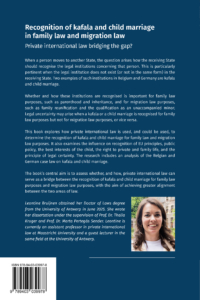
Leontine Bruijnen (Maastricht University) has recently published a book titled Recognition of kafala and child marriage in family law and migration law (Wolters Kluwer, 2025) based on her dissertation written under the supervision of Prof. Dr. Thalia Kruger and Prof. Dr. Marta Pertegás. Read more