Views
The $24 Billion Judgment Against China in Missouri’s COVID Suit
This article was written by Prof. William S. Dodge (George Washington University Law School) and first published on Transnational Litigation Blog. The original version can be found at Transnational Litigation Blog. Reposted with permission.
On March 7, 2025, Judge Stephen N. Limbaugh, Jr. (Eastern District of Missouri) entered a default judgment for more than $24 billion against the People’s Republic of China and eight other Chinese defendants for hoarding personal protective equipment (PPE) during the early days of the COVID pandemic in violation of federal and state antitrust laws. The Eighth Circuit had previously held that the Foreign Sovereign Immunities Act (FSIA) barred most of Missouri’s claims but that the hoarding claim fell within the act’s commercial activity exception.
Missouri now has the judgment against China that it wanted. But Missouri may find that judgment hard to enforce. As discussed below, there appear to be significant procedural problems with the judgment that at least some defendants might raise. More broadly, the properties of foreign states and their agencies or instrumentalities are entitled to immunity from execution under the FSIA. Immunity from execution is broader than immunity from suit, and it is not clear that any of the defendants have property in the United States that can be used to satisfy the judgment. Read more
Trending Topics in German PIL 2024 (Part 1 – Illegal Gambling and “Volkswagen”)
At the end of each year I publish an article (in German) about the Conflict of Laws developments in Germany of the last twelve months, covering more or less the year 2024 and the last months of 2023. I thought it would be interesting for the readers of this blog to get an overview over those topics that seem to be most trending.
The article focuses on the following topics:
- Restitution of Money lost in Illegal Gambling
- Applicable Law in the Dieselgate litigation
- The (Non-)Valitidy of Online Marriages
- New German conflict-of-law rules regarding gender afiliation / identity
- Reforms in international name law
I will start in this post with the two first areas that are mainly dealing with questions of Rome I and Rome II while in my follow-up post I will focus on the three areas that are not harmonized by EU law (yet) and are mainly questions of family law.
Chinese Judicial Practice on Asymmetric Choice of Court Agreements in International Civil & Commercial Disputes
By Yuchen Li, a PhD student at Wuhan University.
A. Introduction
An asymmetric choice of court agreement is commonly used in international commercial transactions, especially in financial agreements, which usually allows one party (option holder) an optional choice about the forum in which proceedings may be brought but the other (non-option holder) an exclusive choice to sue in a designated court.[1] A typical example is as follows:
‘(A) The courts of England have exclusive jurisdiction to settle any disputes ….
(B) The Parties agree that the courts of England are the most appropriate and convenient courts … to settle Disputes and accordingly no Party will argue to the contrary.
(C) This Clause is for the benefit of the Finance Parties only. As a result, no Finance Party shall be prevented from taking proceedings relating to a Dispute in any other courts with jurisdiction. To the extent allowed by law, the Finance Parties may take concurrent proceedings in any number of jurisdictions.’ [2]
In recent years, issues concerning asymmetric choice of court agreements have been controversial in cases within some jurisdictions.[3] Despite the significant amount of research on asymmetric choice of court agreements, little attention has been paid to Chinese stance on this topic. With Chinese private parties actively engaging in international transactions, Chinese attitude towards such clauses is important for commercial parties and academic researchers. This article gives a glimpse of how Chinese courts handle asymmetric choice of court agreements in international and commercial civil litigations.[4] Read more
News
Special Issue: Proceedings of the Bremen Conference on Informed Consent to Dispute Resolution Agreements
The German Law Journal has published a Special Issue featuring the proceedings of the international conference on Informed Consent to Dispute Resolution Agreements, held in Bremen on 20–21 June 2024 (see our earlier announcement here).
Edited by Gralf-Peter Calliess and Nicholas Mouttotos of the University of Bremen, the special issue brings together contributions from leading scholars in private international law, international civil procedure, and international arbitration. Contributors include: Symeon C. Symeonides, Nancy S. Kim, Gralf-Peter Calliess, Frederick Rieländer, Peter McColgan, Laura E. Little, Kermit Roosevelt III, Sören Segger-Piening, John F. Coyle, Hannah L. Buxbaum, Marta Pertegás Sender, Stephen Ware, Stefan F. Thönissen and Nicholas Mouttotos.
The collection addresses a central tension in modern dispute resolution: how to reconcile party autonomy in forum and choice-of-law agreements with the requirement of consent, and how informed should consent be, particularly where such agreements are embedded in standard-form contracts affecting weaker parties such as consumers and employees.
The issue encompasses perspectives from both the United States and the European Union, examining questions of constitutional fairness, access to justice, and the legitimacy of contractual self-determination. Contributions trace the historical development of party autonomy, critique the adequacy of existing consent models, examine their outward abandonment while also exploring comparative regulatory approaches to protecting vulnerable contracting parties.
The special issue is available in the German Law Journal, Volume 26, Special Issue 5, and the editorial can be found here. The German Law Journal is a pioneering (Gold) open-access, peer-reviewed forum for scholarship and commentary on comparative, European, and international law, offering free and unrestricted online access to its publications since 1999.
ZEuP – Zeitschrift für Europäisches Privatrecht 4/2025
A new issue of ZEuP – Zeitschrift für Europäisches Privatrecht is now available and includes contributions on EU private law, comparative law and legal history, legal unification, private international law, and individual European private law regimes. The full table of content can be accessed here: https://rsw.beck.de/zeitschriften/zeup. 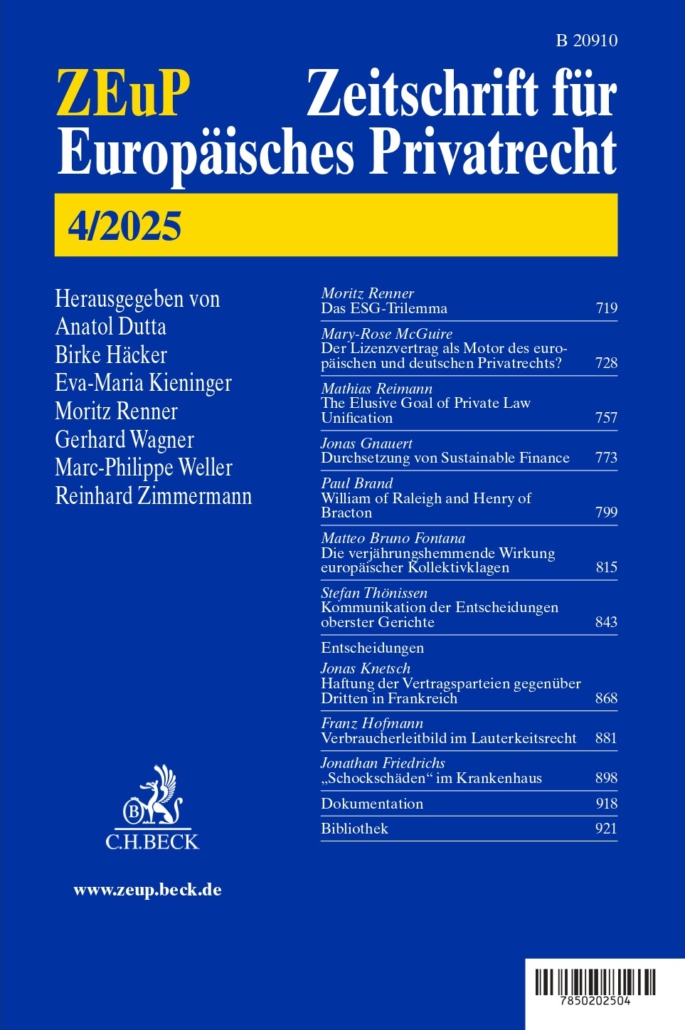
Decoding the Language of Law in the post-Migration Crisis Period: the Informalisation of Migration
The Jean Monnet Chair in Legal Aspects of Migration Management in the EU and in Türkiye and Bilkent University Faculty of Law cordially invite you for the next Migration Talk by Professor Paul James Cardwell (King’s College London) on “Decoding the Language of Law in the post-Migration Crisis Period: the Informalisation of Migration”.
The talk shall be held online. For the Zoom link please contact migration@bilkent.edu.tr.