


Views

French Supreme Court upholds asymmetric jurisdiction clauses in Lastre follow-up
by Jean-Charles Jais, Guillaume Croisant, Canelle Etchegorry, and Alexia Kaztaridou (all Linklaters)
On 17 September 2025, the French Cour de cassation handed down its decision on the Lastre case. This followed a landmark preliminary ruling of February 2025 from the CJEU, which laid out the conditions for a valid asymmetric jurisdiction clause under article 25 of the Brussels I recast regulation.
Asymmetric jurisdiction clauses allow one party to initiate proceedings in multiple courts or any competent court, while the other party has fewer options or is restricted to a specific jurisdiction. Such clauses are common in financial agreements (read more in our previous blog post here).
In the latest development of the Lastre case in France, the French Supreme Court opted for a pro-contractual autonomy stance, favouring the validity of asymmetric jurisdiction clauses.
Using Foreign Choice-of-Law Clauses to Avoid U.S. Law
Can private actors utilize choice-of-law clauses selecting the laws of a foreign country to avoid laws enacted by the United States? In this post, I argue that the answer is a qualified yes. I first examine situations where the U.S. laws in question are not mandatory. I then consider scenarios where these laws are mandatory. Finally, the post looks at whether private parties may rely on foreign forum selection clauses and foreign choice-of-law clauses—operating in tandem—to avoid U.S. law altogether.
Read more
Civil Personal Status Law Litigation in the UAE – Between Lofty Ideals and Sour Realities

I. Introduction
It is not uncommon for scholars to debate whether private international law is needed as a distinct discipline, and whether it is truly indispensable. After all, could one not save the effort and complexity of applying foreign law by simply treating all cases as purely domestic? From a theoretical standpoint, the answer is yes, since no State is under an inherent obligation to apply foreign law. Yet, such an approach entails serious shortcomings, particularly when it comes to respecting vested or acquired rights, meeting the legitimate expectations of the parties, and fostering cross-border commerce. It follows that the costs of refusing to recognize and apply foreign law are far greater than the difficulties associated with maintaining a system of private international law. It is therefore unsurprising that private international law has established itself as a common language for managing the legal diversity inherent in transnational relations. Read more
News

Crossroads in Private International Law Webinar with Prof. Csongor Nagy
The next webinar in the Crossroads in Private International Law webinar series will be given by Prof. Csongor Nagy (University of Galway) on the topic “EU Law and Sports Arbitration: When Global and Regional Regimes Meet“.
The webinar is scheduled for 22 April 2026, 14:00 – 15:00 UTC.
More information about the event and registration is available here, at the webpage of the organiser – the Centre for Private International Law & Transnational Governance of the University of Aberdeen.
PAX Moot 2026 Vladimir Koutikov Round has come to an end – announcement of winners
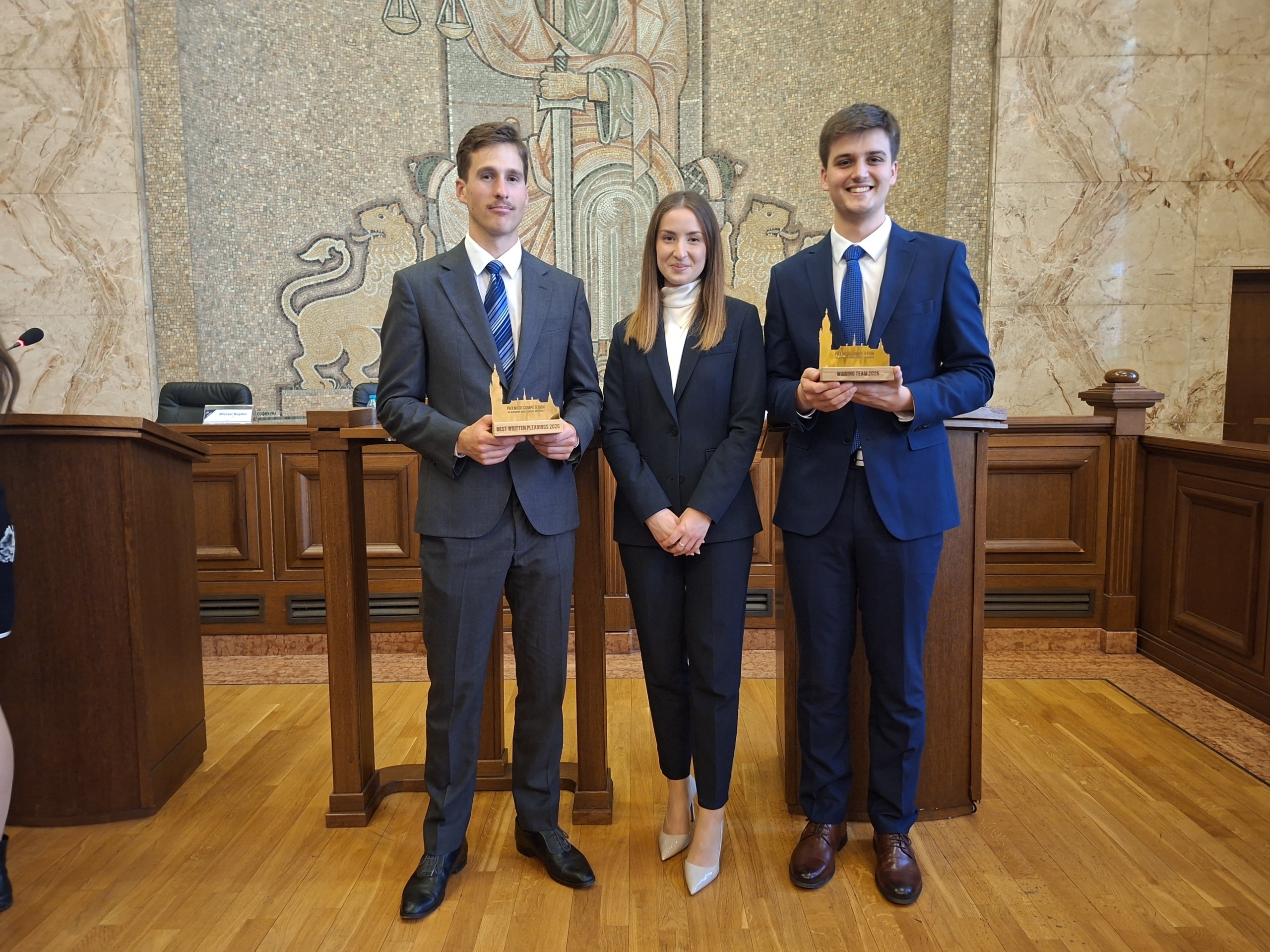 This post has previously been published by PAX Moot (with minor changes). Photo: University of Ljubljana Team.
The PAX Moot 2026 — Vladimir Koutikov Round has come to an end, and what an incredible edition it has been. We hope it was an unforgettable experience for all participants — a unique opportunity to engage in high-level argumentation on Private International Law, grow advocacy skills, and forge lasting friendships along the way.
Without further ado, we are proud to announce the results of this year’s competition:
- Winner — University of Ljubljana
- Runner-up — Sofia University St. Kliment Ohridski
Call for Contributions (International Conference and Edited Volume): Imagining Decolonial Legal Methods in Europe (Pushing Boundaries)
The following Call for Contributions has been kindly shared with us by Sandrine Brachotte (UAntwerpen):