


Views

CJEU, Case C-540/24, Cabris Investment: Jurisdiction Clause in Favour of EU Court is Subject to Art. 25 Brussels Ia even if both Parties are Domiciled in the Same Third State
By Salih Okur, University of Augsburg
On 9 October 2025, the CJEU, in Case C-540/24 (Cabris Investment), had to decide whether Art. 25 Brussels Ia applies to “an agreement conferring jurisdiction in which the contracting parties, who are domiciled in the United Kingdom and therefore (now) in a third State, agree that the courts of a Member State of the European Union are to have jurisdiction over disputes arising under that contract, falls within the scope of that provision, even if the underlying contract has no further connection with that Member State chosen as the place of jurisdiction.“
Unsurprisingly, the Court held that it does.
Pre-print article on SSRN on “Mirin” and the Future of Cross-Border Gender Recognition
I recently published the pre-print version of an article on SSRN that was accepted by the International Journal of Law, Policy and the Family. The article is called ““Mirin” and Beyond: Gender Identity and Private International Law in the EU“. The article is part of a special issue dealing with questions of gender identity that (probably) will come out at the beginning of 2026.
As it deals with matters of private international law (regarding gender identity) and the CJEU decision “Mirin”, I thought it might be interesting for the readers of this blog to get a short summary of the article. If it sparks your interest, of course, I would be glad if you consider reading the whole text – and to receive feedback and further thoughts on this topic. 🙂
Draft General Law on Private International Law aims to bring Brazil from the 19th into the 21st century
Guest post by Gustavo Ferraz de Campos Monaco, Full Professor of Private Internacional Law – University of São Paulo
In Brazilian law, the regulation of conflicts of laws is still based on a legislation from 1942, during a dictatorial regime, which explains its inspiration from the Italian fascist regime. The values prevailing in Brazilian society back then were quite different from those we hold today, especially in matters concerning family relationships. At that time, the family unit was viewed as having a single domicile, and questions related to the definition of parenthood were unthinkable outside traditional presumptions.
On at least two occasions over the past 83 years, attempts to draft new regulations were undertaken by leading figures in the field – Haroldo Valladão, Jacob Dolinger, and João Grandino Rodas – but both initiatives failed during the process, without the Plenary of the Legislative Houses having expressed an opinion on the merits of the projects. Read more
News
Bonn (Germany), 24/25 September 2026, Conference International Filiation Law in the EU
As already announced, there will be an international conference “International Filiation Law in the EU” dealing with questions of filiation law resulting from the EU Parenthood Proposal.
AMEDIP’s upcoming webinar: The HCCH Work Agenda in 2026. Opportunities and Challenges for AMEDIP presented by Ignacio Goicoechea (30 April 2026 – in Spanish)
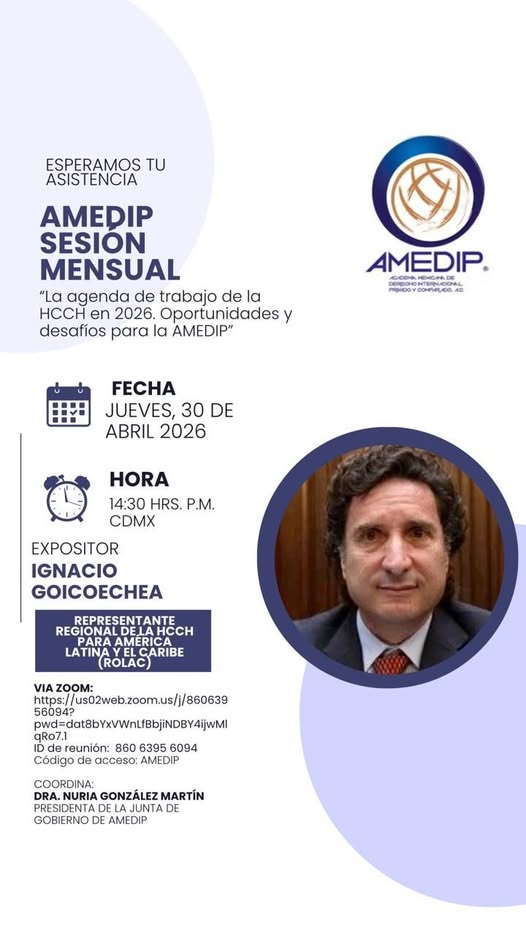
The Mexican Academy of Private International and Comparative Law (AMEDIP) is holding a webinar on Thursday 30 April 2026 at 14:30 (Mexico City time – CST), 22:30 (CEST time). The topic of the webinar is: The HCCH Work Agenda in 2026. Opportunities and Challenges for AMEDIP, which will be presented by Ignacio Goicoechea, Representative of the HCCH Regional Office for Latin America and the Caribbean (ROLAC) (in Spanish). Read more
Launch ECJC ‘Civil Justice Conversations’ – Online Research Seminar Series
Contributed by Adriani Dori
Online Research Seminar Series: Call for expressions of interest
Submission Deadline: Rolling base
Open to: Scholars, practitioners, and early-career researchers
Contact details: ecjc@law.eur.nl
Following the publication of the handbook European Civil Procedure (De Gruyter 2026), the European Civil Justice Centre (ECJC) is pleased to announce a new initiative.
ECJC ‘Civil Justice Conversations’
The ECJC ‘Civil Justice Conversations’ is a new series of online research seminars designed to foster scholarly exchange and collaboration in the field of European civil justice.