


Views
Japanese Supreme Court Renders Decision on Hague Abduction Convention
On December 21, 2017, the Japanese Supreme Court rendered a decision on the Hague Abduction Convention. The Court upheld a lower court decision in favor of the Japanese mother, even though she had turned back on her promise to return the kids from a visit to Japan, and even though that same court had earlier issued a return order in favor of the American father. The matter had received international press attention, and even a Congressional subcommittee hearing.
Japan had long refused to join the Hague Convention, and when it did, in 2014, critical observers already expected that courts would find ways to undermine it. Those observers see themselves vindicated.
Colin Jones reports critically on the decision; he has previously written on Japan’s joining the Convention and on reluctance to enforce it. Useful background from the Law Library of Congress is here.
Japanese accession to the Convention has been a frequent scholarly topic, both in Japan and elsewhere. Yuko Nishitani, who had already written about “International Child Abduction in Japan” in (2006) 8 Yearbook of Private International Law 125-143, and who wrote a long report (in Japanese) for the Japanese Ministry in 2010, provided a brief analysis in 2011. Dai Yokomizo discussed the accession in (2012) Revue critique 799; Jun Yokohama did so in the Mélanges van Loon (2013, pp 661-72). Vol. 57 (2014) of the Japanese Yearbook of International Law contains articles by Tatsuki Nishioka and Takako Tsujisaka, Masayuki Tanamura, Masako Murakami, Martina Erb-Klünemann, and Nigel Vaughan Lowe. Takeshi Hamano helpfully explains the Japanese reluctance with regard to the Japanese ideology of the family. Outside of Japanese authors, Barbara Stark and Paul Hanley wrote most recently in the United States; the topic is also addressed in several student notes. The accession was also discussed by Bengt Schwemann (in German) and Francisco Barberán Pelegrín (in Spanish).
UKSC on Traditional Rules of Jurisdiction: Brownlie v Four Seasons Holdings Incorporated
Shortly before Christmas the UKSC released its decision on jurisdiction in Brownlie v Four Seasons Holdings Incorporated (available here). Almost all the legal analysis is obiter dicta because, on the facts, it emerges that no claim against the British Columbia-based holding corporation could succeed (para 15) and the appeal is allowed on that basis. I suppose there is a back story as to why it took a trip to the UKSC and an extraordinary step by that court (para 14) for the defendant to make those facts clear, but I don’t know what it is. On the facts there are other potential defendants to the plaintiffs’ claim and time will tell whether jurisdictional issues arise for them.
The discussion of the value of the place of making a contract for jurisdiction purposes is noteworthy. In para 16 two of the judges (Sumption, Hughes) are critical of using the traditional common law rules on where a contract is made for purposes of taking jurisdiction. This has been the subject of debate in some recent Canadian decisions, notably the difference in approach between the Court of Appeal for Ontario and the Supreme Court of Canada in Lapointe Rosenstein Marchand Melançon LLP v Cassels Brock & Blackwell LLP, 2016 SCC 30 (available here). The SCC was fine with using the traditional rules for this purpose. In Brownlie, I do not think it is clear as to what view the other three judges take on this point.
Even more interestingly, the UKSC judges split 3-2 on how to understand the idea of damage in the forum as a basis for jurisdiction. Three judges (Hale, Wilson, Clarke) retain the traditional broad common law view – the position in many Canadian provinces prior to Club Resorts Ltd v Van Breda, 2012 SCC 17 (available here) – that ongoing suffering in the forum in respect of a tort that happened abroad is sufficient. Two judges (Sumption, Hughes) reject that approach and adopt a more narrow meaning of damage in the forum (it must be direct damage only).
This 3-2 split is closer even than it might first seem, since Lord Wilson (para 57) suggests that in a different case with fuller argument on the point the court might reach a different result.
Canadian law does not get a fair description in the UKSC decision. The court notes twice (para 21 and para 67) that Canada’s common law uses a broad meaning of damage for taking jurisdiction. Club Resorts, and the change to the law it represents on this very issue, is not mentioned. This is yet another illustration of the importance of being careful when engaging in comparative law analysis.
Conflicts – Between Domestic and Indigenous Legal Systems?
In Beaver v Hill, 2017 ONSC 7245 (available here) the applicant sought custody, spousal support and child support. All relevant facts happened in Ontario. Read more
News
Revue Critique de droit international privé – issue 2023/2
The second issue of the Revue critique de droit International privé of 2023 was released in August. It contains four articles and several case notes.
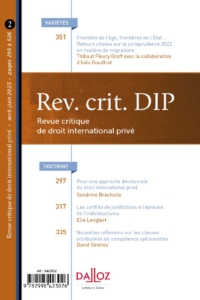 The first part of the issue features the doctrinal work of two young authors, who confront PIL techniques with contemporary developments in social sciences.
The first article Pour une approche décoloniale du droit international privé (A Decolonial Approach to Private International Law) is authored by Dr Sandrine Brachotte (Université Saint-Louis & Université de Lille). Following her doctoral work on The Conflict of Laws and Non-secular Worldviews: A Proposal for Inclusion (see presentation over at EAPIL), Dr Brachotte discusses colonial studies’ implications for PIL scholarship. She examines how plural normativities challenge the traditional conception of conflict of laws and then outlines the potential form of a decolonial PIL. An English translation of the article is available on the website of the editor. Its abstract reads as follows:
Call for Paper: Private International Law and Business Compliance in Asia Pacific
This national conference will be held on 21 February 2024 at The University of Sydney Law School in Australia.
Business compliance in international transactions across the Asia-Pacific region holds immense importance for organizations seeking to expand their activities within this dynamic and evolving landscape. Multinational corporations operating in Asia Pacific often confront unique compliance challenges due to the swiftly changing regulatory and geopolitical environment in the region.
The 2023 NGPIL Lecture Series
Originally posted today on the NGPIL website.
On the 23rd November 2023, 5pm (WAT/Lagos/Abuja) the NGPIL will host our guest speaker Professor Wale Olawoyin SAN, FCIArb at this year’s conference. The event will explore the coming into force of the Arbitration and Conciliation Act 2023 and how, from a private international law perspective, the arbitration appeal process in Nigeria can be enhanced. Discussions will build on practice thus far, and will allow practitioners, judges and academics alike to develop knowledge and insight into its utility.
To register: https://us06web.zoom.us/webinar/register/WN_q5pY1JWARiaUxi1TIw8xBQ
