


Views
This one is next: the Netherlands Commercial Court!
By Georgia Antonopoulou, Erlis Themeli, and Xandra Kramer, Erasmus University Rotterdam (PhD candidate, postdoc researcher and PI ERC project Building EU Civil Justice)
Following up on our previous post, asking which international commercial court would be established next, the adoption of the proposal for the Netherlands Commercial Court by the House of Representatives (Tweede Kamer) today answers the question. It will still have to pass the Senate (Eerste Kamer), but this should only be a matter of time. The Netherlands Commercial Court (NCC) is expected to open its doors on 1 July 2018 or shortly after. Read more
A European Law Reading of Achmea
Written by Prof. Burkhard Hess, Max Planck Institute Luxembourg.
An interesting perspective concerning the Achmea judgment of the ECJ[1] relates to the way how the Court addresses investment arbitration from the perspective of European Union law. This paper takes up the judgment from this perspective. There is no doubt that Achmea will disappoint many in the arbitration world who might read it paragraph by paragraph while looking for a comprehensive line of arguments. Obviously, some paragraphs of the judgment are short (maybe because they were shortened during the deliberations) and it is much more the outcome than the line of arguments that counts. However, as many judgments of the ECJ, it is important to read the decision in context. In this respect, there are several issues to be highlighted here: Read more
CJEU on the compatibility with EU law of an arbitration clause in an Intra-EU BIT – Case C-284/16 (Slovak Republic v Achmea BV)
Written by Stephan Walter, Research Fellow at the Research Center for Transnational Commercial Dispute Resolution (TCDR), EBS Law School, Wiesbaden, Germany
Today, the CJEU has rendered its judgement in Slovak Republic v Achmea BV (Case C-284/16). The case concerned the compatibility with EU law of a dispute clause in an Intra-EU Bilateral Investment Treaty (BIT) between the Netherlands and the Slovak Republic which grants an investor the right to bring proceedings against the host state (in casu: the Slovak Republic) before an arbitration tribunal. In concrete terms, the German Federal Court of Justice referred the following three questions to the CJEU (reported here): Read more
News
Second Issue of the Journal of Private International Law for 2023
The second issue of the Journal of Private International Law for 2023 has just been published. It contains the following articles:
DJB Svantesson & SC Symeonides, “Cross-border internet defamation conflicts and what to do about them: Two proposals”
Conflicts of laws in cross-border defamation cases are politically and culturally sensitive and their resolution has always been difficult. But the ubiquity of the internet has increased their frequency, complexity, and intensity. Faced with the realities of the online environment—including the virtual disappearance of national borders—several countries have acted unilaterally to preserve their values and protect their interests. Some countries enacted laws favouring consumers or other potential plaintiffs, while other countries took steps to protect potential defendants, including publishers and internet service providers. As a result, these conflicts are now more contentious than ever before. We believe there is a better way—even-handed multilateral action rather than self-serving unilateral action. In this article, we advance two proposals for multilateral action. The first is a set of soft law principles in the form of a resolution adopted by the Institut de Droit International in 2019. The second is a proposed Model Defamation Convention. After presenting and comparing these two instruments, we apply them to two scenarios derived from two leading cases (the first and one of the latest of the internet era) decided by courts of last resort. The first scenario is based on Dow Jones & Company Inc v Gutnick, which was decided by the High Court of Australia in 2002. The second is based on Gtflix Tv v. DR, which was decided by the Court of Justice of the European Union at the end of 2021. We believe that these two instruments would produce more rational solutions to these and other cross-border defamation conflicts. But if we fail to persuade readers on the specifics, we hope to demonstrate that other multilateral solutions are feasible and desirable, and that they are vastly superior to a continuing unilateral “arms race.” In any event, we hope that this article will spur the development of other proposals for multilateral action.
Conference on Digital Justice for Cross-border Cases: University of Alicante, 23 November 2023 (in Spanish)
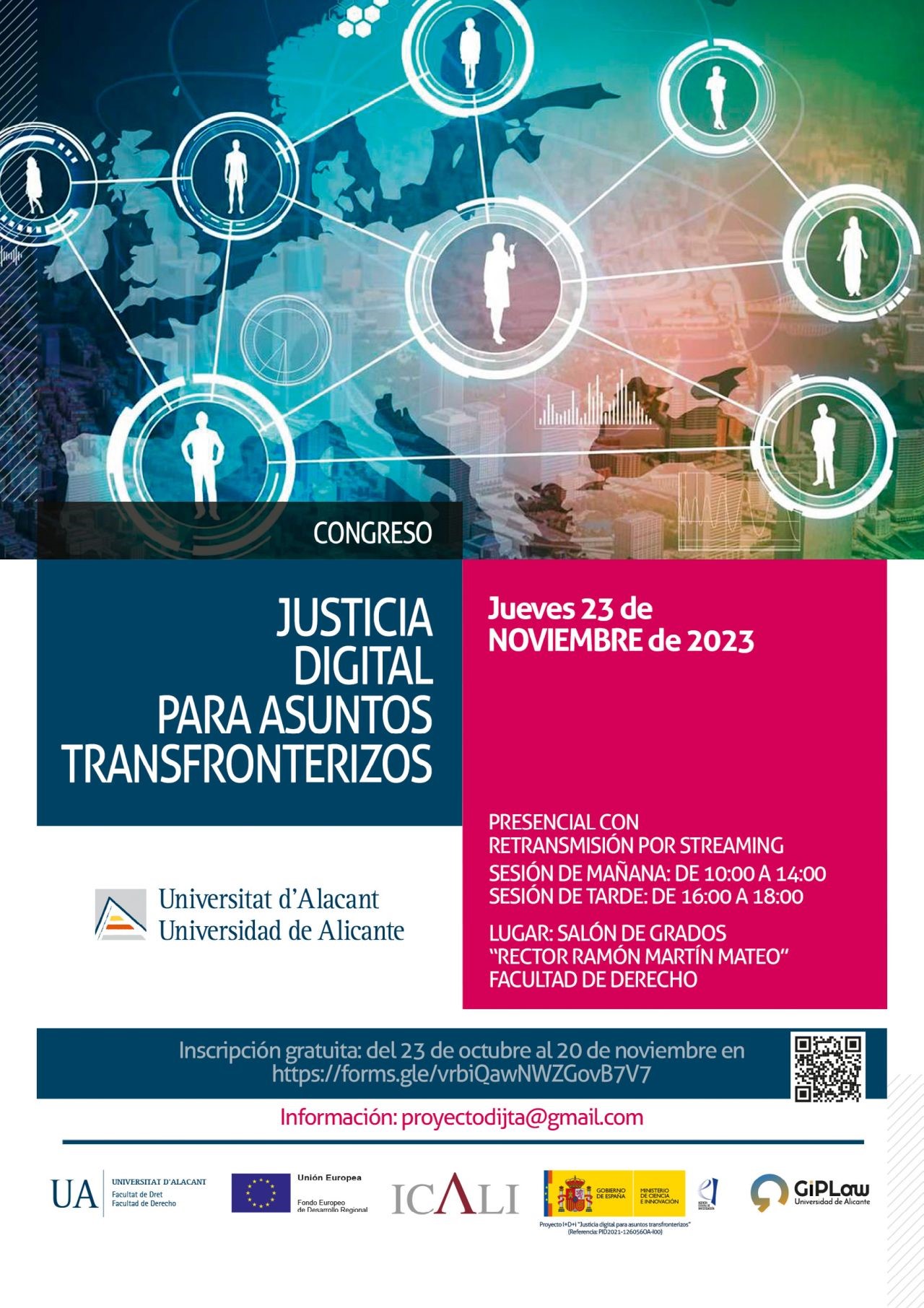
The Private International Law Department of the University of Alicante is organizing a conference entitled “Digital Justice for Cross-border Cases” (both onsite and online – in Spanish). The event will take place on 23 November 2023 at the Salón de Grados “Rector Ramón Martín Mateo” of the Faculty of Law at the University of Alicante.
Chinese Journal of Transnational Law Special Issue: Call for Papers
CHINESE JOURNAL OF TRANSNATIONAL LAW
Call for Papers
Special Issue: Private International Law and Sustainable Development in Asia
The United Nations Agenda 2030 with its 17 Sustainable Development Goals (SDGs) seems to have a blind spot for the role of private and private international law. That blind spot is beginning to be closed. A collective volume with global outlook published in 2021 addressed “the private side of transforming our world”: each of the 17 SDGs was discussed in one chapter of the book devoted to the specific relevance of private law and private international law. In 2022, the IACL-ASADIP conference in Asunción, Paraguay discussed sustainable private international law with regard to Latin America; the contributions published in 2023 in a special issue of the University of Brasilia Law Journal – Direito.UnB., V.7., N.3 (2023).
In this occasion the focus is on Asia. The Chinese Journal of Transnational Law invites submissions for its Vol. 2 Issue 2, to be published in 2025, engaging critically with the functions, methodologies and techniques of private international law in relation to sustainability from an Asian perspective, as well as in relation to the actual and potential contributions of private international law to the SDGs in Asia. Read more