


Views
Supreme Court of Canada: Israel, not Ontario, is Forum Conveniens for Libel Proceedings
The decision to stay proceedings under the doctrine of forum non conveniens is discretionary, which in part means that appeal courts should be reluctant to reverse the decisions of motions judges on the issue. It comes as some surprise, therefore, that the Supreme Court of Canada has disagreed with not only the motions judge but also the Court of Appeal for Ontario and overturned two earlier decisions denying a stay. In Haaretz.com v Goldhar (available here) the court held (in a 6-3 decision) that the plaintiff’s libel proceedings in Ontario should be stayed because Israel is the clearly more appropriate forum.
The decision is complex, in part because the appeal also considered the issue of jurisdiction and in part because the nine judges ended up writing five sets of reasons, four concurring in the result and a fifth in dissent. That is very unusual for Canada’s highest court.
The case concerned defamation over the internet. The plaintiff, a resident of Ontario, alleged that an Israeli newspaper defamed him. Most readers of the story were in Israel but there were over 200 readers in Ontario.
On assumed jurisdiction, the court was asked by the defendant to reconsider its approach as set out in Club Resorts (available here), at least as concerned cases of internet defamation. Eight of the nine judges refused to do so. They confirmed that a tort committed in Ontario was a presumptive connecting factor to Ontario, such that it had jurisdiction unless that presumption was rebutted (and they held it was not). They also confirmed the orthodoxy that the tort of defamation is committed where the statement is read by a third party, and that in internet cases this is the place where the third party downloads and reads the statement (paras 36-38 and 166-167). Only one judge, Justice Abella, mused that the test for jurisdiction should not focus on that place but instead on “where the plaintiff suffered the most substantial harm to his or her reputation” (para 129). This borrows heavily (see para 120) from an approach to choice of law (rather than jurisdiction) that uses not the place of the tort (lex loci delicti) but rather the place of most substantial harm to reputation to identify the applicable law.
On the stay of proceedings, six judges concluded that Israel was the most appropriate forum. Justice Cote wrote reasons with which Justices Brown and Rowe concurred. Justice Karakatsanis disagreed with two key points made by Justice Cote but agreed with the result. Justices Abella and Wagner also agreed with the result but, unlike the other seven judges (see paras 91 and 198), they adopted a new choice of law rule for internet defamation. This was a live issue on the stay motion because the applicable law is a relevant factor in determining the most appropriate forum. They rejected the lex loci delicti rule from Tolofson (available here) and instead used as the connecting factor the place of the most substantial harm to reputation (paras 109 and 144). Justice Wagner wrote separately because he rejected (paras 147-148) Justice Abella’s further suggestion (explained above) that the law of jurisdiction should also be changed along similar lines.
The core disagreement between Justice Cote (for the majority) and the dissent (written jointly by Chief Justice McLachlin and Justices Moldaver and Gascon) was that Justice Cote concluded that the motions judge made six errors of law (para 50) in applying the test for forum non conveniens, so that no deference was required and the court could substitute its own view. In contrast, the dissent held that four of these errors were “merely points where our colleague would have weighed the evidence differently had she been the motions judge” (para 179) which is inappropriate for an appellate court and that the other two errors were quite minor and had no impact on the overall result (para 178). The dissent held strongly to the orthodox idea that decisions on motions to stay are entitled to “considerable deference” (para 177) lest preliminary motions and appeals over where litigation should occur undermine stability and increase costs (para 180).
Another fundamental disagreement between Justice Cote and the dissent was their respective view of the scope of the plaintiff’s claim. During the motion and appeals, the plaintiff made it clear that he was only seeking a remedy in respect of damage to his reputation in Ontario (as opposed to anywhere else) and that he was not going to sue elsewhere. The dissent accepted that this undertaking to the court limited the scope of the claim (paras 162-163) and ultimately it pointed to Ontario as the most appropriate forum. In contrast, Justice Cote held that the plaintiff’s undertaking “should not be allowed to narrow the scope of his pleadings” (para 23). It is very hard to accept that this is correct, and indeed on this point Justice Karakatsanis broke with Justice Cote (para 101) and agreed with the dissent. Why should the court not accept such an undertaking as akin to an amendment of the pleadings? Justice Cote claimed that “[n]either Goldhar nor my colleagues … may now redefine Goldhar’s action so that it better responds to Haaretz’s motion to stay” (para 24). But why should the plaintiff not be able to alter the scope of his claim in the face of objections to that scope from the defendant?
There are many other points of clash in the reasons, too many to engage with fully here. How important, at a preliminary stage, is examination of what particular witnesses who have to travel might say? What role does the applicable law play in the weighing of the more appropriate forum when it appears that each forum might apply its own law? Does a subsequent proceeding to enforce a foreign judgment count toward a multiplicity of proceedings (which is to be avoided) or do only substantive proceedings (on the merits) count? Is it acceptable for a court to rely on an undertaking from the plaintiff to pay the travel and accommodation costs for the defendant’s witnesses or is this allowing a plaintiff to “buy” a forum?
It might be tempting to treat the decision as very much a product of its specific facts, so that it does not offer much for future cases. There could, however, be cause for concern. As a theme, the majority lauded “a robust and careful” assessment of forum non conveniens motions (para 3). If this robust and careful assessment is to be performed by appellate courts, is this consistent with deference to motions judges in their discretionary, fact-specific analysis? The dissent did not think so (para 177).
Case C-191/18 and Us
Open your eyes, we may be next. Or maybe we are already there? Case C- 191/18, KN v Minister for Justice and Equality, is not about PIL. The questions referred to the CJ on March 16, actually relate to the European Arrest warrant (and Brexit). However, PIL decisions are mirroring the same concerns.
It has been reported, for instance, that a Polish district court has refused a Hague child return to England on the basis (inter alia) that Brexit makes the mother`s position too uncertain. A recent case before the Court of Appeal of England and Wales shows that English judges are also struggling with this (see “Brexit and Family Law”, published on October 2017 by Resolution, the Family Law Bar Association and the International Academy of Family Lawyers, supplemented by mainland IAFL Fellows, Feb 2018).
And even if it was not the case: can we really afford to stay on the sidelines?
Needless to say, Brexit is just one of the ingredients in the current European Union melting pot. Last Friday’s presentation at the Comité Français de Droit International Privé, entitled « Le Droit international privé en temps de crise », by Prof. B. Hess, provided a good assessment of the main economic, political and human factors explaining European contemporary mess – by the way, the parliamentary elections in Slovenia on Sunday did nothing but confirm his views. One may not share all that is said on the paper; it’s is legitimate not to agree with its conclusions as to the direction PIL should follow in the near future to meet the ongoing challenges; the author’s global approach, which comes as a follow up to his 2017 Hague Lecture, is nevertheless the right one. Less now than ever before can European PIL be regarded as a “watertight compartment”, an isolated self-contained field of law. Cooperation in criminal and civil matters in the AFSJ follow different patterns and maybe this is how it should be (I am eagerly waiting to read Dr. Agnieszka Frackowiak-Adamska’s opinion on the topic, which seem to disagree with the ones I expressed in Rotterdam in 2015, and published later). The fact remains that systemic deficiencies of the judiciary in a given Member State can hardly be kept restricted to the criminal domain and leave untouched the civil one; doubts hanging over one prong necessarily expand to the other. The Celmer case, C-216/18 PPU, Minister for Justice and Equality v LM, heard last Friday (a commented report of the hearing will soon be released in Verfassungsblog, to the best of my knowledge), with all its political charge, cannot be deemed to be of no interest to us; precisely because a legal system forms a consistent whole mutual trust cannot be easily, if at all, compartmentalized.
The Paris presentation was of course broader and it is not my intention to address it in all its richness, in the same way that I cannot recall the debate which followed, which will be reproduced in due time at the Travaux. Still, I would like to mention the discussion on asylum and PIL, if only to refer to what Prof. S. Courneloup very correctly pointed out to: asylum matters cannot be left to be dealt with by administrative law alone; on the contrary, PIL has a big say and we – private international lawyers- a wide legal scenario to be alert to (for the record, albeit I played to some extent the dissenting opinion on Friday, my actual stance on the need to pair up public and private law for asylum matters is clear in CDT, 2017). Last year the JURI Committee of the European Parliament commissioned two studies (here and here; they were also reported in CoL) on the relationship between asylum and PIL, thus suggesting some legislative initiative might be taken. But nothing has happened since.
Doors open for First Hearing of International Chamber at Paris Court of Appeal
Written by Duncan Fairgrieve (BIICL;Université de Paris Dauphine) and Solenn Le Tutour (avocat, Barreau de Paris)
When the French Government announced in February this year plans to launch an “English” Commercial court in Paris, eyebrows were raised and, it is fair to say, an element of skepticism expressed in the common law world as to whether such a development would really prove to be a serious competitor to the Commercial Courts on Fetter Lane in London. Read more
News
Second Issue of the Journal of Private International Law for 2023
The second issue of the Journal of Private International Law for 2023 has just been published. It contains the following articles:
DJB Svantesson & SC Symeonides, “Cross-border internet defamation conflicts and what to do about them: Two proposals”
Conflicts of laws in cross-border defamation cases are politically and culturally sensitive and their resolution has always been difficult. But the ubiquity of the internet has increased their frequency, complexity, and intensity. Faced with the realities of the online environment—including the virtual disappearance of national borders—several countries have acted unilaterally to preserve their values and protect their interests. Some countries enacted laws favouring consumers or other potential plaintiffs, while other countries took steps to protect potential defendants, including publishers and internet service providers. As a result, these conflicts are now more contentious than ever before. We believe there is a better way—even-handed multilateral action rather than self-serving unilateral action. In this article, we advance two proposals for multilateral action. The first is a set of soft law principles in the form of a resolution adopted by the Institut de Droit International in 2019. The second is a proposed Model Defamation Convention. After presenting and comparing these two instruments, we apply them to two scenarios derived from two leading cases (the first and one of the latest of the internet era) decided by courts of last resort. The first scenario is based on Dow Jones & Company Inc v Gutnick, which was decided by the High Court of Australia in 2002. The second is based on Gtflix Tv v. DR, which was decided by the Court of Justice of the European Union at the end of 2021. We believe that these two instruments would produce more rational solutions to these and other cross-border defamation conflicts. But if we fail to persuade readers on the specifics, we hope to demonstrate that other multilateral solutions are feasible and desirable, and that they are vastly superior to a continuing unilateral “arms race.” In any event, we hope that this article will spur the development of other proposals for multilateral action.
Conference on Digital Justice for Cross-border Cases: University of Alicante, 23 November 2023 (in Spanish)
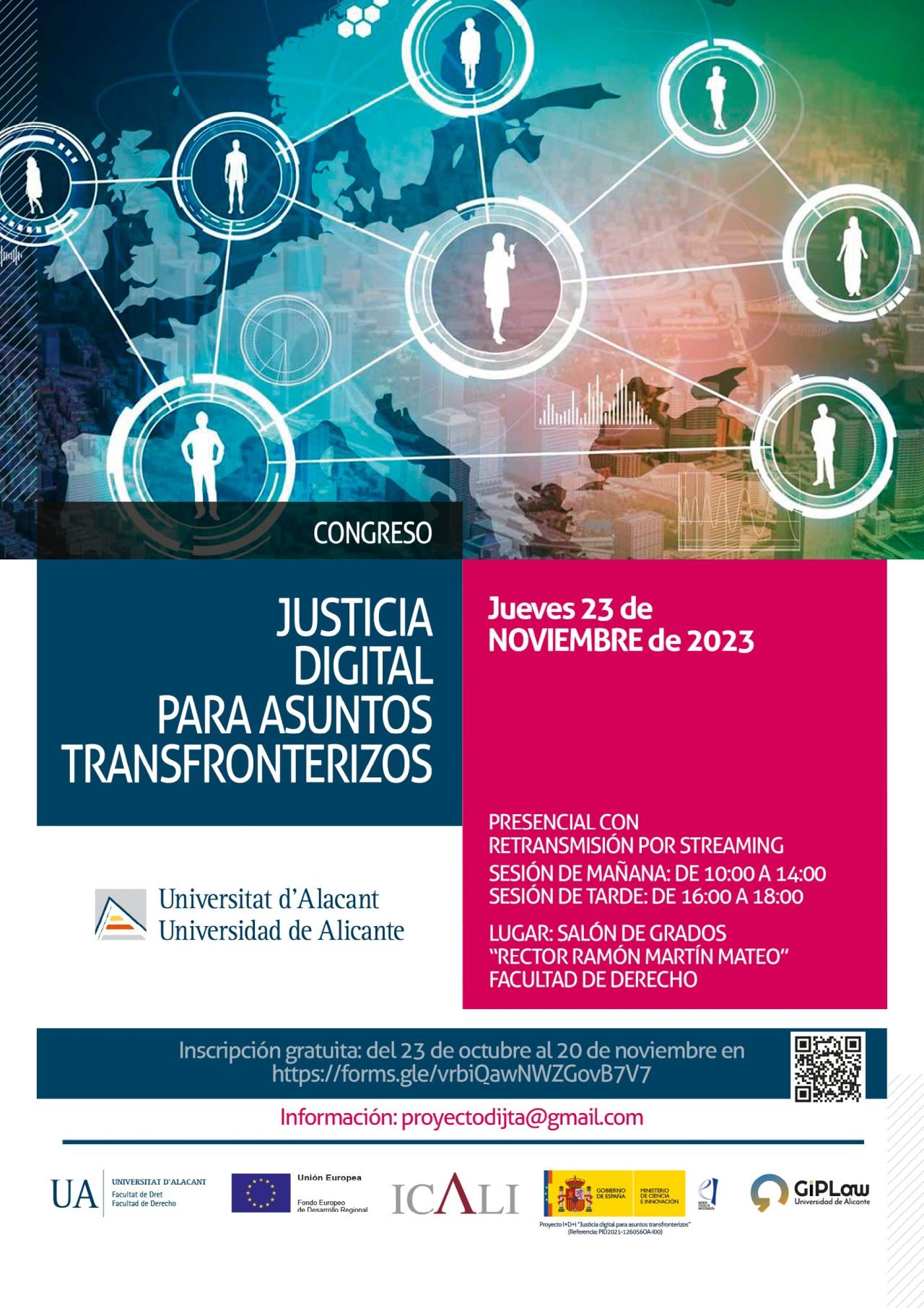
The Private International Law Department of the University of Alicante is organizing a conference entitled “Digital Justice for Cross-border Cases” (both onsite and online – in Spanish). The event will take place on 23 November 2023 at the Salón de Grados “Rector Ramón Martín Mateo” of the Faculty of Law at the University of Alicante.
Chinese Journal of Transnational Law Special Issue: Call for Papers
CHINESE JOURNAL OF TRANSNATIONAL LAW
Call for Papers
Special Issue: Private International Law and Sustainable Development in Asia
The United Nations Agenda 2030 with its 17 Sustainable Development Goals (SDGs) seems to have a blind spot for the role of private and private international law. That blind spot is beginning to be closed. A collective volume with global outlook published in 2021 addressed “the private side of transforming our world”: each of the 17 SDGs was discussed in one chapter of the book devoted to the specific relevance of private law and private international law. In 2022, the IACL-ASADIP conference in Asunción, Paraguay discussed sustainable private international law with regard to Latin America; the contributions published in 2023 in a special issue of the University of Brasilia Law Journal – Direito.UnB., V.7., N.3 (2023).
In this occasion the focus is on Asia. The Chinese Journal of Transnational Law invites submissions for its Vol. 2 Issue 2, to be published in 2025, engaging critically with the functions, methodologies and techniques of private international law in relation to sustainability from an Asian perspective, as well as in relation to the actual and potential contributions of private international law to the SDGs in Asia. Read more