


Views
Reciprocity and the Enforcement of Foreign Judgments in Egypt – A Critical Assessment of a Recent Supreme Court Decision

I. Introduction
Reciprocity is probably one of the most controversial requirements in the field of the recognition and enforcement of foreign judgments. While its legitimacy appears to be on the wane (see Béligh Elbalti, “Reciprocity and the Recognition and Enforcement of Foreign Judgments: A Lot of Bark but Not Much Bite,” 13 JPIL 1 (2017) 184), reciprocity can still strike hard – particularly when it is applied loosely and without sufficient consideration.
The case presented here, decided by the Egyptian Supreme Court (Appeal No. 11434 of 21 June 2025), provides a good illustration. Despite the Court’s well-established case law imposing certain restrictions on the use of the reciprocity requirement, this recent judgment shows that, when not applied with the necessary rigor, reciprocity can still produce significant effects that undermine the legitimate expectations of the parties.
The WTO TRIPS Agreement and Conflict-of-Laws Rules in Intellectual Property Cases
By Marketa Trimble, Samuel S. Lionel Professor of Intellectual Property Law, Co-Director of the IP Law Concentration, William S. Boyd School of Law, University of Nevada, Las Vegas
It is neither new nor surprising that international treaties affect the design and application of conflict-of-laws rules; not only international conventions on private international law but also other international treaties shape conflicts rules, with human rights treaties being the primary example. But a recent decision concerning the interpretation of the WTO’s Agreement on Trade-Related Aspects of Intellectual Property Rights (“TRIPS Agreement”) could have profound and arguably unprecedented effects on the conflict rules that are applied in intellectual property (“IP”) cases, such as cross-border cases concerning copyright infringement, trademark ownership, and patent licenses.
Kairos Shipping II LLC (appellant) v Songa Product and Chemical Tankers III AS (respondent), The interpretation of natural language on charter contracts
Written by Nicolás Preus Miranda, student at Universidad Carlos III in Getafe, Spain, specializing in maritime, international law and international commercial arbitration
The decision in Kairos Shipping II LLC v Songa Product and Chemical Tankers III AS [2025] EWCA Civ 1227 represents a pivotal clarification in the interpretation of repossession clauses within standard-form bareboat charterparties, particularly under the BIMCO Barecon 2001 framework. Arising from a dispute over the early termination of a charter for a 49,708 DeadWeight Tonnage (DWT) chemical/oil tanker, the case underscores the English courts’ commitment to contextual and purposive contract interpretation, balancing textual fidelity with commercial practicality. This analysis expands on the case’s significance, the interpretive principles it embodies, and its ultimate resolution, drawing from judicial reasoning and industry commentary.[1] Read more
News
Hybrid Lecture: Venezuela’s Oil, Between a Rock and a Hard (Arbitration) Place (UCL, 26 Feb 2026, 1pm)
EAPIL Conference in Geneva from 18-20 June 2026: Registration open!
 From 18 to 20 June 2026 the European Association of Private International Law (EAPIL) will host its third biannual conference. Following the Association’s conferences in Aarhus (Denmark) and Wroclaw (Poland) the conference promises to be a key event for scholars and practitioners interested in the present and future of European private international law.
Programme and Audience
Under the title “Shaping the Future of Private International Law in Europe – Putting Together the Pieces & Filling Gaps”, the conference will address structural developments, unresolved issues, and emerging challenges in European private international law. Special emphasis will be placed on 1) the consolidation of European private international law in a single instrument (EuPIL Act), 2) the unification of international property law (including the protection of cultural objects), and 3) the relationship of European Private International Law with third States.
All topics will be addressed from an analytical and a forward-looking perspective, combining doctrinal reflection with policy-oriented debate. Contributions will come from an internationally diverse group of speakers, reflecting EAPIL’s commitment to comparative and transnational perspectives.
The conference is open to academics, judges, practitioners, policymakers, and early-career researchers with an interest in (European) private international law.
Venue and Organisation
Hosted by the Faculty of Law of the University of Geneva, the conference will take place exclusively in person in Geneva. The choice of venue underscores the international outlook of the event and provides an ideal setting for scholarly exchange and networking.
Registration
Registration is available here. An early-bird rate applies until 15 March 2026, with standard registration available until 17 May 2026. Participation fees vary depending on registration date and include the option to attend the conference dinner. Further details on fees and registration can be found on the conference website.
Why Attend?
The EAPIL Conference 2026 offers a unique opportunity to:
- engage with cutting-edge research in private international law,
- discuss current reform projects and unresolved doctrinal questions,
- connect with leading scholars and practitioners from across jurisdictions, and
- contribute to shaping the future development of the field.
Further Information
More information on the programme, registration, and practical details is available on the conference website.
About EAPIL
The European Association of Private International Law was founded in 2019 to promote the study and development of Private International Law. It has today more than 600 members from more than 70 countries. For more information visit the EAPIL website and follow the EAPIL blog.
Crossroads in Private International Law Webinar with Tobias Lutzi on “Crossroads in Private International Law Seminar on the Reform of EU Private International Law” at the University of Aberdeen
The Centre for Private International Law & Transnational Governance of the University of Aberdeen is continuing its Crossroads in Private International Law webinar series with a talk by Tobias Lutzi (University of Augsburg) titled ‘Between Ambition and Realism – What to Expect from the Upcoming Reforms to the Rome II and Brussels Ia Regulation?’: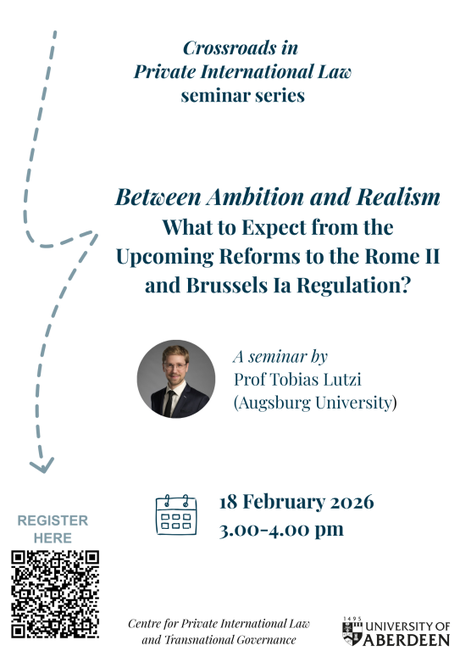
The Centre for Private International Law & Transnational Governance invites you to attend the next seminar in our Crossroads in Private International Law seminar series. You can find the link to register at the bottom of this page.
Prof Tobias Lutzi (Junior Professor for Private Law at Augsburg University) will give a seminar on the reforms to the Rome II and Brussels Ia Regulation. Prof Lutzi has kindly provided the following abstract:
Last year, the EU Commission formally kicked off the process of reforming two key instruments of EU Private International Law, identifying potential areas for reform and setting out some overarching policy goals. In 2026, the Commission will face the more difficult decision of which of those areas to actually focus on. This talk will discuss the respective merits of those areas of reform, highlighting the tension between ambition and realism that will shape the Commission’s work.
We are looking forward to welcoming you online or on campus!
Additional information and the link to register can be found here.