
Convergence and Divergence in Private International Law – Liber Amicorum Kurt Siehr


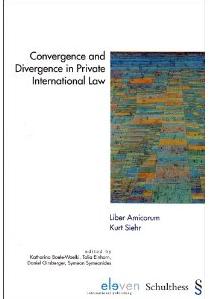 As we pointed out in a previous post, a very rich collection of essays in honor of Prof. Kurt Siehr on his 75th birthday has been recently published by Eleven International Publishing and Schulthess, under the editorship of Katharina Boele-Woelki, Talia Einhorn, Daniel Girsberger and Symeon Symeonides: Convergence and Divergence in Private International Law – Liber Amicorum Kurt Siehr. A previous Festschrift was dedicated to Prof. Siehr in 2000: “Private Law in the International Arena – From National Conflict Rules Towards Harmonization and Unification: Liber amicorum Kurt Siehr” (see Google Books).
Here’s the table of contents:
Part I: General Aspects of PIL Law-Making.
- Talia Einhorn, American vs. European Private International Law – The Case for a Model Conflict of Laws Act (MCLA);
- Peter Hay, Comparative and International Law in the United States – Mixed Signals;
- Herbert Kronke, Connecting Factors and Internationality in Conflict of Laws and Transnational Commercial Law;
- Jim Nafziger, Democratic Values in the Choice-of-Law Process;
- Anton K. Schnyder, Keine Berührungsangst des Schweizerischen Bundesgerichts im Umgang mit Eingriffsnormen;
- Frank Vischer, ‘Revolutionary ideas’ and the Swiss Statute on Private International Law;
- Jun Yokoyama, Renvoi in Japanese Private International Law.
Part II: Family Relations and Succession.
- Katharina Boele-Woelki & Maarit Jantära-Jareborg, Protecting Children Against Detrimental Family Environments under the 1996 Hague Convention and the Brussels II bis Regulation;
- Andrea Bonomi, Choice-of-law Aspects of the Future EC Regulation in Matters of Succession – A First Glance at the Commission’s Proposal;
- Alegria Borras, The Necessary Flexibility in the Application of the New Instruments on Maintenance;
- William Duncan, Hague Conference Future Developments in International Family Law with Special Emphasis on Cross-border Child Protection: A View from The Hague;
- Eric Jayme, Der deutsche Nachlaßrichter und die amerikanische „tracing rule“ im Internationalen Ehegüterrecht – Eine Problemskizze;
- Peter Kindler, From Nationality to Habitual Residence: Some Brief Remarks on the Future EU Regulation on International Successions and Wills;
- Patrick Kinsch, Luxembourg Recognition in the Forum of a Status Acquired Abroad – Private International Law Rules and European Human Rights Law;
- Christian Kohler, Germany Elliptiques variations sur un thème connue: compétence judiciaire, conflits de lois et reconnaissance de décisions en matière alimentaire d’après le règlement (CE) n° 4/2009 du Conseil;
- Rong-chwan Chen, Conflict of Laws of Divorce: Judicial Practice and Legislative Development of Taiwan;
- Heinz-Peter Mansel, The Impact of the European Union’s Prohibition of Discrimination and the Right of Free Movement of Persons on the Private International Law Rules of Member States – With comments on the Sayn-Wittgenstein case before the European Court of Justice;
- Gustaf Moller, On the Hague Convention on the Civil Aspects of International Child Abduction and its application by the Supreme Court of Finland;
- Jan Neels, South Africa External Public Policy, the Incidental Question Properly So-called and the Recognition of Foreign Divorce Orders;
- Teun Struycken, The Netherlands Surrogacy, a New Way to Become a Mother? A New PIL Issue.
Part III: Contractual and Non-Contractual Obligations.
- Michael Bogdan, Some Reflections on Contracts and Torts in Cyberspace in view of Regulations Rome I and Rome II;
- Andreas Furrer, Cross-border Multimodal Transport – Problems and Limits of Finding an Appropriate Legal Regime;
- Ulrich Magnus, UN-Kaufrecht und Verbraucher;
- Peter Mankowski, The Principle of Characteristic Performance Revisited Yet Again;
- Robin Morse, Contracts of Carriage and the Conflict of Laws;
- Monika Pauknerova, Presumptions, Escape Clauses and International Carriage of Goods Contracts;
- Oliver Remien, Tourism, Conflict of Laws and the Rome I Regulation;
- Symeon Symeonides, Party Autonomy in Rome I and II from a Comparative Perspective; [see our dedicated post here]
- Lajos Vekas, Hungary Questions of Contract Law in the New Hungarian Civil Code.
Part IV: International Litigation and Arbitration.
- Paul R. Beaumont & Burcu Yüksel, The Validity of Choice of Court Agreements under the Brussels I Regulation and the Hague Choice of Court Agreements Convention;
- George Bermann, USA Parallel Litigation: Is Convergence Possible?;
- Dagmar Coester-Waltjen, Einige Überlegungen zu Schiedsgerichtsvereinbarungen und ihrer Wirksamkeit;
- Giuditta Cordero-Moss, Legal Capacity, Arbitration and Private International Law;
- Harry Duintjer Tebbens, New Impulses for the Ascertainment of Foreign Law in Civil Proceedings: A question of (inter)networking?;
- Marc Fallon & Dimitrios-Panagiotis Tzakas, Res Judicata Effects of Foreign Class Action Rulings in the EU Member States;
- Celia Fassberg-Wasserstein, Israeli Foreign Judgments Law: A Case for Codification?;
- Manlio Frigo, The Linguistic Factor in the Circulation of Arbitral Awards and Some of its Pitfalls;
- Helene Gaudemet-Tallon, La clause attributive de juridiction, un moyen d’échapper aux lois de police?;
- Daniel Girsberger, The Effects of Assignment on Arbitration Agreements – Why Conflict-of-Laws Theory is Still Needed;
- Tibor Varady, Observation of Group Affiliation (or: Cohabitation with the Impossible) in International Commercial Arbitration;
- Spyridon Vrellis, The Validity of a Choice of Court Agreement Under the Hague Convention of 2005.
Part V: Cultural Property.
- Johan Erauw, Conflict of Laws with Folgerecht (‘droit de suite’) on the Sale of Works of Art in and out of Europe – after the EC-Directive No. 2001/84;
- John Henry Merryman, The van Meegeren Problem;
- Gerte Reichelt, Versunkene Welten Rechtlicher Schutz des archäologischen Unterwasserkulturerbes;
- Marc-André Renold, The International Scope of Application of the Swiss Rules on the Due Diligence of Dealers in Cultural Property.
– – – – – – – – – – – – – – – – – – – – – – –
Title: Convergence and Divergence in Private International Law – Liber Amicorum Kurt Siehr, edited by Katharina Boele-Woelki, Talia Einhorn, Daniel Girsberger, Symeon Symeonides; Eleven International Publishing – Schulthess, The Hague – Zürich, 2010, 918 pages.
ISBN : 978-90-77596-93-7 (Eleven); 978-3-7255-6165-0 (Schulthess).