


Views
The long tentacles of the Helms-Burton Act in Europe (III)
Written by Nicolás Zambrana-Tévar LLM(LSE) PhD(Navarra), Associate Professor KIMEP University (Kazakhstan), n.zambrana@kimep.kz
There has recently been a new and disappointing development in the saga of the Sánchez-Hill, a Spanish-Cuban-US family who filed a lawsuit before Spanish courts against a Spanish Hotel company (Meliá Hotels) for unjust enrichment. Meliá is exploiting several hotels located on land owned by Gaviota S.A., a Cuban company owned by the Republic of Cuba. That land was expropriated by Cuba without compensation, following the revolution of 1959.
Read more
Choice of Law in the American Courts in 2022: Thirty-Sixth Annual Survey
The 36th Annual Survey of Choice of Law in the American Courts (2022) has been posted to SSRN.
The cases discussed in this year’s survey cover such topics as: (1) choice of law, (2) party autonomy, (3) extraterritoriality, (4) international human rights, (5) foreign sovereign immunity, (6) foreign official immunity, (7) adjudicative jurisdiction, and (8) the recognition and enforcement of foreign judgments. Happy reading!
John Coyle (University of North Carolina School of Law)
William Dodge (University of California, Davis School of Law)
Aaron Simowitz (Willamette University College of Law)
Book: Intolerant Justice: Conflict and Cooperation on Transnational Litigation by Asif Efrat
Summary provided by the author, Asif Efrat
In a globalized world, legal cases that come before domestic courts are often transnational, that is, they involve foreign elements. For example, the case before the court may revolve around events, activities, or situations that occurred in a foreign country, or the case may involve foreign parties or the application of foreign law. Such cases typically present an overlap between the legal authorities of two countries. To handle a transnational case cooperatively, one legal system must cede its authority over the case, in full or in part, to a foreign legal system. This effectively means that a local citizen would be subjected to the laws or jurisdiction of a foreign legal authority, and that raises a host of questions and concerns: Does the foreign legal system abide by the rule of law? Does it guarantee human rights? Will the foreign court grant our citizen the due process and fair treatment they would have enjoyed at home?
The newly published book Intolerant Justice: Conflict and Cooperation on Transnational Litigation (Oxford University Press) argues that the human disposition of ethnocentrism – the tendency to divide the world into superior in-groups and inferior out-groups – would often lead policymakers to answer these questions negatively. The ethnocentric, who fears anything foreign, will often view the foreign legal system as falling below the home country’s standards and, therefore, as unfair or even dangerous. Understandably, such a view would make cooperation more difficult to establish. It would be harder to relinquish the jurisdiction over legal cases to a foreign system if the latter is seen as unfair; extraditing an alleged offender to stand trial abroad would seem unjust; and the local enforcement of foreign judgements could be perceived as an affront to legal sovereignty that contravenes fundamental norms.
This book examines who expresses such ethnocentric views and how they frame them; and, on the other hand, who seeks to dispel these concerns and establish cooperation between legal systems. In other words, the domestic political debate over transnational litigation stands at the center of this book.
In this debate, the book shows, some domestic actors are particularly likely to oppose cooperation on ethnocentric grounds: the government’s political opponents may portray the government’s willingness to cooperate as a dangerous surrender to a foreign legal system, which undermines local values and threatens the home country’s citizens; NGOs concerned for human rights might fear the human-rights consequences of cooperation with a foreign legal system; and lawyers, steeped in local rules and procedures, may take pride in their legal system and reject foreign rules and procedures as wrong or inferior.
By contrast, actors within the state apparatus typically view cooperation on litigation more favorably. Jurists who belong to the state – such as judges, prosecutors, and the justice-ministry bureaucracy – may support cooperation out of a concern for reciprocity or based on the principled belief that offenders should not escape responsibility by crossing national borders. The ministry of foreign affairs and the ministry of defense may similarly support cooperation on litigation that could yield diplomatic or security benefits. These proponents of cooperation typically argue that legal differences among countries should be respected or that adequate safeguards can guarantee fair treatment by foreign legal authorities. In some cases, these arguments prevail and cooperation on litigation is established; in other cases, the ethnocentric sentiments end up weakening or scuttling the cooperative efforts.
These political controversies are examined through a set of rich case studies, including the Congressional debate over the criminal prosecution of U.S. troops in NATO countries, the British concerns over extradition to the United States and EU members, the dilemma of extradition to China, the wariness toward U.S. civil judgments in European courts, the U.S.-British divide over libel cases, and the concern about returning abducted children to countries with a questionable human rights record.
Overall, this book offers a useful analytical framework for thinking about the tensions arising from transnational litigation and conflict of laws. This book draws our attention to the political arena, where litigation-related statutes and treaties are crafted, oftentimes against fierce resistance. Yet the insights offered here may also be used for analyzing judicial attitudes and decisions in transnational cases. This book will be of interest to anyone seeking to understand the challenges of establishing cooperation among legal systems.
News
AMEDIP’s upcoming webinar: Private International Law in the Inter-American system: A glance in the light of the 50 anniversary of the CIDIP (27 February 2025 – in Spanish)
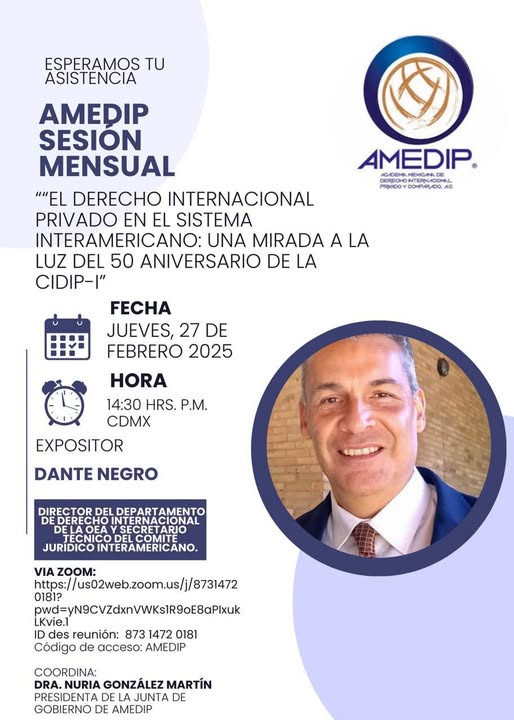
The Mexican Academy of Private International and Comparative Law (AMEDIP) is holding a webinar on Thursday 27 February 2025 at 14:30 (Mexico City time – CST), 21:30 (CET time). The topic of the webinar is ‘Private International Law in the Inter-American system: A glance in the light of the 50 anniversary of the CIDIP’ and will be presented by OAS Director Dante Negro (in Spanish).
CIDIP is the Spanish acronym for the Inter-American Specialized Conferences on Private International Law. For a history of the CIDIP, click here. Read more
Book Launch: Philosophical Foundations of Private International Law – Oxford, March 19, 4pm-6pm
In 2024, Oxford University Press published Philosophical Foundations of Private International Law, edited by Roxana Banu, Michael S Green, and Ralf Michaels. The book represents the first inter-disciplinary engagement with questions of private international law from a philosophical perspective, covers a wide range of philosophical questions in private international law and brings philosophers in conversation with private international law scholars to demystify the analytical tools of each discipline in relationship to the other. More information on the book, including a table of contents, is here.
Now, Oxford University is organizing a hybrid book launch on March 19, 4pm-6pm. An introduction from the Editors will be followed by a discussion on key themes by Gabriel Encinas, Verónica Ruiz Abu-Nigm, Robert Stevens, Antonios Tzanakopoulos, and Emmanuel Voyiakis. More information on the event and on how to sign up for physical or virtual participation is here.
Workshop on Cross-border Protection of Cultural Property-Agenda
Workshop on Cross-border Protection of Cultural Property Agenda
2025.2.28, UTC 8:00 – 12:15 (London Time)
| 8:00 – 8:05 | Opening Remarks | ||
| Zheng Tang | professor of Law, editor in chief, Chinese Journal of Transnational Law; Associate Dean, Wuhan University Academy of International Law and Global Governance | ||
| 8:05 – 8:45 | Keynote Address | ||
| Christa Roodt | Senior Lecturer of History of Art, University of Glasgow | ||
| Zhengxin Huo | Professor of Law, China University of Political Science and Law | ||
| Panel 1: Legal Mechanisms of Cross-Border Cultural Property Protection | |||
| 8:45 – 9:00 | Elena Moustaira | The contribution of Postcolonial Theory to the cross-border protection of Indigenous cultural heritage | |
| 9:00 – 9:15 | Yehya Badr | Restitution of stolen foreign cultural property and hurdles in choice of law | |
| 9:15 – 9:30 | Maggie Fleming Cacot | Forfeiture and freezing orders in transborder cultural property litigation | |
| 9:30 – 9:50 | Commentary and Discussion | ||
| Panel 2: Regional Practices and Challenges in Cultural Property Restitution | |||
| 9:50 – 10:05 | Andrzej’s Jakubowski | Moving People, Shifting State Borders and the Return of Cultural Property: The Case of Poland | |
| 10:05 – 10:20 | Miroslaw Michal Sadowski | From freedom to restitution (with special focus on Central and Eastern Europe and the Lusophone community) | |
| 10:20 – 10:35 | Ekin Omeroglu | The Issue of Applicable Law in Disputes Arising from Violations of Private Law Regulations on Cultural Properties: The Case of Turkiye | |
| 10:35 – 10:50 | Ruida Chen | Restitution of cultural property in China: In search of a new paradigm for cross-border cultural property claims | |
| 10:50 – 11:10 | Commentary and Discussion | ||
| Panel 3: Looking to the Past and the Future | |||
| 11:10 – 11:25 | Dabbie De Girolamo | The Relevance of ADR for transnational cultural property disputes: A Survey and Analysis of China’s experience | |
| 11:25 – 11:40 | Andreas Giorgallis | Restitution of cultural objects unethically acquired during the colonial era: The intersection of Public and Private International Law | |
| 11:40 – 11:55 | Evelien Campfens | Evolving Legal Models of Restitution | |
| 11:55 – 12:15 | Commentary and Discussion | ||
Join Zoom Meeting:
https://zoom.us/j/87424891864?pwd=8rHX72dmzi7FCDWWnm7F2n1OLIOFaC.1
Meeting ID: 874 2489 1864 Password: 574150