


Views
UK Supreme Court in Jalla v Shell: the claim in Bonga spill is time barred
The UK Supreme Court ruled that the cause of action in the aftermath of the 2011 Bonga offshore oil spill accrued at the moment when the oil reached the shore. This was a one-off event and not a continuing nuisance. The Nigerian landowners’ claim against Shell was thus barred by the limitation periods under applicable Nigerian law (Jalla and another v Shell International Trading and Shipping Company and another [2023] UKSC 16, on appeal from [2021] EWCA Civ 63).
On 10 May 2023, the UK Supreme Court has ruled in one of the cases in the series of legal battles started against Shell in the English courts in the aftermath of the Bonga spill. The relevant facts are summarized by the UK Supreme Court as follows at [6] and [7]:
Data on Choice-of-Court Clause Enforcement in US
The United States legal system is immensely complex. There are state courts and federal courts, state statutes and federal statutes, state common law and federal common law. When I imagine a foreign lawyer trying to explain this system to a foreign client, my heart fills with pity.
This feeling of pity is compounded when I imagine this same lawyer trying to advise her client as to whether a choice-of-court clause will be enforced by a court in the United States. The law on this subject is complicated. It is, moreover, not easy to determine how it is applied in practice. Are there differences in clause enforcement rates across the states? Across federal circuits? Do state courts enforce these clauses at the same rate as federal courts? Until recently, there was no data that would allow a foreign lawyer – or a U.S. lawyer, for that matter – to answer any of these questions.
Over the past several years, I have authored or co-authored several empirical articles that seek to answer the questions posed above. This post provides a summary of the data gathered for these articles. All of the cases referenced involve outbound choice-of-court clauses, i.e. clauses that select a jurisdiction other than the one where the suit was filed. Readers interested in the data collection process, the caveats to which the data is subject, or other methodological issues should consult the articles and their appendices. This post first describes state court practice. It then describes federal court practice. It concludes with a brief discussion comparing the two.
Polish Constitutional Court about to review the constitutionality of the jurisdictional immunity of a foreign State?
Written by Zuzanna Nowicka, lawyer at the Helsinki Foundation for Human Rights and lecturer at Department of Logic and Legal Argumentation at University of Warsaw
In the aftermath of the judgment of the ICJ of 2012 in the case of the Jurisdictional Immunities of the State (Germany v. Italy: Greece intervening) that needs no presentation here (for details see, in particular, the post by Burkhard Hess), by its judgment of 2014, the Italian Constitutional Court recognized the duty of Italy to comply with the ICJ judgment of 2012 but subjected that duty to the “fundamental principle of judicial protection of fundamental rights” under Italian constitutional law (for a more detailed account of those developments see this post on EAPIL by Pietro Franzina and further references detailed there). In a nutshell, according to the Italian Constitutional Court, the fundamental human rights cannot be automatically and unconditionally sacrificed in each and every case in order to uphold the jurisdiction immunity of a foreign State allegedly responsible for serious international crimes.
Since then, the Italian courts have reasserted their jurisdiction in such cases, in some even going so far as to decide on the substance and award compensation from Germany. The saga continues, as Germany took Italy to the ICJ again in 2022 (for the status of the case pending before the ICJ see here). It even seems not to end there as it can be provocatively argued that this saga has its spin-off currently taking place before the Polish courts.
News

Report from the inaugural conference of the Australasian Association of Private International Law (AAPrIL)
On 16 and 17 April 2025, the Australasian Association of Private International Law (AAPrIL) held its inaugural conference in Brisbane, Australia. Hosted by Griffith University—the home of AAPrIL President Mary Keyes—the conference featured stimulating panel presentations from speakers from around Australia and abroad.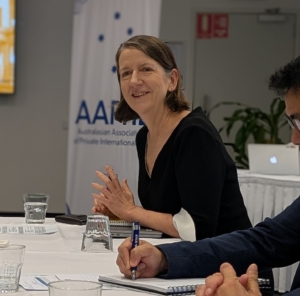
The conference started with a panel on jurisdiction and judgments, chaired by Richard Garnett of Melbourne Law School. Reid Mortensen of USQ kicked things off with a presentation on Australia’s cross-vesting scheme. Priskila Penasthika of the Universitas Indonesia then spoke on ‘The Indonesian Language Contract Requirements versus Arbitration as a Choice of Forum’. Read more
Workshops on Addressing Conflict of Laws and Facilitating Digital Product Passports (DPPs) in Cross-border Value Chains
UN/CEFACT would like to invite you to attend:
New Article on Public Policy Exception
In every private international law system, the forum state reserves the right to reject the application of a foreign rule that deeply offends the forum’s fundamental sense of justice and fairness. In all systems, this “public policy reservation” (ordre public) operates as an exception to the forum’s choice-of-law rules, not its rules on jurisdiction or access to courts. Surprisingly, the First and Second Conflicts Restatements in the United States deviate from this international consensus by narrowly phrasing the exception as a ground for denying a forum to foreign causes of action rather than as a ground for refusing to apply other foreign rules, including those raised as defenses.
A forthcoming article by Symeon Symeonides titled The Public Policy Exception in Choice of Law: The American Version discusses the origins of this unique formulation in Judge Cardozo’s classic but misinterpreted decision in Loucks v. Standard Oil Co. of New York, the problems it creates, its tacit rejection by most American courts, and the new flexible formulation of the exception in the proposed Third Conflicts Restatement.
The article will be published in Praxis des Internationalen Privat- und Verfahrensrechts (IPRax), as well as in a special issue of the Emory Journal of International Law dedicated to the renowned conflicts scholar Peter Hay.