


Views
Book Review: The UN Guiding Principles on Business & Human Rights
This book review was written by Begüm Kilimcioglu, PhD researcher, Research Groups Law & Development and Personal Rights & Property Rights, University of Antwerp
Barnali Choudbury, The UN Guiding Principles on Business & Human Rights- A Commentary, Edward Elgar Publishing, 2023
The endorsement of the United Nations Guiding Principles (UNGPs) in 2011 represents a milestone for business and human rights as the principles successfully achieved to put the duties of different actors involved in (possible) human rights abuses on the international agenda. The UNGPs provide a non-binding yet authoritative framework for a three-pillared scheme to identify and contextualize the responsibilities with regard to business and human rights: the State’s responsibility to protect, businesses’ responsibility to respect, and facilitating access to remedy. However, although the impact of the principles can be described as ground-breaking, they have also been criticized for their vague and generic language which provides for a leeway for certain actors to circumvent their responsibilities (see Andreas Rasche & Sandra Waddock, Surya Deva, Florian Wettstein).Therefore, it is important to determine and clarify the content of the principles to increase their efficiency and effectiveness. In this light, this commentary on the UNGPs which examines all the principles one-by-one through the inputs of various prominent scholars, academics, experts and practitioners is indeed a reference guide to when working on corporate social responsibility.
The Visible College of International Lawyers and the HCCH 2019 Judgments Convention – Conference in Bonn
The HCCH 2019 Judgments Convention has been the subject of an ever-growing body of academic research and discussion ever since it was signed; but due to the pandemic, almost all of it had to happen in writing. Just in time for its entry into force, though, and thus perfectly timed, the first international conference on the HCCH 2019 Judgments Convention Cornerstones – Prospects – Outlook took place a week ago at the University of Bonn, hosted by Matthias Weller together with Moritz Brinkmann and Nina Dethloff, in cooperation with the Permanent Bureau of the HCCH, and with the support of the German Federal Ministry of Justice.
The conference brought together much of the aforementioned discussion between a range of academics, practitioners and policymakers, including the contributors to the book of the same title, edited by Matthias Weller, João Ribeiro-Bidaoui, Moritz Brinkmann, and Nina Dethloff, for which the conference doubled as a launch event. It accordingly followed the same structure, organized into seven panels overall that were split into three larger blocks.
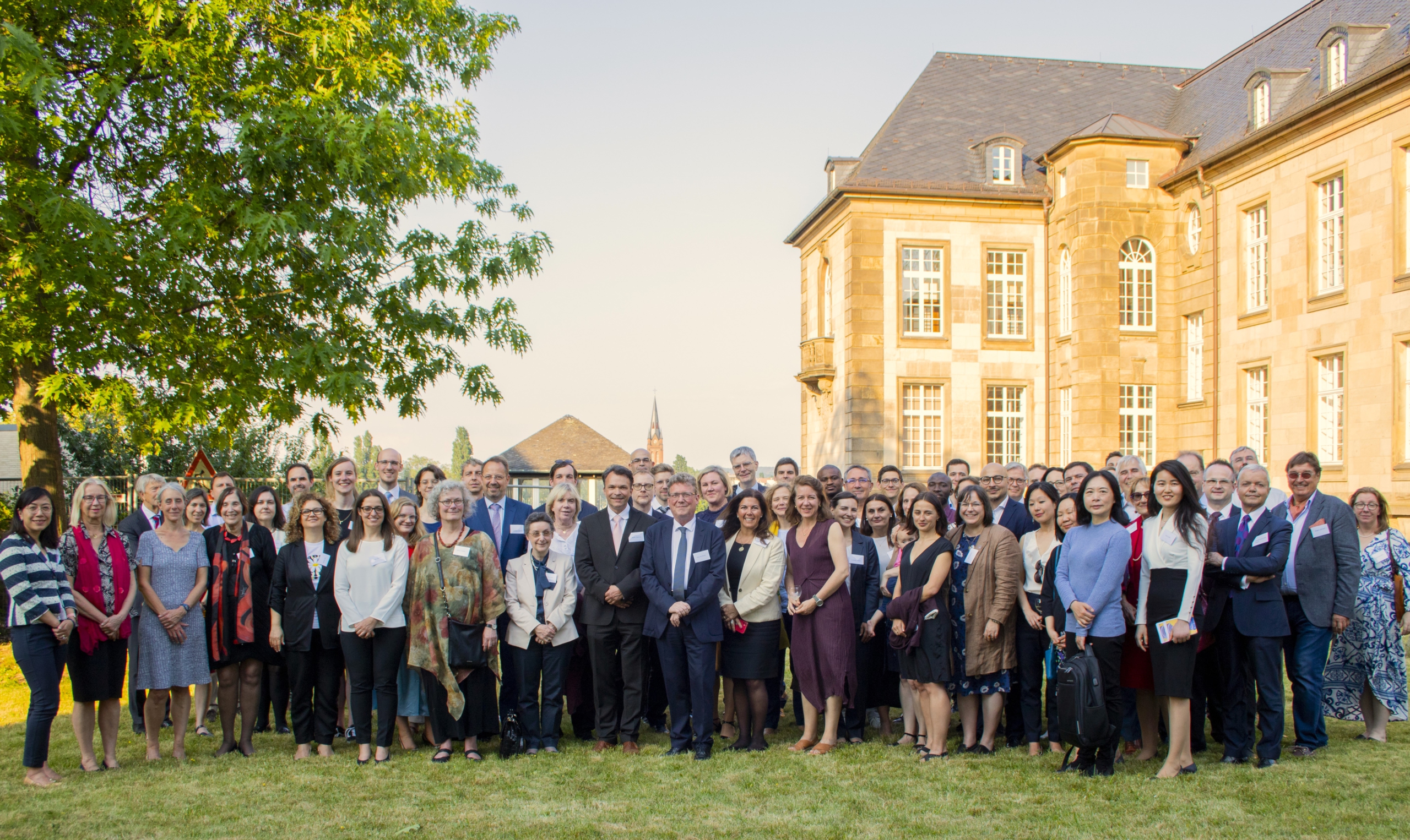
The first of those (“Cornerstones”) focused on some of the core concepts underpinning the Convention. Wolfgang Hau (LMU Munich) discussed the meaning of ‘judgments’, ‘recognition’, and ‘enforcement’; Pietro Franzina (Catholic University of Milan) focused on the jurisdictional filters (with an emphasis on contractual obligations, i.e. Art. 5(1)(g)); and Marcos Dotta Salgueiro (University of the Republic of Montevideo) discussed the grounds for refusal. After some lively discussion, the block continued with papers on the Convention’s much-discussed Art. 29 (Cristina Mariottini (Luxembourg)) and on its interplay with the 2005 Choice of Court Convention (Paul Beaumont (University of Stirling)).
Review of Choice of Law in International Commercial Contracts
While doing research on a choice of law article, I found it necessary to consult a book generally co-edited by Professors Daniel Girsberger, Thomas Graziano, Jan Neels on Choice of Law in International Commercial Contracts (‘Girsberger et al’). The book was officially published on 22 March 2021. I began reading sections of the book related to tacit choice of law sometime in December 2022 and found the work truly global and compelling. At the beginning of June this year, I decided to read the whole book and finished reading it today. It is 1376 pages long!
To cut the whole story short, the book is the bible on choice of law in international commercial contracts. It covers over 60 countries, including regional and supranational bodies’ rules on choice of law. Professor Symoen Symeonides had previously written a single authored award winning book on Codifying Choice of Law Around the World, but that work did not cover as much as Girsberger et al’s book in terms of the number of countries, and regional and supranational instruments (or principles) covered.
News
Seminar: Child marriage: root causes and questions of recognition, 5 June
At the occasion on 5 June of the PhD Defence of Leontine Bruijnen on How can Private International Law bridge the Gap between the Recognition of Unknown Family Relations such as Kafala and Child Marriage for Family Law and Migration Law Purposes? , we are organising an expert seminar at the University of Antwerp and online:
Child marriage: root causes and questions of recognition:
11.00: Welcome and introduction by Thalia Kruger, University of Antwerp
11.10: The Role of Customs and Traditions in Addressing Child Marriages in Tanzania: A Human Rights-Based Approach, by Esther Kayamba, Mzumbe University and University of Antwerp
11.25: The link between climate change and child marriage in Tanzania, by Agripina Mbilinyi, Mzumbe University and University of Antwerp
11.40: Socio-cultural factors that Sustain Child Marriage at Quarit Wereda, Amhara Region, Ethiopia by Yitaktu Tibetu, Human Rights Lawyer, Senior Gender Adviser and councillor psychologist
12.00: Perspective from Europe by Bettina Heiderhoff, University of Münster and Trui Daem, PhD researcher Ghent University
12.20: Debate and Q&A
12.50: End
To register, please contact Thalia Kruger
Second Issue of Lloyd’s Maritime and Commercial Law Quarterly for 2025
The second issue of LMCLQ was recently published.
It contains the following conflict of laws works,
David Foxton, “The Applicable Law of an Arbitration Agreement: Floating or on the Rocks?”
Marcus Teo and Kah-Wai Tan, “Territoriality over Universalism”
Adrian Briggs, “Submission to a Russian Court”
Virtual Workshop (in English) on June 3, 2025: Michael Karayanni on “Voice and Exit in Private International Law: The Case of the Israeli Inter-religious Regime”

On Tuesday, June 3, 2025, the Hamburg Max Planck Institute will host its monthly virtual workshop Current Research in Private International Law at 11:00 a.m. – 12:30 p.m. (CEST). Professor Michael Karayanni (Hebrew University of Jerusalem) will speak, in English, about the topic
“Voice and Exit in Private International Law: The Case of the Israeli Inter-religious Regime”
Private international law can play a significant role in countries with inter-religious legal regimes by offering individuals an option to “exit” their personal religious law in favor of secular law in effect in a foreign country. My presentation will examine the development of the lex loci celebrationis choice of law rule within Israel’s inter-religious regime. Additionally, it will investigate whether this development has empowered individuals with an adequate “voice” to challenge community-based religious norms.
The presentation will be followed by open discussion. All are welcome. More information and sign-up here.
If you want to be invited to these events in the future, please write to veranstaltungen@mpipriv.de.