


Views
Mbatha v. Cutting: Implications for Litigants of Indian Origin
Guest Post by Chytanya S. Agarwal*
I. Introduction
Rising cross-border migration of people and concomitant increase in lawsuits relating to matrimonial disputes between couples brings to the forefront the issue of conflict of jurisdictional laws (219th Law Commission Report, ¶1.1-¶1.2). Mbatha v. Cutting is one such recent case that grapples with conflict of laws pertaining to divorce and division of matrimonial property when the spouses are domiciled in separate jurisdictions. In this case, the Georgian Court of Appeal dealt with competing claims from a couple who married in New York and had their matrimonial domicile in South Africa. The wife, domiciled in Georgia, USA, argued for the application of the matrimonial property regime of South Africa – their only (though temporary) common matrimonial domicile. In determining the applicable law, the Court upheld the traditional approach, which favours lex situs for real property and lex domicilii for personal property.
Views and News from the 9th Journal of Private International Law Conference 2023 in Singapore
Four years after the 8th JPIL conference in Munich, the global community of PIL scholars finally got another opportunity to exchange thoughts and ideas, this time at Singapore Management University on the kind invitation of our co-editor Adeline Chong.
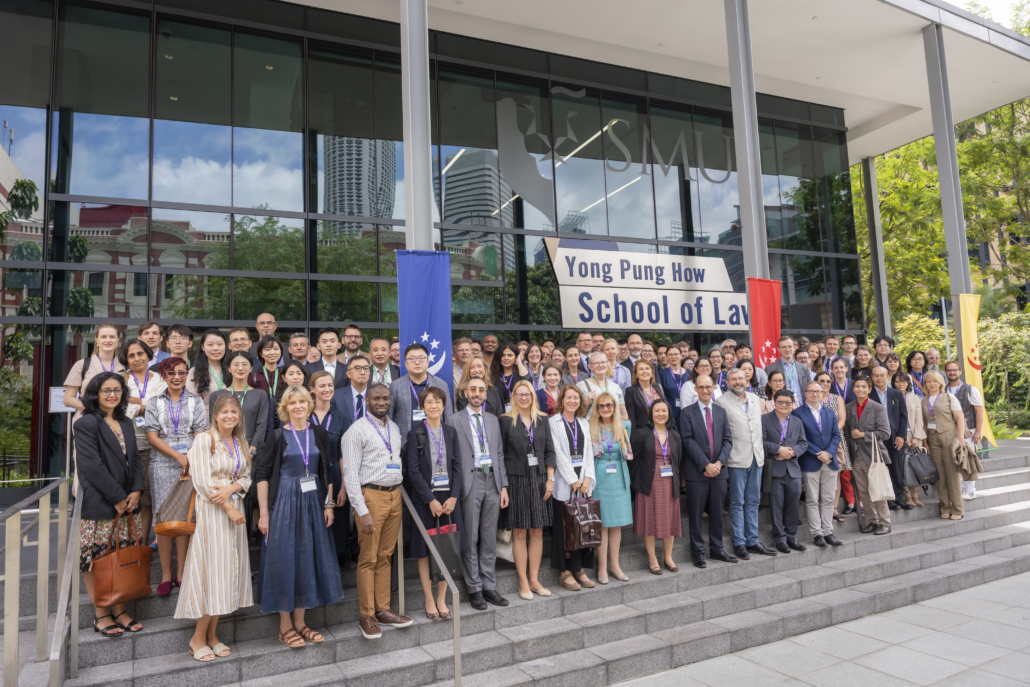
The conference was kicked off by a keynote speech by Justice Philip Jeyaretnam (Singapore International Commercial Court), providing an in-depth analysis of the Court of Appeal’s decision in Anupam Mittal v Westbridge Ventures II [2023] SGCA 1 (discussed in more detail here).
The keynote was followed by a total of 23 panels and four plenary sessions, a selection of which is summarised below by our editors.
The EU Sustainability Directive and Jurisdiction
The Draft for a Corporate Sustainable Due Diligence Directive currently contains no rules on jurisdiction. This creates inconsistencies between the scope of application of the Draft Directive and existing jurisdictional law, both on the EU level and on the domestic level, and can lead to an enforcement gap: EU companies may be able to escape the existing EU jurisdiction; non-EU companies may even not be subject to such jurisdiction. Effectivity requires closing that gap, and we propose ways in which this could be achieved.
(authored by Ralf Michaels and Antonia. Sommerfeld and crossposted at https://eapil.org/)
- The Proposal for a Directive on Corporate Sustainability Due Diligence
The process towards an EU Corporate Sustainability Due Diligence Directive is gaining momentum. The EU Commission published a long awaited Proposal for a Directive on Corporate Sustainability Due Diligence (CSDDD), COM(2022) 71 final, on 23 February 2022; the EU Council adopted its negotiation position on 1 December 2022; and now, the EU Parliament has suggested amendments to this Draft Directive on 1 June 2023. The EU Parliament has thereby backed the compromise textreached by its legal affairs committee on 25 April 2023. This sets off the trilogue between representatives of the Parliament, the Council and the Commission.
News
Webinar on the 1996 Hague Child Protection Convention, 30 June & 1 July
|
This research project examines the legal framework for the cross-border protection of children, focusing on the 1996 Hague Convention on Jurisdiction, Applicable Law, Recognition, Enforcement and Co-operation in Respect of Parental Responsibility and Measures for the Protection of Children (‘the 1996 Hague Convention’).
|
The International Committee of the Singapore International Commercial Court: A Transnational Appeal Mechanism
Written by Yip Man (Professor of Law, Yong Pung How School of Law, Singapore Management University)
To bolster Singapore’s position as an international dispute resolution hub, the Singapore International Commercial Court (International Committee) Bill[1] was introduced in Parliament on 14 October 2024 to establish the International Committee of the Singapore International Commercial Court (the SICC), a standalone body, to hear prescribed civil appeals and related proceedings from prescribed foreign jurisdictions.[2] The Bill was passed by Parliament on 12 November 2024. The Singapore International Commercial Court (International Committee) Act 2024 (the “International Committee Act”) is uncommenced.[3] Read more
Conference: “The Next 25 Years of Private International Law: What Does the World Need?”, 23 June 2025 in Groningen
The Ulrik Huber Institute for Private International Law is delighted to announce a special one-day conference entitled:
The Next 25 Years of Private International Law: What Does the World Need?
This conference marks a significant occasion: the celebration of Professor Mathijs ten Wolde’s 25-year tenure as a professor and director of the Ulrik Huber Institute. In honour of his contribution to the field and his mentorship of generations of legal scholars, the event will bring together former PhD students and distinguished colleagues from across the globe to reflect on the future direction of private international law.
Key Themes Include:
- The role of private international law in a changing world;
- Evolving cross-border legal frameworks (e.g. EU Regulations and HccH Conventions);
- Regional vs. global harmonisation efforts;
- The impact of digitalisation;
- New frontiers in family, commercial, IP, transport and procedural law.
We warmly invite all scholars, practitioners and students with an interest in private international law to join us for this day of dialogue and celebration. More information, including the conference programme, is available via the following link: https://www.rug.nl/rechten/agenda/2025/the-next-25-years