


Views
The Jurisdiction Puzzle: Dyson, Supply Chain Liability and Forum Non Conveniens
Written by Dr Ekaterina Aristova, Leverhulme Early Career Fellow, Bonavero Institute of Human Rights, University of Oxford
On 19 October 2023, the English High Court declined to exercise jurisdiction in Limbu v Dyson Technology Ltd, a case concerning allegations of forced labour and dangerous conditions at Malaysian factories which manufactured Dyson-branded products. The lawsuit commenced by the migrant workers from Nepal and Bangladesh is an example of business and human rights litigation against British multinationals for the damage caused in their overseas operations. Individuals and local communities from foreign jurisdictions secured favourable outcomes and won jurisdictional battles in the English courts over the last years in several notable cases, including Lungowe v Vedanta, Okpabi v Shell and Begum v Maran.
Navigating Global Jurisdiction: The Indian Courts’ Approach to Online IP Infringement
Written by Akanksha Oak, Jindal Global Law School, India
Introduction
The modern commerce landscape faces a significant challenge: the widespread infringement of intellectual property (“IP”) rights due to online interactions that enable instant global access. This issue is exacerbated by cross-border activities, necessitating the application of private international law (“PIL”). However, IP protection remains territorial, guided by the principle of “lex loci protectionis.” This results in complexities when it intersects with PIL. Online IP infringement further convolutes matters due to the internet’s omnipresence and accessibility, making the establishment of jurisdiction a complicated process for legal professionals. A pivotal development in this arena occurred in 2021 when the Delhi High Court rendered a judgement in the case of HK Media Limited and Anr v. Brainlink International Inc.,[1] illuminating India’s legal framework for determining jurisdiction in cases of online IP infringement within the context of cross-border disputes.
The 2019 Hague Judgments Convention Applied by Analogy in the Dutch Supreme Court
Written by Birgit van Houtert, Assistant Professor of Private International Law at Maastricht University
On 1 September 2023, the 2019 Hague Judgments Convention (HJC) entered into force. Currently, this Convention only applies in the relationship between EU-Member States and Ukraine. Uruguay has also ratified the HJC on 1 September 2023 (see status table). The value of the HJC has been criticised by Haimo Schack inter alia, for its limited scope of application. However, the HJC can be valuable even beyond its scope as this blog will illustrate by the ruling of the Dutch Supreme Court on 29 September 2023, ECLI:NL:HR:2023:1265.
News
AAPrIL’s June online seminar: The Law of the Arbitration Agreement – Australasian Perspectives
On Wednesday, 11 June 2025, the Australasian Association of Private International Law (AAPrIL) will hold its latest instalment of its online Seminar Series, as Timothy Lindsay of Lindsay Francis & Mangan presents on ‘The Law of the Arbitration Agreement – Australasian Perspectives’.
The topic:
Contracts with international arbitration agreements can engage a complex interaction of different laws: the governing law of the contract, the law of the seat, and the law of the arbitration agreement itself. Parties to international commercial contracts usually address the first two of these issues, but are often silent as to the law of the arbitration agreement. A light has recently shone on this well-known issue by the United Kingdom’s Arbitration Act 2025, which includes a new default rule for determining the law of the arbitration agreement, and similar changes to the Rules of the Singapore International Arbitration Centre, as well as developing case law in other jurisdictions. How might Australian and New Zealand courts react? Read more
Open Position as a Research Associate at Freiburg University
The Institute for Comparative and Private International Law (Department 3) at Freiburg University (Germany) is seeking a Research Associate (m/f/d), 26%, to begin as soon as possible. Read more
ZEuP – Zeitschrift für Europäisches Privatrecht 2/2025
A new issue of ZEuP – Zeitschrift für Europäisches Privatrecht is now available and includes contributions on EU private law, comparative law and legal history, legal unification, private international law, and individual European private law regimes. The full table of content can be accessed here.
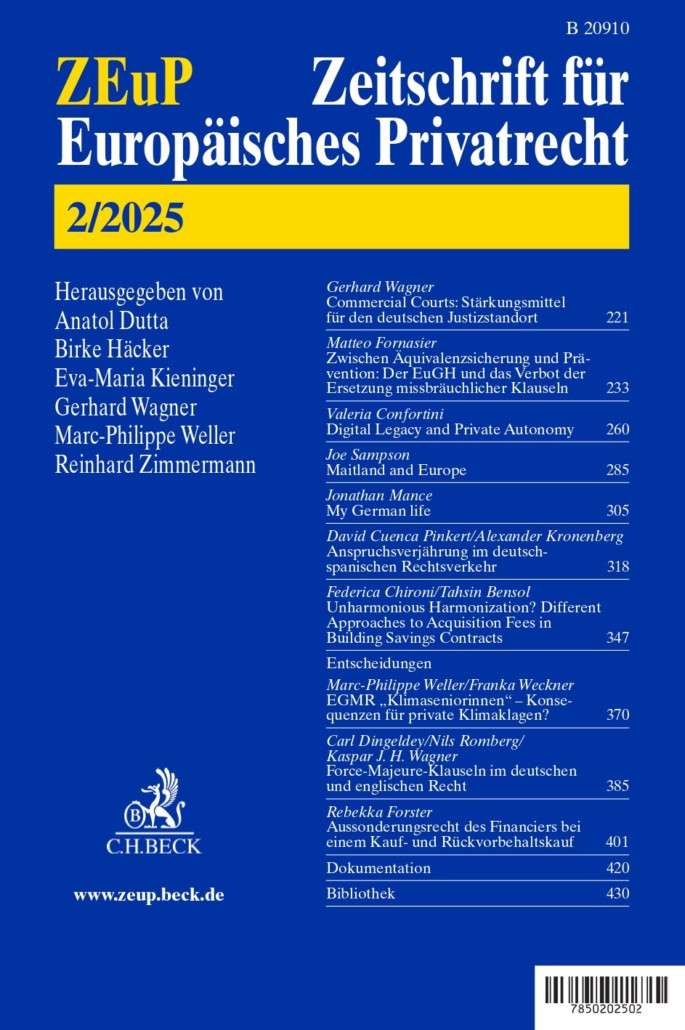
The following contributions might be of particular interest for the readers of this blog:
- Anspruchsverjährung im deutsch-spanischen Rechtsverkehr
David Cuenca Pinkert and Alexander Kronenberg on the statute of limitation in cross-border situations involving Germany and Spain: Against the background of the relevance of the application of foreign law in practice, the article analyses the institute of the statute of limitations under Spanish substantive law and also deals with similarities and differences to German law as well as selective references to conflict of laws and particularities. Due to its practical relevance, the article focuses on the treatment of the limitation period for tortious claims for damages, especially as a result of road traffic accidents. - EGMR „Klimaseniorinnen“ – Konsequenzen für private Klimaklagen?
Marc-Philippe Weller and Franka Weckner comments on the decision by the ECtHR in Klimaseniorinnen and discuss the consequences of this decision for climate litigation brought before civil courts.