


Views
French Cour de cassation rules (again) on duty of domestic courts to apply European rules of conflict on their own motion
 In the Airmeex case (Civ. 1re 27 septembre 2023, n°22-15.146, available here), the French Cour de cassation (première chambre civile) had the opportunity to rule on the duty of domestic courts to apply European rules of conflict on their own motion. The decision is a great opportunity to discuss the French approach to the authority of conflict-of-laws rules.
Postmodernism in Singapore private international law: foreign judgments in the common law
Guest post by Professor Yeo Tiong Min, SC (honoris causa), Yong Pung How Chair Professor of Law, Yong Pung How School of Law, Singapore Management University
Merck Sharp & Dohme Corp (formerly known as Merck & Co, Inc) v Merck KGaA (formerly known as E Merck) [2021] 1 SLR 1102, [2021] SGCA 14 (“Merck”), noted previously, is a landmark case in Singapore private international law, being a decision of a full bench of the Court of Appeal setting out for the first time in Singapore law the limits of transnational issue estoppel. It was also the beginning of the deconstruction of the common law on the legal effect to be given to foreign judgments. Without ruling on the issue, the court was not convinced by the obligation theory as the rationale for the recognition of foreign in personam judgments under the common law, preferring instead to rest the law on the rationales of transnational comity and reciprocal respect among courts of independent jurisdictions. There was no occasion to depart from the traditional rules of recognition of in personam judgments in that case, and the court did not do so. However, the shift in the rationale suggested that changes could be forthcoming. While this sort of underlying movements have generally led to more expansive recognition of foreign judgments (eg, in Canada’s recognition of foreign judgments from courts with real and substantial connection to the underlying dispute), the indications in the case appeared to signal a restrictive direction, with the contemplation of a possible reciprocity requirement as a necessary condition for recognition of a foreign judgment, and a possible defence where the foreign court had made an error of Singapore domestic law.
Amendment of Chinese Civil Procedure Law Concerning Foreign Affairs
by Du Tao*/Xie Keshi
On September 1, 2023, the fifth session of the Standing Committee of the 14th National People’s Congress deliberated and adopted the Decision of the Standing Committee of the National People’s Congress on Amending the Civil Procedure Law of the People’s Republic of China, which will come into force on January 1, 2024. This amendment to the Civil Litigation Law implements the Party Central Committee’s decision and deployment on coordinating domestic rule of law and foreign-related rule of law, strengthening foreign-related rule of law construction, and among the 26 amendments involved, the fourth part of the Special Provisions on Foreign-related civil Procedure is exclusive to 19, which is the first substantive amendment to the foreign-related civil procedure since 1991.
News
HCCH Monthly Update: July 2025
Conventions & Instruments
On 1 July 2025:
- The 2019 Judgments Convention entered into force for the United Kingdom. At present, 33 HCCH Members are either bound by the 2019 Judgments Convention or a Contracting Party for which the Convention has not entered into force yet (Albania, Andorra, and Montenegro). More information is available here.
- The 1996 Child Protection Convention entered into force for El Salvador. The Convention currently has 57 Contracting Parties. More information is available here.
- The 2007 Child Support Convention entered into force for Colombia. At present, 55 States and the European Union are bound by the 2007 Child Support Convention. More information is available here.
- The 2005 Choice of Court Convention entered into force for Bahrain. At present, 37 States and the European Union are bound by the 2005 Choice of Court Convention. More information is available here.
On 5 July 2025, the 1970 Evidence Convention entered into force for the Philippines. The Convention currently has 69 Contracting Parties. More information is available here.
On 24 July 2025, the Republic of Moldova acceded to the 1970 Evidence Convention. The Convention currently has 69 Contracting Parties. More information is available here.
Publications
On 22 July 2025, the Permanent Bureau announced the publication of the fifth editions of the Practical Handbooks on the Operation of the 1965 Service and 1970 Evidence Conventions. Incorporating recent developments, court decisions, and practical examples provided by experts from around the world, as well as updates from the meeting of the Special Commission held in July 2024, the fifth editions of the Handbooks are essential resources for anyone involved in the implementation and operation of the 1965 Service and 1970 Evidence Conventions. More information is available here.
Meetings & Events
On 10 July 2025, the Permanent Bureau of the HCCH and the Asian Business Law Institute co-hosted the webinar “Cross-border Commercial Dispute Resolution – Electronic Service of Documents and Remote Taking of Evidence”. More information is available here.
On 11 July 2025, the first meeting of the Working Group dedicated to the Model Forms for Chapter II of the 1970 Evidence Convention was held online, hosted by the Permanent Bureau. More information is available here.
Other Developments
On 9 July 2025, the premises of the HCCH’s Regional Office for Africa, hosted by the Kingdom of Morocco, were officially opened in Rabat. More information is available here.
On 10 July 2025, the Permanent Bureau of the HCCH announced several developments with regard to the HCCH’s International Child Abduction Database (INCADAT), including the launch of its new notification service. More information is available here.
These monthly updates are published by the Permanent Bureau of the Hague Conference on Private International Law (HCCH), providing an overview of the latest developments. More information and materials are available on the HCCH website.

Changes to the Editorial Board
We are delighted to announce that Wilson Lui will be joining our Editorial Board. Wilson holds degrees from the Universities of Oxford, Cambridge, the Chinese University of Hong Kong and the University of Hong Kong. He currently teaches at the University of Hong Kong while working towards his PhD at the University of Melbourne. His many publications include a comprehensive volume on the conflict of laws in Hong Kong, Hong Kong Private International Law (Hart 2025; together with Anselmo Reyes).
At the same time, we are sad to see Samuel Fulli-Lemaire (Université de Strasbourg), David P. Stewart (Georgetown University), and Marlene Wethmar-Lemmer (University of South Africa) retire from the blog after years of service to this project – we are all the more grateful for their contributions and wish them all the best.
Revue Critique de droit international privé – Issue 2025/2
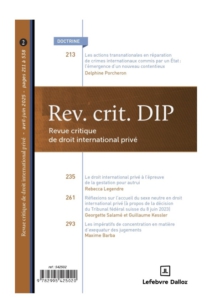 Written by Hadrien Pauchard (assistant researcher and doctoral student at Sciences Po Law School)
The second issue of the Revue Critique de droit international privé of 2025 has just been released. It contains four articles, seven case notes and numerous book reviews. In line with the Revue Critique’s recent policy, the doctrinal part will soon be made available in English on the editor’s website (for registered users and institutions). Read more