


Views
 CC BY SA 3.0 ComQuat Wikimedia Commons
Climate Litigation Before the German Federal Court of Justice – “Too Complex” for Private Law instruments?
Written by Marc-Philippe Weller, Carolina Radke, and Marianna Dänner (all Heidelberg University)
On 2 March 2026, the German Federal Court of Justice (Bundesgerichtshof; “BGH”) held an oral hearing in two proceedings concerning the civil liability of companies regarding climate change. The authors of this blog post attended the hearing as members of the audience.
The German NGO Deutsche Umwelthilfe (DUH) is suing the car manufacturers BMW and Mercedes Benz, requesting a legal order obliging both companies to refrain from placing combustion engine cars on the market beyond 2030. These two proceedings join the club of (strategic) climate change lawsuits in Germany. Crucially, they are the first of their kind based on tort law to reach the German Federal Court of Justice. Accordingly, the hearing was eagerly awaited by many. The decision, which will be rendered on 23 March 2026, will undoubtedly have an impact on future climate lawsuits.
While no issues of international jurisdiction or applicable law arose in the proceedings in question – as all Parties are seated in Germany –, the judgment of the BGH could further motivate foreign parties to bring claims against German companies, thereby giving rise to questions of international jurisdiction and the applicable law (see for more details Weller/Weiner, Corporate Climate Liability in Private International Law, in: Japanese Yearbook of Private International Law, Vol. 26 (2024), 2). In this context, one may refer to the deliberations of the Higher Regional Court (OLG) Hamm in Lliuya against RWE (OLG Hamm, 28. Mai 2025, 5 U 15/17).
Brazilian Ruling Recognises US Name Change
Written by Prof Dr João Costa-Neto, Assistant Professor, Faculty of Law, University of Brasília
and Dr Pedro Pagano Payne, Academic Assistant, Faculty of Law, University of Brasília
In April 2025, the highest chamber (Corte Especial) of the Brazilian Superior Court of Justice (STJ), under Justice Maria Isabel Gallotti as rapporteur, ruled on 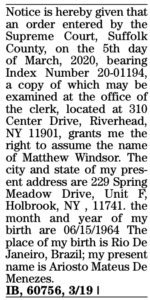 ‘Recognition of a Foreign Judgment’ (HDE) no. 7.091/EX. The case concerned the recognition of a United States ruling changing the last name of a Brazilian national who had acquired US nationality. The Plaintiff sought recognition of (i) his US naturalisation and (ii) a ruling of the Supreme Judicial Court of Suffolk County, Massachusetts, which changed his name from ‘Ariosto Mateus de Menezes’ to ‘Matthew Windsor’. Read more
Anti-Arbitration Injunction in Foreign-Seated Arbitrations: The Delhi High Court’s Controversial Intervention in Engineering Projects (India) Limited v. MSA Global LLC (Oman)
This post is posted on behalf of Arnav Sharma, Jindal Global Law School, Sonipat, India
Introduction
On 25th July 2025, a single judge bench of the Delhi High Court delivered a judgment in Engineering Projects (India) Limited v. MSA Global LLC (Oman) in CS (OS) 243 of 2025[1] that has stirred considerable discourse in international arbitration circles. The fundamental question at issue in the instant case was whether an Indian Court can grant an anti-arbitration injunction to stay proceedings in a foreign-seated arbitration on grounds of the proceedings turning oppressive and vexatious due to procedural impropriety, notwithstanding internationally well-settled principles of minimal judicial intervention, party autonomy, and lex arbitri that govern international commercial arbitration? The Delhi High Court answered in the affirmative, holding that Indian civil courts possess inherent power under Section 9 read with Section 151 of the Code of Civil Procedure, 1908 (“CPC”) to intervene under exceptional circumstances where the arbitral process itself becomes a vehicle of abuse.
News
Revue critique de droit international privé – Issue 2026/1
Written by Hadrien Pauchard (assistant researcher and doctoral student at Sciences Po Law School)
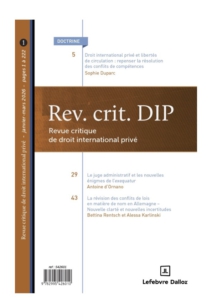 The first issue of the Revue Critique de droit international privé of 2026 has just come off the press and is available online. It contains three articles, nine case notes, and eight book reviews. In line with the Revue Critique’s recent policy, the doctrinal part will soon be made available in English on the editor’s website (for registered users and institutions).
Read more
Foreign Judgment Enforcement: Zimbabwean High Court holds that a Confirmed Mareva Injunction is a Final Judgment
Virtual Workshop (in German) on May 5, 2026: Thomas Pfeiffer on „Anwaltliche Erfolgshonorare im Internationalen Privatrecht“

On Tuesday, May 5, 2026, the Hamburg Max Planck Institute will host its monthly virtual workshop Current Research in Private International Law at 11:00 a.m. – 12:30 p.m. (CEST).
Prof. Dr. Dr. h.c. Thomas Pfeiffer (Universität Heidelberg) will speak, in German, about the topic
“Anwaltliche Erfolgshonorare im Internationalen Privatrecht”
In Deutschland dürfte zum juristischen Allgemeinwissen zählen, dass anwaltliche Erfolgshonorare in den USA (und manchen anderen Rechtsordnungen) zulässig und vielfach sogar üblich sind, in Deutschland hingegen früher generell als unzulässig galten und auch heute noch deutlichen rechtlichen Grenzen unterliegen. Im IPR wird meist angenommen, dass sich diese Grenzen auch international zwingend durchsetzen, soweit es um deutsche Anwälte geht. Die schon früher relevante Frage nach Differenzierungen im Einzelnen hat durch die spürbaren Lockerungen der maßgebenden sachrechtlichen Regeln in jüngerer Zeit nochmals an Bedeutung gewonnen.
The presentation will be followed by open discussion. All are welcome. More information and sign-up here.
If you want to be invited to these events in the future, please write to veranstaltungen@mpipriv.de.