


Views
An anti-suit injunction in support of an arbitration agreement in light of the EU Sanction against Russia
By Poomintr Sooksripaisarnkit, Lecturer in Maritime Law, Australian Maritime College, College of Sciences and Engineering, University of Tasmania
On 24th September 2024, Mimmie Chan J handed down the judgment of the Court of First Instance of the High Court of the Hong Kong Special Administrative Region in Bank A v Bank B [2024] HKCFI 2529. In this case, the Plaintiff (Bank A) with its base of operation in Germany was under the supervision of the German Federal Financial Supervisory Authority (BaFin). Its majority shareholder was the Defendant (Bank B) who held 99.39% shares. In turn, the Defendant was a Russian bank whose majority shareholder was the Government of the Russian Federation.
Compensation, y nada más – CJEU decides against Real Madrid in Case C-633/22
Just two days after losing to LOSC Lille in the Champions League, Real Madrid suffered another defeat against a French opponent. Among the 44 (!) judgments published this Friday by the CJEU – a flurry of decisions reminiscent of the madness that is the current Champions League format –, the Court decided a true ‘clásico’ of European private international law in Case C-633/22 Real Madrid Club de Fútbol.
The Dubai Supreme Court on Indirect Jurisdiction – A Ray of Clarity after a Long Fog of Uncertainty?
I. Introduction
It is widely acknowledged that the recognition and enforcement of foreign judgments depend, first and foremost, on whether the foreign court issuing the judgment was competent to hear the dispute (see Béligh Elbalti, “The Jurisdiction of Foreign Courts and the Enforcement of Their Judgments in Tunisia: A Need for Reconsideration”, 8 Journal of Private International Law 2 (2012) 199). This is often referred to as “indirect jurisdiction,” a term generally attributed to the renowned French scholar Bartin. (For more on the life and work of this influential figure, see Samuel Fulli-Lemaire, “Bartin, Etienne”, in J. Basedow et al. (eds.), Encyclopedia of Private International Law – Vol. I (2017) 151.)
News
Symeonides on Private International Law Bibliography 2025: U.S. and Foreign Sources in English

There is no better Christmas present than a comprehensive and up-to-date compilation of the previous year’s scholarship in private international law, and when that bibliography is prepared by Professor Symeon C. Symeonides (Alex L. Parks Distinguished Professor of Law, Dean Emeritus), it is truly something special.
As usual, and without fail for the past twenty years, Professor Symeonides has produced an exceptionally thorough and reliable survey of the field.
The 2025 compilation (Private International Law Bibliography 2025: U.S. and Foreign Sources in English) lists no fewer than 115 books and 397 journal articles devoted to private international law (or conflict of laws) and related areas.
The Absract reads as follows:
“This is the twentieth annual bibliography of private international law compiled by the undersigned as a service to fellow teachers and students of this subject. It includes 115 books and 397 journal articles that appeared in print in 2025.
The term “private international law” is used here in the broadest and arguably expanded sense. It encompasses not only the three divisions of the law of conflict of laws (adjudicatory jurisdiction, choice of law, and recognition of sister-state and foreign judgments), but also prescriptive jurisdiction, extraterritoriality, federal-state conflicts, as well as certain aspects of arbitration, the law of foreign relations, and international human rights.
AI Note: This compilation is the product of human labor-mine. I have visually verified all entries, although I have used electronic search engines to locate them. I have not used generative artificial intelligence (AI).
Access to the bibliography is available on Prof. Symeonides’ SSRN page here.
Readers may also wish to consult his insightful essay, Reflections from Fifty Years in the Conflicts Vineyard, in which he offers a concise yet profound and wide-ranging reflection on half a century of scholarship in the field, available here
Many thanks to Professor Symeonides for this invaluable contribution, which continues to be an essential resource for scholars and practitioners alike.
Third Issue of the Journal of Private International Law for 2025
The third issue of the Journal of Private International Law for 2025 was just published. It contains the following articles:
Elena Rodríguez-Pineau, “Cross-border insolvency avoidance actions in the EU: a necessary reflection”
After 25 years, the European Union can boast of having harmonised EU cross-border insolvencies in a Regulation (recasted once). The EU is presently addressing substantive harmonisation of insolvency law (via Directives) within the Union with a focus on restructuring and stakeholders’ interests. Although such legislation should apply without prejudice to the EU Insolvency Regulation, this approach is somewhat difficult to articulate since that Regulation was drafted with a focus on liquidation and maximising creditors’ protection. This tension is particularly acute in relation to transaction avoidance actions as the Regulation sets a double avoidance requirement while the proposed Directive fosters a more pro-avoidance position. This paper suggests several options that the EU legislature may follow to revise the Regulation’s transaction avoidance rule. It is contended that such revision needs to bear in mind how the issue is being addressed outside the EU in order to consider the ad extra regulation of said actions.
Benjamin Hayward, “So many thoughts about Tesseract: a private international law perspective”
On 7 August 2024, the High Court of Australia handed down its decision in Tesseract International Pty Ltd v Pascale Construction Pty Ltd. In doing so, it held (contrary to existing practitioner consensus) that certain Australian proportionate liability laws apply in Australian domestic commercial arbitration. Existing analyses assess this case from an arbitration perspective. As this article shows, however, the case is really about private international law. This being so, this article critiques the High Court’s reasoning and also Tesseract’s existing commentaries from a private international law perspective. As arbitration is a dispute resolution process grounded in law, these critiques are offered in the service of helping Australian arbitration better secure its trade facilitation purposes.
Stefano Dominelli, “Torts in outer space: conflict of laws perspectives”
Human activities in outer space impose a reflection on the structural inadequacy of current connecting factors, such as the lex loci damni, which may not properly operate when all events are localised in areas (rather than a territory) not subject to the sovereignty of a State. By integrating space law principles and interests in conflict of law approaches, the aim of this work is to propose connecting factors which may apply in cases of satellite collisions or for torts in sub-orbital flights. Different constellations are created, each of which requires a specific assessment of the relevant interest which should mould specific solutions.
Thu Thuy Nguyen, “Governance of low-skilled labour migration: rethinking the potential of private international law for the promotion of decent work for migrant workers”
The proliferation of temporary labour migration programmes has enabled low-skilled workers from developing countries to seek employment in industrialised countries. However, due to inadequate regulatory frameworks at the national and international levels, these programmes fail to ensure decent work for the low-skilled migrant workers. By utilising the low-skilled labour migration between Vietnam and Japan as a case study, this article highlights the failure of the current regulatory framework in adequately governing the intermediaries and employers throughout the migration process. This article also presents the private international law challenges faced by migrant workers when initiating transnational civil litigation against abusive intermediaries and employers before Vietnamese or Japanese courts. To combat the exploitative practices of the migration industry and promote decent work, besides reforming ex-ante regulations, this article argues that the international community should reconsider the potential of private international law. This paper advocates that private international law could be better crafted to enable different stakeholders to engage in social dialogue about, and to seek the realisation of, the value of decent work. Based on this argument, this paper proposes solutions to remedy Vietnamese and Japanese private international law rules to facilitate the realisation of the value of decent work for low-skilled migrant workers under temporary migration programmes.
Aygun Mammadzada, “Beyond the model law: the case for a Commonwealth-wide adoption of the Hague Judgments Convention”
The 2019 Hague Judgments Convention (Judgments Convention) marks a pivotal development in private international law, offering a uniform framework for cross-border enforcement that enhances predictability and reduces legal fragmentation. By promoting legal certainty, it supports international trade and commercial relations and aligns with the broader push for greater judicial cooperation in the interconnected world. This article argues that it is in the clear interests of Commonwealth states to ratify the Convention. The Convention offers an avenue to strengthen the “Commonwealth advantage” by leveraging shared legal traditions and institutional ties to facilitate cooperation which the Commonwealth Model Law is unlikely to do on its own. Set against the backdrop of Brexit and the UK’s search for new legal alignments, the article further proposes that the UK’s ratification of the Convention can serve as a source of proactive inspiration for other Commonwealth states. As the key influencer and first Commonwealth state to ratify the Convention (apart from Malta and Cyprus, which acceded through their EU membership), the UK is uniquely positioned to promote wider adoption and reinforce both legal integration and commercial certainty. Such cooperative efforts can further consolidate the Commonwealth’s role in shaping the evolution of global private international law.
Bianca Scraback, “The international element requirement for consumer contract jurisdiction in the Brussels Ia Regulation”
Whether or not local jurisdiction in consumer contract cases is regulated in the EU by the Brussels Ia Regulation or domestic rules on jurisdiction hinges on the existence of a relevant international element. Even determining the relevance of international elements using a rules-based approach and despite two decisions of the CJEU, the paper argues that the requirement leads to unpredictability that is not warranted in light of the interests involved. It therefore proposes a legislative change limiting the determination of local jurisdiction to consumer contract cases where the parties are not both domiciled in the same Member State. If there are more than two parties involved, the paper proposes to include a rule modelled after Article 8(1) of the Brussels Ia Regulation.
Bálint Kovács, “Europeanisation of private international law: Balancing national traditions and EU rules”
The reviewed monograph provides a thorough examination of Hungarian private international law, set against the backdrop of EU private international law developments, and their application by the Hungarian judiciary. The book begins with a historical overview of Hungarian private international law, culminating in the 2017 recodification under the Act on Private International Law (APIL). It systematically explores sources of private international law, including national legislation, EU regulations, and international treaties. Key issues such as choice-of-law principles, jurisdiction, recognition and enforcement of judgments, and international civil procedure are dissected with comprehensive reference to Hungarian jurisprudence. The book also contains the English translation of the Hungarian APIL, as well as a complete list of bilateral and multilateral international agreements that include private international law provisions to which Hungary is a party. Its clarity, analytical depth, and practical insights make it a significant contribution, and an invaluable resource for both scholars and practitioners.
RabelsZ 89 (2025): Issue 4
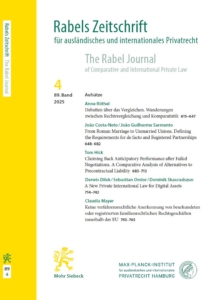
The latest issue of RabelsZ has just been released. The table of contents is available here. All content is Open Access: CC BY 4.0. More recent articles and book reviews are available Online First.
ESSAYS
Anne Röthel, Debatten über das Vergleichen. Wanderungen zwischen Rechtsvergleichung und Komparatistik [Debates about Comparison. Journeys between Comparative Law and Comparative Literature], pp 615–647, https://doi.org/10.1628/rabelsZ-2025-0060
Many academic fields look to comparative methods in pursuit of insight, with scholars debating how to proceed and what they hope to learn from the comparison. This article explores what comparative law stands to gain from interdisciplinary dialog with other fields of comparative inquiry. By way of example, it evaluates the potential gain from several journeys into the field of comparative literature. At first, these journeys back and forth between disciplines reveal a number of parallels: a striking resemblance between each field’s narrative of its own becoming; both fields’ exposure to fundamental criticisms; both fields ethicizing along similar trajectories; each one’s encounter with related dilemmas. At the same time, these journeys into comparative literature reveal implicit hierarchies and orientations in comparative law. But these cursory journeys through the history of comparative literature also counsel that comparative law would do well to avoid letting its own debates over the direction of the field veer into polarization and name-calling, into a kind of struggle that is mostly unwinnable and unproductive.
João Costa-Neto, João Guilherme Sarmento, From Roman Marriage to Unmarried Unions.
Defining the Requirements for de facto and Registered Partnerships, pp. 648–682, https://doi.org/10.1628/rabelsZ-2025-0059
This study examines the historical and comparative evolution of family law, tracing the transition from Roman marriage to contemporary partnerships. The article explores how Roman law conceptualised marriage as a social institution based on affectio maritalis, detailing its transformation through Christian doctrine into an indissoluble sacrament and its subsequent adaptation within modern legal systems. By analysing legal frameworks in Germany, Italy, France, England, and Brazil, the inquiry highlights the varying degrees of recognition granted to unmarried unions, from informal cohabitation to registered partnerships. The comparative analysis reveals the dynamic interplay between tradition, societal norms, and legal evolution, underscoring how distinct legal systems balance autonomy and protection in family law. This work contributes to the broader discourse on the harmonisation of family law and the impact of evolving societal values on legal institutions.
Tom Hick, Claiming Back Anticipatory Performance after Failed Negotiations.
A Comparative Analysis of Alternatives to Precontractual Liability, pp. 683–713, https://doi.org/10.1628/rabelsZ-2025-0049
As a matter of principle, breaking-off negotiations or refusing a contract offer are lawful actions. For based on freedom of contract, each individual is free to contract, free to choose one’s counterpart and the content of the contract, and equally free not to contract. Only exceptionally can a party be held liable for breaking-off negotiations based on wrongful conduct. Hence, it appears worthwhile to look for alternative approaches to recover fruitlessly incurred costs in the context of negotiations that failed independently of any wrongful conduct. Undue payment offers precisely this possibility. Therefore, the present contribution offers an exploratory look at the chances of success of an action for undue payment to recover costs incurred in the context of failed contract negotiations in Belgium, France, the Netherlands, and Germany. The paper finds that in those cases where fruitlessly incurred costs technically qualify as a payment in the respective national legal system, the prospects for the party seeking to recover these costs are surprisingly positive.
Derwis Dilek, Sebastian Omlor, Dominik Skauradszun, A New Private International Law for Digital Assets, pp. 714–742, https://doi.org/10.1628/rabelsZ-2025-0053
The increasing popularity of digital assets presents significant challenges for private international law, as fundamental conflict-of-laws rules concerning proprietary issues are often absent. This article outlines a possible approach to a technologically neutral and function-based conflict-of-laws framework. Taking existing instruments into account, it examines in particular the role of party autonomy through a choice-of-law rule, as well as alternative connecting factors based on structural, functional, or factual links between digital assets and legal systems. Building on this, the article proposes a conflict-of-laws framework for determining the law applicable to proprietary issues. This framework is designed to be applicable to various types of digital assets, including those based on decentralized networks. The proposed draft rule combines an express choice-of-law option with a multi-layered system of objective connecting factors and includes supplementary mechanisms for cases where the applicable law lacks substantive provisions.
Claudia Mayer, Keine verfahrensrechtliche Anerkennung von beurkundeten oder registrierten familienrechtlichen Rechtsgeschäften innerhalb der EU, [No Procedural Recognition of Acts Affecting Personal Status Based on Certificates Issued by Public Agencies within the EU], pp. 743–765, https://doi.org/10.1628/rabelsZ-2025-0058
In EU law, there is a discernible tendency on the part of the EU legislature to subject legal acts to procedural recognition – including as to their substance – based on certificates of recording or other kinds of documents issued by public agencies. It has therefore already been argued in the literature that a change of method has taken place whereby the conflict-of-laws as well as substantive review in the receiving state has been replaced by a recognition system. But this position must be rejected; generally, such documents issued by public agencies, from a procedural point of view, only have formal probative value. If the validity of the underlying legal act is ultimately uncertain from the point of view of the originating state and if no (procedural) position can be established based on the state’s participation, the substance of the act may and must be re-examined by the receiving state in accordance with the law designated by a conflict of laws examination there, even at the risk of creating a limping legal relationship. The ECJ’s case law on Art. 21 of the TFEU does not alter this principle. To further prevent limping legal relationships at the European level, what is needed instead is better standardization of the conflict of laws in EU secondary law.
BOOK REVIEWS
This issue also contains several reviews of literature in the fields of comparative private and private international law and on related topics (pp. 766–820).