


Views
Beyond Domicile: The BHP Litigation and the Functional Interconnection of Public and Private International Law
from Marcel Vitor de Magalhães e Guerra
On 14 November 2025, the English High Court handed down its Stage 1 judgment in Município de Mariana and others v. BHP Group Plc and BHP Group Limited [2025] EWHC 3001 (TCC), finding the defendants liable — under Brazilian law — for the 2015 collapse of the Fundão tailings dam: over 600,000 claimants, an estimated £36 billion, the largest group litigation in English legal history. This post argues that Mariana exposes a functional interconnection between public and private international law at the stage of determining jurisdiction itself: although doctrinally distinct, the court’s application of a private international law rule required engaging questions of corporate organisation, adjudicatory legitimacy, and transnational responsibility that traditionally belong to public international law. Read more
Conflicts of jurisdiction in Senegal: lesson from the Senegalese Supreme Court on Lis Pendens and the Exequatur of foreign judgments

This post was kindly prepared by Véronique Carole Ngono, Professor of Private Law (agrégée), University of Douala, Cameroon.
I. Introduction
The recognition and enforcement of foreign judgments in French-speaking sub-Saharan Africa has not been the subject of many studies. Although a few such studies do exist, this is in contrast to the field of conflict of laws and personal status law in particular. Consequently, the two rulings issued by the Supreme Court of Senegal on August 12, 2020, in connected disputes went practically unnoticed, even though they offer valuable insights into determining the jurisdiction of Senegalese courts in international disputes and the enforcement of foreign judgments.
The purpose of this note is therefore to shed light on the law and practice of conflict jurisdictions in Senegal.
Adoption in the proposal for a European Parenthood Regulation
This post was written by Aukje Mens, Jurist at INEA, the Dutch expertise centre on intercountry adoption. She wrote in her own name.
Recently, an article I wrote about adoption in the proposal for a European Parenthood Regulation was published in the Dutch Journal of Family and Youth Law (Tijdschrift voor Familie- en Jeugdrecht, 2026/3). This article examines the uncertainties and gaps in the regulation of adoption and argues for an autonomous European Adoption Regulation to adequately govern international adoptions. Below is a summary in English of the article.
News
Out Now: Calliess & Renner, Rome Regulations: Commentary (4th Edition)
【Out Now】Silberman’s Hague Academy General Course: The Counter-Revolution in U.S. Private International Law: From Standards to Rules?
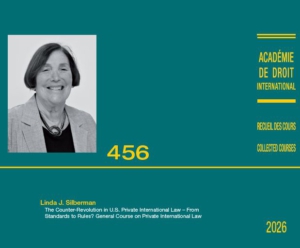
For anyone who begins studying private international law – particularly from a civil law perspective – one of the first concepts encountered, after Savigny’s ‘Copernican Revolution’, is the American ‘Choice-of-Law Revolution’. Since the late 1950s, American courts and scholars have progressively abandoned the rigid territorial methodology embodied in the First Restatement of Conflict of Laws in favour of more flexible approaches based on standards and policy-oriented analyses. The pioneering contributions of Brainerd Currie, David Cavers, Robert Leflar, and William Baxter, among others, fundamentally reshaped American conflicts law and made the United States a laboratory of modern choice-of-law theory.
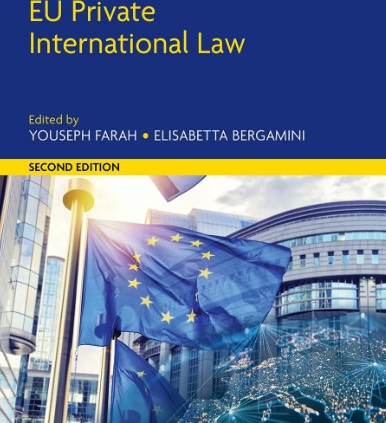
New Publication: Second Edition of the Elgar’s Research Handbook on EU PIL
While much of Europe slows down for August, there is still some fresh academic news to share: the publication of the second edition of the *Research Handbook on EU Private International Law*, edited by Youseph Farah, of the University of East Anglia and Elisabetta Bergamini, of the University of Udine, and published by Edward Elgar Publishing as part of the *Research Handbooks in European Law* series.
Thoroughly revised and updated, the new edition brings together civil-law and common-law perspectives to examine some of the most important questions and continuing challenges in EU private international law. Alongside the traditional fields of jurisdiction, contractual and non-contractual obligations, the Handbook addresses significant developments in family law, parental responsibility and cross-border succession.