Views
Recognition of Italian Extrajudicial Divorces in Tunisia — Between Methodological Uncertainty and the Need to Preserve Continuity of Personal Status Across Borders

I. Introduction
Recent years have witnessed a movement towards the dejudicialization of consensual divorce and the proliferation of extrajudicial divorce mechanisms notably in Europe. While this mode of “private divorce” is not, as such, a new phenomenon and extrajudicial divorce has been practised in different forms across various parts of the world (see e.g., Béligh Elbalti, “Le divorce au Japon et son accueil en Tunisie” (2026) 73 Osaka University Law Review 6), it has attracted increasing attention in recent years, given the growing number of European jurisdictions that have introduced mechanisms allowing spouses to dissolve their marriage outside the courts, as well as the complex questions that such divorces raise in terms of their recognition and circulation across borders (for a comparative view in Europe, see e.g., CJEU, Directorate for Research and Documentation, “Extrajudicial Divorce: Rules, Procedures and Cross-Border Recognition in Member States” (Research Note, February 2022) 3; Pablo Quinzá Redondo, “The Recognition of Non-Judicial Divorces in Europe” in Konrad Duden and Denise Wiedemann (eds), Changing Families, Changing Family Law in Europe (Intersentia, 2024) 23). This is particularly true of the Italian form of extrajudicial divorce, introduced by Decree-Law No. 132/2014, converted into Law No. 162/2014, which allows spouses meeting specified conditions to obtain a divorce through an agreement before the civil registrar, rather than through a court.
Private International Law and European Society

from Marlene Tiede, a Research Fellow and PhD Candidate at the Max Planck Institute for Comparative Public Law and International Law.
Can one speak of a European society without speaking about private relations? Recent scholarship on European society has largely approached the concept through the lens of public law. Yet societies are constituted at least as much by the horizontal relations between individuals and groups as by public institutions. In the absence of a comprehensive European private law, this blogpost turns to EU private international law (PIL), the principal framework for coordinating interactions between the diverse private laws of the Member States and structuring cross-border private life within the Union. I will argue that EU PIL brings into view the importance of coordination frameworks for organising a mode of integration based not on unification, but on interdependence.
The New Zealand Supreme Court’s judgment in Kea Investments Ltd v Wikeley on anti-enforcement relief
In Kea Investments Ltd v Wikeley [2026] NZSC 97, the New Zealand Supreme Court recently delivered its reasons for reinstating world-wide anti-enforcement orders in relation to a fraudulently obtained default judgment from Kentucky. The judgment, given by Kós J, contains a useful analysis of the principles on anti-suit and anti-enforcement injunctions and offers guidance on the interrelationship between fraud and comity.
The background to the case is set out in previous posts (here, here and here). In summary, Kea Investments Ltd (Kea), a British Virgin Islands company, alleged that the default judgment obtained by Wikeley Family Trustee Ltd (WFTL), a New Zealand company, was based on fabricated claims intended to defraud Kea. The New Zealand High Court found that the defendants had perpetrated a tortious conspiracy. The Court of Appeal upheld the findings of fraud but allowed an appeal against the grant of the injunction, concluding that an injunction could only be granted as a step of last resort, which required Kea to pursue its right of appeal against the Kentucky judgment.
It was not in issue before the Supreme Court that the claim in the Kentucky court formed part of a conspiracy to defraud Kea (at [102]). It was also not in issue that New Zealand was the proper jurisdiction to deal with the claim of fraud (at [102]). In these circumstances, the Court found that comity did not stand in the way of anti-enforcement relief.
News
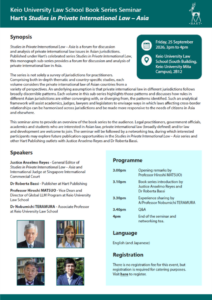
Keio University Law School Book Series Seminar: Hart’s Studies in Private International Law – Asia (25 September 2026, 3–4PM)
 Keio University Law School in Tokyo (KLS) will be hosting a seminar entitled “Keio University Law School Book Series Seminar: Hart’s Studies in Private International Law – Asia” at Room 2B12 in South Building, Keio University Mita Campus, on Friday, 25 September 2026, from 3 to 4pm.
As the readers of ConflictofLaws.net are well aware, Studies in Private International Law – Asia is a forum for discussion and analysis of private international law issues in Asian jurisdictions, which is published under Hart’s celebrated series Studies in Private International Law. This seminar aims to provide an overview of the book series to the audience. Legal practitioners, government officials, academics and students who are interested in Asian law, private international law (broadly defined) and/or law and development are welcome to join.
 The seminar will be followed by a networking tea, during which interested participants may explore future publication opportunities in the Studies in Private International Law – Asia series and other Hart Publishing outlets with Justice Anselmo Reyes (General Editor of Studies in Private International Law – Asia and International Judge at Singapore International Commercial Court) and Dr Roberta Bassi (Publisher at Hart Publishing).
There is no registration fee for this event, but registration is required for catering purposes. Visit here to register.
Programme
| 3.00pm | Opening remarks by Professor Hiroshi MATSUO (Vice Dean and Director of Global LLM Program at Keio University Law School) |
| 3.10pm | Book series introduction by Justice Anselmo Reyes and
Dr Roberta Bassi |
| 3.30pm | Experience sharing by Dr Nobumichi TERAMURA (Associate Professor at Keio University Law School) |
| 3.40pm | Q&A |
| 4pm | End of the seminar and networking tea |
Private International Law Festival 24-25 September 2026: Registration Open
 Breakdown of the Rules-Based International Order
– What Role for Private International Law?
Following the first Private International Law Festival in 2022 (conference report), on 24-25 September 2026, the University of Edinburgh Law School and the Max Planck Institute for Comparative and International Private Law, generously supported by the Lindemann Foundation, will cohost the second Private International Law Festival at Edinburgh University’s splendid Playfair Library in Edinburgh. Two days of conflict of laws, plus a Ceilidh!
The program is here, a flyer is here. As to the Ceilidh, no prior expertise is expected, but you can take a look here.
Registration is open until August 28, please register here.
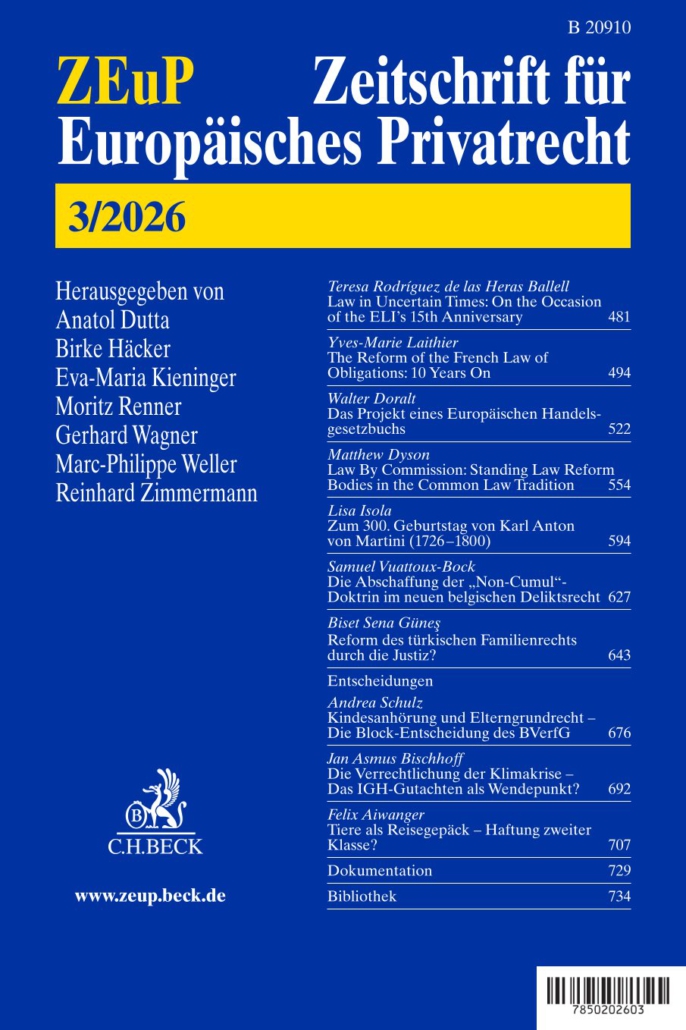
ZEuP – Zeitschrift für Europäisches Privatrecht 3/2026
A new issue of ZEuP – Zeitschrift für Europäisches Privatrecht is now available and includes contributions on EU private law, comparative law and legal history, legal unification, private international law, and individual European private law regimes. The full table of content can be accessed here: https://rsw.beck.de/zeitschriften/zeup.