


Views
CJEU on the place of the damage under Article 7(2) of Brussels Ia as regards violation of personality rights of a legal person
First personal impressions presented by Edina Márton, LLM, PhD (Saarbruecken)
For jurisdictional purposes, the localisation of cross-border violations of personality rights under European instruments, such as Regulation (EU) No 1215/2012 (Brussels Ia), has attracted the attention of a considerable number of scholars and often led to different legal solutions in the national judicial practice. At EU level, besides Shevill (C-68/93; ECLI:EU:C:1995:61) as well as eDate and Martinez (C-509/09 and C-161/20; ECLI:EU:C:2011:685), since 17 October 2017, a third judgment in case Bolagsupplysningen (C-194/16; ECLI:EU:C:2017:766) has given further clarification in this area. In the recently delivered judgment, the ECJ specified one of the two limbs of the connecting factor “where the harmful event occurred or may occur” under Article 7(2) of Brussels Ia, namely the place of the alleged damage. Read more
Is “la réserve héréditaire” part of French international public policy ?
Through two decisions (Civ. 1ère, 27 sept. 2017, n° 16-17198 et 16-13151) both issued on September 27th, The French Cour de cassation finally gave an answer to one of the most discussed question of French Succession law: Is la réserve héréditaire part of French international public policy?
The circumstances of both cases are very similar. Two French composers living in California, where they had most of their assets, got married respectively in 1984 and 1990. They put their assets in a trust and designated their wives as beneficiaries. In both cases, the settlers did not designate the children they had from previous relationships as beneficiaries of the trust. After the death of their fathers, the latter turned to French courts in order to obtain part of the inheritance. They argued that the Californian law applicable to the succession should be declared contrary to French international public policy for not including a réserve héréditaire for certain heirs.
According to Article 912 §1 of the French Civil Code, la réserve hérédiataire or the reserved portion « is that part of the assets and rights of the succession whose devolution, free of charge, the law assures to certain heirs, called forced heirs, if they are called to the succession and if they accept it ». In other words, under French succession law, a person cannot freely dispose of all of his or her assets. French law set boundaries by putting aside a reserved portion of the deceased’s property. However, he or she can freely dispose of the disposable portion (quotité disponible) which is defined as « that part of the assets and rights of the succession that is not reserved by law and of which the deceased can freely dispose by liberalities » (Article 912 § 2).
Whereas the Court of Cassation ruled that the reserved portion is mandatory in internal matters, the question of its imperative nature in international cases was yet unclear. Authors disagree. While some consider that the réserve héréditaire cannot be considered as such as part of French ordre public international, others consider that due to the fact that it is an expression of solidarity among family members as well as a guarantee of equality between heirs, it has to be part of French international public policy.
The controversy was aggravated in 2011 when the Conseil Constitutionnel condemned le droit de prélèvement for amounting to a discrimination based on nationality. The droit de prélèvement is another specific French mechanism. It allows French heirs that have been deprived of the reserved portion from the assets located abroad to deduct the equivalent of such reserved portion from the part of the deceased’s assets that are located in France. As a consequence of this decision, the reserved portion remained the only protection for heirs from the risk of disinheritance.
However, in both decisions, the Court found that the mere fact that the foreign law does not provide for a mechanism such as the reserved portion does not amount to a violation of French international public policy. The foreign law could nevertheless be disregarded, but only if its concrete application in a specific case leads to a situation that would be incompatible with French essential principles.
Giving the particulars circumstances of the cases, the Court found that in both cases the application of Californian law was not contrary to French public policy. First, the Court outlined that the deceased had lived in California for over thirty years and that most of their assets were located there. As a consequence, both situations were not strongly connected to the French forum. Then, the Court pointed out that the children living in France were adults and that their economic situation will not suffer from their being deprived of the succession.
These observations lead the Court to consider that, in these situations, the Californian law is not contrary to French international public policy even though it does not provide for a reserved portion. The Court emphasis on the particular circumstances of the case, namely that the situation was mainly located in California and that none of the claimants was in need or economically instable, indicates that these circumstances weighed strongly on the outcome. It does not exclude that, in different circumstances, a foreign law that would not provide for a reserved portion could be dismissed as contrary to public policy.
Prior to the coming into force of the Succession Regulation, the solution appears in accordance with its public policy provision. Stating that courts could only refuse to apply provisions that are manifestly incompatible with the forum’s international public policy, Article 35 allows that foreign laws be disregarded when their application could lead to serious consequences. It does not appear to be the case in the present situations.
The new discussed question is now: In which case the application of a foreign law not including a reserved portion could lead to a situation incompatible with French essential principles ?
Freedom of establishment after Polbud: Free transfer of the registered office
Bastian Brunk, research assistant and doctoral student at the Institute for Comparative and Private International Law at the University of Freiburg (Germany), has provided us with the following first thoughts on the CJEU’s groundbreaking Polbud judgment.
The Judgment
In its judgment in Polbud (C-106/16), the CJEU again took the work out of the EU legislature’s hands while further developing the freedom of establishment provided for in Articles 49 and 54 TFEU. The case was heard following a request for a preliminary ruling under Article 267 TFEU by the Sad Najwyzszy (Supreme Court of Poland). In short, the CJEU had to decide on the following questions:
(1) Are Articles 49 and 54 TFEU applicable to a transfer of the registered office of a company incorporated under the law of one Member State to the territory of another Member State with the purpose of converting its legal form, when the company has no intention to change the location of its real head office or to conduct real economic activity in the latter Member State?
(2) Is a national legislation that makes the removal of a company from the commercial register and, accordingly, the out-migration of that company conditional upon its liquidation compatible with the freedom of establishment?
Answering these questions, the CJEU made Polbud, the company at stake, a liberal gift and strengthened the mobility of companies within the European Single Market. First, the CJEU stated that the freedom of establishment applies to the transfer of the registered office of a company from one Member State to another even if no real business is intended to be conducted in the latter Member State. Secondly, the CJEU ruled out national legislation providing for the mandatory liquidation of a company if the company requests the removal from the initial commercial register in cases of outward migration.
The facts
In September 2011, the shareholders of Polbud, a limited liablity company established under Polish law, decided to transfer the company’s registered office from Poland to Luxembourg. The resolution made no reference to a simultaneous transfer of either the real head office or the place of real economic activity. Based on that resolution, the registry court in Poland recorded the opening of the liquidation procedure. In May 2013, following a resolution adopted by a shareholder meeting in Luxembourg, the registered office of Polbud was transferred to Luxembourg. Polbud was renamed to Consoil Geotechnik and its legal form was changed to the Société à responsabilité limitée (S. à r. l.), the Luxembourgish private limited liability company. Subsequently, Polbud lodged an application with the Polish registry court for its removal from the commercial register. This application was refused to be registered because, as the registry court stated, Polbud failed to provide evidence of the successful execution of a liquidation procedure. Polbud appealed against this decision, arguing that no liquidation was needed because the company continued to exist as a legal person incorporated under Luxembourgish law.
The precedents
Articles 49 and 54 TFEU provide for the freedom of establishment. According to the CJEU case-law, the concept of “establishment” within the meaning of these Articles is a very broad one, allowing a Union national to participate, on a stable and continuous basis, in the economic life of another Member State and to profit therefrom (CJEU in Gebhard, C-55/94, para. 25 and Almelo, C-470/04, para. 26). It involves the actual pursuit of an economic activity through a fixed establishment in another Member State for an indefinite period (CJEU in Factortame and Others, C-221/89, para. 20 and Commission v. United Kingdom, C-246/89, para. 21). In order to claim freedom of establishment, it is generally necessary to have secured a permanent presence in the host Member State (CJEU in Centro di Musicologia Walter Stauffer, C-386/04, para. 19 and Schmelz, C-97/09, para. 38). This case law can, generally speaking, be translated as “no freedom of establishment without establishment”.
On the other hand, the CJEU generously extended the application of Articles 49 and 54 TFEU to letterbox companies without “fixed establishment” and/or “permanent presence” in their home Member State. In Centros (C-212/97) the Court ruled that EU law is applied to the set-up of subsidiaries, branches and agencies in other Member States and, in that regard, it is immaterial that the company was formed in one Member State only for the purpose of establishing itself in another Member State, where its main, or indeed entire, business is to be conducted (Centros, para 17).
The CJEU then used its 2009 Cartesio judgment (C-210/06) as an opportunity to, obiter dictu, set guidelines for cross-border transfers of seat. It stated that, on the one hand, a Member state has the power to define both the connecting factor required of a company if it is to be regarded as incorporated under the law of that Member State and, as such, capable of enjoying the right of establishment, and that required if the company is to be able subsequently to maintain that status (thus treating companies as legal creatures of their country of origin). On the other hand, freedom of establishment comprises the right of a company to move from one Member State to another. If domestic legislation of the Member State of origin requires the liquidation of the company, thereby preventing it from converting itself into a legal person governed by the law of the target Member State, such a measure cannot be justified under the rules on freedom of establishment (Cartesio, paras. 110 ff.).
This jurisdiction was complemented by the CJEU in Vale (C-378/10) where the Court clarified the legal position of the Member State of destination. If a Member State allows for the conversion of companies governed by national law, it must also grant the same possibility to foreign EU companies (Vale, para. 46). In the absence of relevant EU-law, the target Member State may set up procedural rules to cover the cross-border conversion but must ensure that they are not less favourable than those governing similar domestic situations (principle of equivalence) and that they do not render impossible in practice or excessively difficult the exercise of rights conferred by the European Union legal order (principle of effectiveness) (Vale, para. 48).
The Opinion of AG Kokott
In her Opinion of 4 May 2017 (see here), AG Kokott took up a distinct position emphasizing the need for actual establishment for the application of Articles 49 and 54. This criterion is sufficiently met, as AG Kokott states, if, at least, the company intends to set up an actual establishment in the sense of conducting at least a nominal economic activity in the target Member State (Opinion, para 36). The AG underlines her position citing the above mentioned CJEU case-law in Factortame and Others (C-221/89), Commission v. United Kingdom (C-246/89), Centro di Musicologia Walter Stauffer (C-386/04) and Schmelz (C-97/09). She concludes that the freedom of establishment “gives economic operators in the European Union the right to choose the location of their economic activity, it does not give them the right to choose the law applicable to them” (Opinion, para. 38).
Implications of the Polbud judgment for the internal market
The CJEU now takes a different point of view: Once formed in accordance with the legislation of a Member State, companies enjoy the full range of that freedom. Nothing new, so far, as Geert van Calster suggests in his comment (see here). But what makes Polbud (r)evolutionary?
First, the CJEU creates legal certainty in an area that is particularly important for the functioning of the European Single Market. In its Cartesio judgment, the Court allowed for the cross-border conversion of EU companies in general but did little to shape the relationship between the involved Member States. Therefore, it was widely thought, that, just like AG Kokott propounds, the conversion of a company from one Member State to another required a genuine economic link with the State of destination. In Polbud, the CJEU clarifies that the regulatory power of a Member State ends when a company converts itself into a company governed by the law of another Member state. It is for the latter State to determine the legal and/or economic conditions that have to be satisfied by the company in order to bring the conversion into effect (paras 33 ff.). Under Articles 49 and 54 TFEU, the State of origin is only allowed to provide legislation for the protection of public interests (such as the protection of creditors, minority shareholders and employees) but cannot impose mandatory liquidation.
Secondly, the CJEU obliges the State of origin to observe the principle of equivalence. This principle, already known from the Vale decision (see above), was generally considered as obliging only the target Member State in cross-border conversion cases to legally treat domestic and foreign companies equally. By contrast, the State of origin was only thought to be bound by the general prohibition of restrictions (i.e. the prohibition of rules hampering or rendering less attractive the exercise of fundamental freedoms, see CJEU in Kraus, C-19/92, para. 32). In Polbud, the CJEU, without being explicit on this point, extends the scope of application of the principle of equivalence to the Member State of origin by stating that “the imposition, with respect to such a cross-border conversion, of conditions that are more restrictive than those that apply to the conversion of a company within that Member State itself” is not acceptable (para. 43).
Finally, recapitulating its jurisdiction in Daily Mail and National Grid Indus (C-371/10), the CJEU points out that exercising the freedom of establishment for the purpose of enjoying the benefit of the most favourable legislation, does not, in itself, amount to an abuse of rights (para. 62). The Court further explains its position saying that “the mere fact that a company transfers its registered office from one Member State to another cannot be the basis for a general presumption of fraud and cannot justify a measure that adversely affects the exercise of a fundamental freedom guaranteed by the Treaty” (para. 63).
Assessment
As already observed, Polbud encouragingly facilitates the cross-border mobility of companies but, on the other hand, leaves the reader with open questions.
It was high time to free cross-border conversions from the requirement of a genuine economic link with the Member State of destination. The legal situation before Polbud, that allowed letterbox companies to conduct their business in other Member States (which can be compared to initial choice of law) but prevented the formation of letterbox companies through the transfer of an existing company’s registered office to another Member State (which can be compared to subsequent choice of law), was somewhat arbitrary from a legal and economic point of view.
On the other hand, the extension of the scope of application of the principle of equivalence to the Member State of origin can only be seen as inconsistent with the legal doctrine of the freedom of establishment provided for in Articles 49 and 54 TFEU. Heretofore, only EU-foreigners could enjoy the right to non-discrimination, whereas, in regard to EU law, Member States were free to impose (relatively) stricter rules to its own citizens. This principle finds its expression, for example, in the above-mentioned treatment of companies as creatures of their state of origin that the CJEU established in its Cartesio judgment. As the principle of equivalence corresponds to the prohibition of discrimination, it is even more astonishing that the CJEU permits exemptions for overriding reasons in the public interest. These unwritten exemptions generally apply only in cases of restrictions of the freedom of movement (see Kraus, para. 32 and Gebhard, para. 37). On the contrary, discriminations require the strict observance of the catalogue of justifications set out in Article 52 TFEU. In future decisions, the CJEU should recall this clear distinction and cease to further the linguistic ambiguity.
News
Out Now: Choice of Law and Recognition in Asian Family Law
A book edited by Anselmo Reyes, Wilson Lui, and Kazuaki Nishioka on Choice of Law and Recognition in Asian Family Law has just been published in the Hart Studies in Private International Law -Asia.
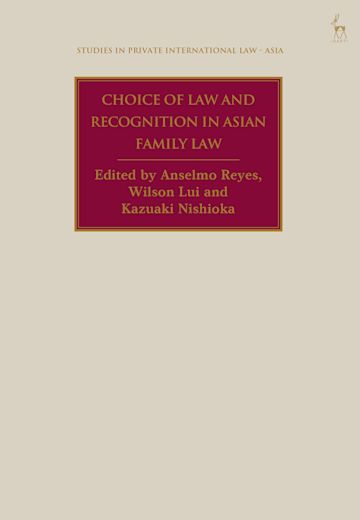
The blurb read as follows:
This thematic volume in the series Studies in Private International Law – Asia outlines the general choice of law and recognition rules relating to family matters of 15 Asian jurisdictions: Mainland China, Hong Kong, Taiwan, Japan, South Korea, Singapore, Malaysia, Vietnam, Cambodia, Myanmar, the Philippines, Indonesia, Thailand, Sri Lanka and India. The book examines pressing questions and proposes ways in which their systems may be reformed. A concluding chapter considers the extent to which Asian cross-border family law systems can and should be harmonised.
The book provides a comprehensive analysis of cross-border family law challenges, including child surrogacy, child abduction, the recognition of same-sex unions, the recovery of maintenance, and the regulation of intercountry adoption. These are among the matters now testing Asian institutions of private international law and acting as forces for their modernisation.
With contributions by leading Asian private international law experts, the book proposes necessary reforms for each of the jurisdictions analysed as well as for Asia as a whole.
Out Now: Treatment of Foreign Law in Asia
A book edited by Kazuaki Nishioka on Treatment of Foreign Law in Asia has just been published in the Hart Studies in Private International Law -Asia.
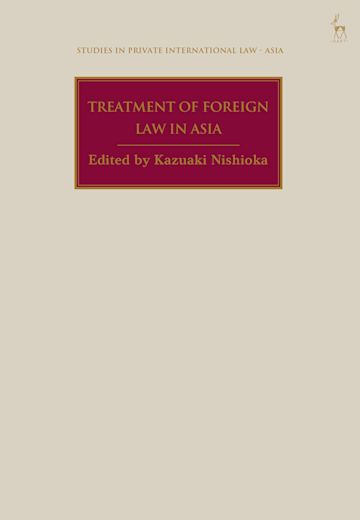
The blurb read as follows:
How do Asian courts ascertain, interpret, and apply a foreign law as the law governing the merits of the case? What should judges do if parties do not raise or disagree on the content of foreign law? This thematic volume in the Studies in Private International Law – Asia series analyses the treatment of foreign law before judicial authorities, that is, how the courts of Asian states deal with the proof of foreign law in court litigation involving cross-border elements.
The individual chapters cover 15 Asian jurisdictions: Mainland China, Hong Kong, Taiwan, Japan, South Korea, Singapore, Malaysia, Vietnam, Cambodia, Myanmar, the Philippines, Indonesia, Thailand, Sri Lanka, and India.
The Introduction and Conclusion examine similarities and differences in the approaches taken by the 15 Asian states with a view to assessing the extent to which those approaches are consistent or different from each other. The book also puts forward suggestions for harmonising differing approaches, especially between Asian common law and civil law states.
The book is a one-stop reference guide on the treatment of foreign law in Asia and will be indispensable to judges, practitioners, and scholars not just in Asia, but worldwide.
Out Now: Internationales Privat- und Prozessrecht in Lateinamerika by Jürgen Samtleben
Jürgen Samtleben just published a collection of his work on the PIL of Latin America; he kindly shared the following announcement with us:
Jürgen Samtleben has authored numerous articles over the years on private international law and international civil procedure in Latin America. These contributions have now been updated and systematically organized into a single volume, thereby offering a unique overview of the conflict of laws in Latin American countries. The collection of articles in German, Spanish and English is supplemented by a comprehensive volume containing the relevant statutory materials in their original language as well as in German translation.
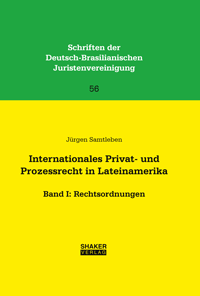
The indices of volume I (‘Rechtsordnungen’) and volume II (‘Gesetzestexte’) can be found here and here. More information is available here.