


Views
Conference Report: Contracts for the Supply of Digital Content and Digital Services, A legal debate on the proposed directive, ERA Brussels, 22 November 2017
Written by Antonella Nolten, Research Fellow at the EBS Law School, Wiesbaden, Germany
On 22 November 2017 the Academy of European Law (ERA) hosted a conference on the recent developments on the Proposal for a Digital Content Directive in Brussels. Read more
Bob Wessels, International Insolvency Law: Part II European Insolvency Law, 4th edition 2017, Wolters Kluwer
Written by Lukas Schmidt, Research Fellow at the Center for Transnational Commercial Dispute Resolution (TCDR) of the EBS Law School, Wiesbaden, Germany
With International Insolvency Law Part II having been published, Bob Wessels’ 10 volume series ‘Insolventierecht’ (Insolvency Law) is now completed in its 4th edition. The publication comprehensively deals with the European Insolvency Regulation Recast as entered into force on 26 June 2017, while International Insolvency Law: Part I Global Perspectives on Cross-Border Insolvency Law, already published at the end of 2015, covers the core concepts of Cross-Border Insolvency Law, other regional frameworks than the EIR and relevant instruments of soft law. Read more
Deference to Foreign Sovereign Submissions
As previously reported here, the United States Court of Appeals for the Second Circuit issued a decision in 2016 reversing a $147.8 million price-fixing judgment against two Chinese manufacturers of Vitamin C. The plaintiffs alleged that the Chinese manufacturers engaged in price fixing and supply manipulation in violation of U.S. antitrust laws. In its first ever appearance as an amicus before a U.S. court, the Chinese government filed a formal statement asserting that Chinese law required the Chinese manufacturers to set prices and reduce the quantities of Vitamin C sold abroad. Relying on this statement, the Second Circuit held that because the Chinese manufacturers could not comply with both Chinese law and the U.S. antitrust laws, principles of international comity compelled dismissal of the case.
This case raises a host of interesting questions. First, did the Second Circuit reach the right result? Second, is this a comity case or a foreign sovereign compulsion case? Third, what level of deference is due to a foreign sovereign that appears in private litigation to explain their country’s laws? Fourth, should U.S. judges defer to such an explanation?
In June 2017, the United States Supreme Court called for the views of the United States. This past Tuesday, the Solicitor General (SG) filed this brief in response to the Court’s order.
In this submission, the SG explains that the Court should grant review of the Second Circuit’s decision in order to review the court of appeals’ holding that the Chinese government’s submission conclusively established the content of Chinese law. According to the SG, “a foreign government’s characterization of its own law is entitled to substantial weight, but it is not conclusive.” The SG argues that the case warrants the Court’s review because “[t]he degree of deference that a court owes to a foreign government’s characterization of its own law is an important and recurring question, and foreign sovereigns considering making their views known to federal courts should understand the standards that will be applied to their submissions.”
Should the Court grant review, the question of what standard should be applied to foreign sovereign submissions will be key. This is a question I have explored here.
It will be interesting to see whether the Court accepts the SG’s request to review the Second Circuit’s decision.
News
Vulnerability: a Matter of Perspective(s)
The international seminar “Vulnerability: a Matter of Perspective(s)”, is scheduled to be held online on Friday, 29 September 2023, starting at 10 a.m. CET on Microsoft Teams.
The seminar is centered around Private International Law (PIL). Specifically, various sessions of the seminar will delve into the diverse and interdisciplinary perspectives of PIL in the context of ‘Vulnerability.’ Many presentations will scrutinize the role of PIL, as well as international conventions and treaties, in relation to vulnerable communities, territories, and individuals. Additionally, the seminar will emphasize the importance of PIL in devising viable solutions. These solutions aim to ensure that present and future generations can remain in their homelands and achieve sustainable human development. This encompasses a broad range of societal aspects, including food, housing, artificial intelligence, and finance.
HCCH CODIFI Edition 2023 – CBDCs

The Permanent Bureau is pleased to announce that a colloquium on Central Bank Digital Currencies (CBDCs), titled “CODIFI Edition 2023 – CBDCs”, will be held online on Thursday 5 October 2023, following the mandate of the Council on General Affairs and Policy (CGAP) at its 2023 meeting (C&D No 17).
CODIFI Edition 2023 – CBDCs will cover selected topics related to the HCCH’s CBDCs Project, established by CGAP in March 2023 with the mandate to study the private international law implications of CBDCs. The colloquium will feature a series of pre-recorded video discussions, led by subject-matter experts of the CBDCs Project and other specialists of academia, government, and industry. Live discussion sessions will also take place on the same day to summarise the proceedings and provide more insights and some ideas on the way forward.
Out Now: Private International Law and Competition Litigation in a Global Context, by Mihail Danov
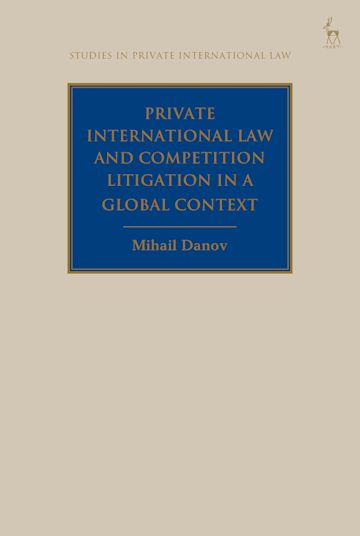
Description
This important book systematically analyses the private international law issues regarding private antitrust damages claims which arise out of transnational competition law infringements. It identifies those problems that need to be considered by injured parties, defendants, judges and policy-makers when dealing with cross-border private antitrust damages claims in a global context. It considers the post-Brexit landscape and the implications in cross border private proceedings before the English courts and suggests how the legal landscape should be developed. It also sets out how private international law techniques could play an increasingly important role in private antitrust enforcement.
Comprehensive and rigorous, this is required reading for scholars of both competition litigation and private international law.