Views
Mutual Recognition and Enforcement of Civil and Commercial Judgments among China (PRC), Japan and South Korea
Written by Dr. Wenliang Zhang, Lecturer in the Law School of Renmin U, China (PRC)
Against the lasting global efforts to address the issue of recognition and enforcement of civil and commercial judgments (“REJ”), some scholars from Mainland China, Japan and South Korea echoed from a regional level, and convened for a seminar on “Recognition and Enforcement of Judgments between China, Japan and South Korea in the New Era”. The seminar was held in School of Law of Renmin University of China on December 19, 2017 and the participants were involved in discussing in depth the status quo and the ways out in relation to the enduring REJ dilemma between the three jurisdictions, especially that between China and Japan. Read more
The ECtHR rules on the compatibility with the right to respect for private and family life of the refusal of registration of same-sex marriages contracted abroad
By a judgment Orlandi and Others v. Italy delivered on December 14 the ECtHR held that the lack of legal recognition of same sex unions in Italy violated the right to respect of private and family life of couples married abroad.
The case concerned the complaint of six same sex-couples married abroad (in Canada, California and the Netherlands). Italian authorities refused to register their marriages on the basis that registration would be contrary to public policy. They also refused to recognize them under any other form of union. The complaints were lodged prior to 2016, at a time when Italy did not have a legislation on same-sex unions.
The couples claimed under articles 8 (right to respect of private and family life) and 14 (prohibition of discrimination) of the Convention, taken in conjunction with article 8 and 12 (right to marry), that the refusal to register their marriages contracted abroad, and the fact that they could not marry or receive any other legal recognition of their family union in Italy, deprived them of any legal protection or associated rights. They also alleged that “the situation was discriminatory and based solely on their sexual orientation” (§137).
Recalling that States are still free to restrict access to marriage to different sex-couples, the Court indicated that nonetheless, since the Oliari and others v. Italy case, States have an obligation to grant same-sex couples “a specific legal framework providing for the recognition and the protection of their same-sex unions” (§192).
The Court noted that the “the crux of the case at hand is precisely that the applicants’ position was not provided for in domestic law, specifically the fact that the applicants could not have their relationship – be it a de facto union or a de jure union recognized under the law of a foreign state – recognized and protected in Italy under any form” (§201).
It pointed out that although legal recognition of same-sex unions had continued to develop rapidly in Europe and beyond, notably in American countries and Australia, the same could not be said about registration of same-sex marriages celebrated abroad. Giving this lack of consensus, the Court considered that the State had “a wide margin of appreciation regarding the decision as the whether to register, as marriage, such marriages contracted abroad” (§204-205).
Thus, the Court admitted that it could “accept that to prevent disorder Italy may wish to deter its nationals from having recourse in other States to particular institutions which are not accepted domestically (such as same-sex marriage) and which the State is not obliged to recognize from a Convention perspective” (§207).
However, the Court considered that the refusal to register the marriages under any form left the applicants in “a legal vacuum”. The State has failed “to take account of the social reality of the situation” (§209). Thus, the Court considered that prior to 2016, applicants were deprived from any recognition or protection. It concluded that, “in the present case, the Italian State could not reasonably disregard the situation of the applicants which correspond to a family life within the meaning of article 8 of the Convention, without offering the applicants a means to safeguard their relationship”. As a result, it ruled that the State “failed to strike a fair balance between any competing interests in so far as they failed to ensure that the applicants had available a specific legal framework providing for the recognition and the protection of their same-sex union” (§ 210).
Thus, the Court considered that there had been a violation of article 8. It considered that, giving the findings under article 8, there was no need to examine the case on the ground of Article 14 in conjunction with article 8 or 12. (§212).
Functioning of the ODR Platform: EU Commission Publishes First Results
Written by Emma van Gelder and Alexandre Biard, Erasmus University Rotterdam (PhD and postdoc researchers ERC project Building EU Civil Justice)
On 13 December 2017, the European Commission published a report on the functioning of the Online Dispute Resolution (ODR) Platform for consumer disputes, and the findings of a web-scraping exercise of EU traders’ websites that investigated traders’ compliance with their information obligations vis-à-vis consumers. Read more
News
New article published in African Journal of International and Comparative Law
A new conflict of laws article was just published today on the African Journal of International and Comparative Law. It is titled: CSA Okoli, A Yekini & P Oamen, “The Igiogbe Custom as a Mandatory Norm in Conflict of Laws: An Exploration of Nigerian Appellate Court Decisions.”
The abstract reads as follows:
Under the Igiogbe custom of the Bini Kingdom of Edo State Nigeria, the eldest surviving son exclusively inherits the ancestral home of his deceased father. This custom is a mandatory norm in conflict of laws. Litigation on the custom has been described as a matter of life and death. There is a widely shared view among academic writers, practitioners, and judges that this customary law is absolute. Contrary to this popular view, this work argues that the Igiogbe custom can be displaced by statute and other customary or religious laws. To substantiate this position, this article examines all the reported appellate court decisions on the Igiogbe custom and other connected principles. It is often taken for granted that every Bini man is subject to customary law, thereby leading to the overriding application of the Igiogbe custom. Recent developments in case law suggest otherwise. There is a conflict of personal law question that is often ignored in most litigation concerning the Igiogbe. Careful consideration of this question can potentially lead to the application of other systems of succession law (statutory, religious, and other customary laws) other than the Igiogbe custom. Besides, these conflict of laws techniques and constitutional human rights norms can be used to strike the appropriate balance between competing interests and reasonable legitimate expectations of the deceased and their heirs.
Call for papers: 2024 NGPIL Conflict of Laws’ Essay Prize
Originally posted in the NGPIL website
The Nigeria Group on Private International Law “(NGPIL”) invites submissions for the annual NGPIL Conflict of Laws’ Competition. The winner will be awarded for the best essay on any aspect of Nigerian conflict of laws. Entries will be accepted from the following: an undergraduate and/or postgraduate scholar studying in Nigeria, or any Nigerian lawyer five years call or below practising and residing in Nigeria. The essay should be unpublished at the time of submission. Submitted essays should be in the English language. Submitted essays should also be within five to eight thousand words. Competitors may be citizens of any nation, age or gender but must be an undergraduate and/or postgraduate scholar studying in Nigeria, or any lawyer below five years post-call experience practising and residing in Nigeria.
The first prize is 150,000 Naira (NGN), and the winner of the competition will be encouraged to publish the paper in any high-quality peer reviewed journal on private international law (conflict of laws). The second prize is 90,000 Naira (NGN), and third prize is 60,000 Naira (NGN). The prize is sponsored by and will be awarded by NGPIL.
Submissions to the Prize Committee must be received no later than January 15, 2024. Entries should be submitted by email in Word or pdf format. The winner will be announced no later than 2 months after the deadline. Decisions of the NGPIL on the winning essay and on any conditions relating to this prize are final. Submissions and any queries should be addressed by email to ngpilaw@gmail.com. All submissions will be acknowledged by e-mail.
Previous Winners
Oluwabusola Fagbemi (Winner for the 2022/2023 session)
Solomon Adegboyo (Winner for the 2021/2022 session)
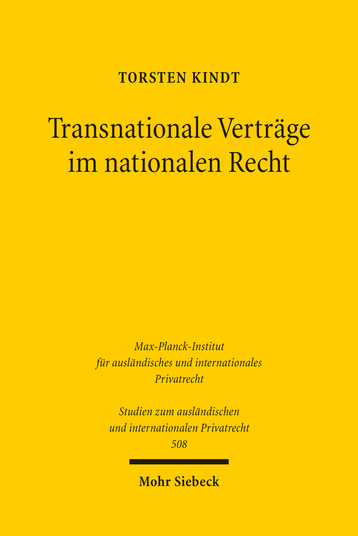
Out Now: Torsten Kindt, Transnationale Verträge im nationalen Recht
It is a truth universally acknowledged that a significant portion of international commerce is organized around instruments and structures that do not emanate from national states and laws but from private entities. Traditionally, most legal scholars addressing this phenomenon could be sorted into one of two camps: those who want to limit the notion of ‘law’ to the state and see instances of private ordering primarily as social, rather than legal phenomena; and those who consider national law already as a abstract concept with limited and decreasing importance for the reality of international business. Torsten Kindt belongs to neither of those two camps. With his recently published book, based on his doctoral thesis, he attempts to fill the gap left between the two seemingly irreconcilable positions, with a special focus on the transnational dimension of private ordering.