


Views
Online Symposium on Recent Developments in African PIL (I) – Recognition and Enforcement of International Judgments in Nigeria

As previously announced, we are launching the second online symposium on recent developments in African private international law. As part of this symposium, a series of blog posts addressing various aspects of recent developments in African private international law will be published on this platform over the coming days.
We open the series with a blog post by Abubakri Yekini (Senior Lecturer in Law at the University of Manchester) and Chukwuma Samuel Adesina Okoli (Assistant Professor in Commercial Conflict of Laws at the University of Birmingham and Senior Research Associate at the Centre for Private International Law in Emerging Countries at the University of Johannesburg), focusing on the recognition and enforcement of international judgments in Nigeria.
Online Symposium on Recent Developments in African Private International Law
It is not uncommon for African and foreign scholars of private international law (PIL) to lament the current state of the field in Africa. Until the early years of the 21st century, PIL was widely regarded, often with little hesitation, as ‘a neglected and highly underdeveloped subject in Africa’.[i] Professor Forsyth famously described it as a ‘Cinderella subject, seldom studied and little understood’.[ii] This limited scholarly attention is reflected, for instance, in the treatment of African PIL in the Hague Academy courses, which include only 4 courses specifically devoted to PIL in Africa, the most recent of which dates back to 1993.[iii] Since then, a number of pleas for greater attention to PIL in Africa,[iv] as well as calls for enhanced cooperation with African countries to ensure better involvement and inclusiveness,[v] have been voiced.[vi] Read more
Conflict of laws in the South African courts: an(other) recent missed opportunity
Posted on behalf of Jason Mitchell, barrister at Maitland Chambers in London and at Group 621 in Johannesburg.
An Australian, Hannon, wants to book a Southern African safari with his partner, Murti, as a surprise birthday gift. He sees one he likes on an Australian travel website. Hannon fills in the online form.
It turns out that the website is just the agent for a South African company, Drifters Adventours. Drifters emailed Hannon the price and payment details. Attached to the email is a brochure. The brochure says, “Drifters do not accept responsibility for any loss, injury, damage, accident, fatality, delay or inconvenience experienced while on tour.” The brochure also says, “You will be required to complete and sign a full indemnity prior to your tour departure.” Read more
News
AAPrIL June Seminar (Online): “A Long-Awaited Reform: Papua New Guinea’s New Arbitration Law A conversation with Michael Henao”
News from the Australasian Associate of Private International Law:
We are pleased to share the updated flyer for our forthcoming event, A Long-Awaited Reform: Papua New Guinea’s New Arbitration Law — A Conversation with Michael Henao, taking place on 9 June. We are delighted to confirm that Cara North will be joining Michael Henao for what promises to be a timely and engaging discussion on this significant development in the region’s arbitration landscape.
This is an excellent opportunity to hear first-hand insights into Papua New Guinea’s new arbitration framework from a highly respected practitioner. We very much look forward to welcoming you on the day and encourage you to circulate the attached flyer among interested colleagues. Further details can be found in the flyer enclosed:
Workshop on Private International Law, Sustainability and Fashion
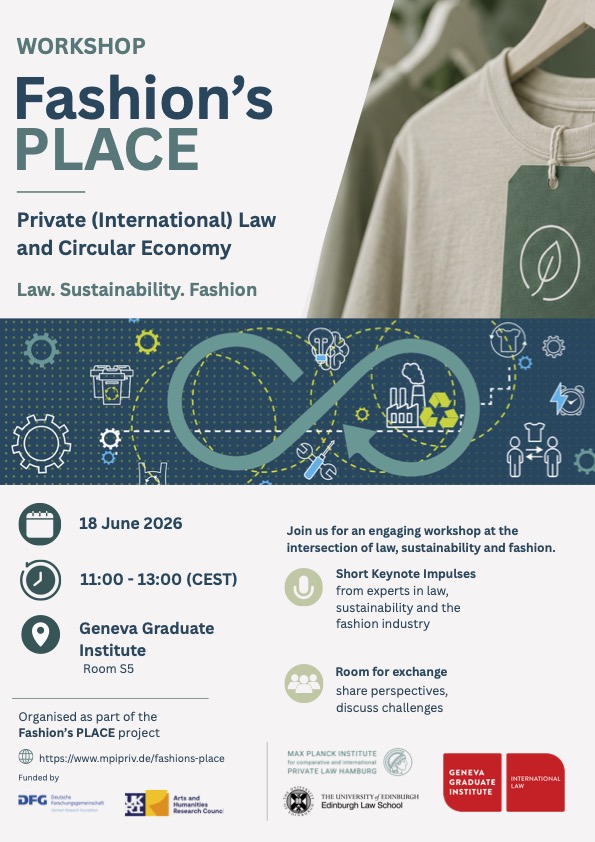 As part of the DFG- and AHRC-funded Fashion’s PLACE project, there will be a workshop on Private International Law, Sustainability and Fashion at the Geneva Graduate Institute on 18 June 2026 (11:00–13:00 CEST), just prior to the EAPIL conference. The event will bring together perspectives from law, sustainability and the fashion industry, with short presentations and space for discussion. If you are in Geneva and interested in the intersection of private international law, circular economy and fashion, consider coming. No sign-up necessary.
Conference: European Principles of Transnational Litigation and Their Reception Abroad (Hamburg, 8–10 Oct 2026)
On 8–10 October 2026, Julian Rapp and Wolfgang Wurmnest will be hosting a conference on European Principles of Transnational Litigation and Their Reception Abroad at the University of Hamburg.
The aim of the conference is described as follows:
As cross-border disputes grow increasingly common in today’s globalized world, reflection on key European procedural principles – and their influence beyond Europe – deserves closer examination. This conference examines how European procedural rules, particularly those shaped by the Court of Justice of the European Union, have evolved into general principles of transnational litigation. It will discuss classic jurisdictional rules (contract and tort jurisdiction, jurisdiction agreements, and lis pendens), the protection of weaker parties, and the recognition and enforcement of judgments – all reflecting the practical challenges that litigants and courts face in cross-border litigation.