


Views
The CJEU settles the issue of characterising the surviving spouse’s share of the estate in the context of the Succession Regulation
It has not been yet noted on this blog that the CJEU has recently settled a classic problem of characterisation that has plagued German courts and academics for decades (CJEU, 1 March 2018 – C-558/16, Mahnkopf, ECLI:EU:C:2018:138). The German statutory regime of matrimonial property is a community of accrued gains, i.e. that each spouse keeps its own property, but gains that have been made during the marriage are equalised when the marriage ends, i.e. by a divorce or by the death of one spouse. According to § 1371(1) of the German Civil Code (Bürgerliches Gesetzbuch – BGB), the equalisation of the accrued gains shall be effected by increasing the surviving spouse’s share of the estate on intestacy by one quarter of the estate if the property regime is ended by the death of a spouse; it is irrelevant in this regard whether the spouses have made accrued gains in the individual case. How is this claim to be characterized? Read more
Torture, Universal Civil Jurisdiction and Forum Necessitatis: Naït-Litman v. Switzerland before the ECtHR
On March 15 the ECtHR, sitting as the Grand Chamber,decided on the Naït-Litman v. Switzerland case (application no. 51357/07), against the applicant and his claim of violation of Article 6 ECHR. Independently on whether one agrees or not with the final outcome, for PIL lawyers and amateurs the judgment (for very busy people at least the press release) is certainly worth reading. Read more
The Pitfalls of International Insolvency and State Interventionism in Slovenia
Written by Dr. Jorg Sladic, Attorney in Ljubljana and Assistant Professor in Maribor (Slovenia)
The most interesting development in European private international law and European insolvency law seems the Croatian AGROKOR case. Rulings of English courts have been reported (see e.g. Prof. Van Calster’s blog, Agrokor DD – Recognition of Croatian proceedings shows the impact of Insolvency Regulation’s Annex A.)[1] However, a new and contrary development seems to be an order by the Slovenian Supreme Court in case Cpg 2/2018 of 14 March 2018.[2] Read more
News
Dutch Journal of PIL (NIPR) – issue 2023/3
The latest issue of the Dutch Journal on Private International Law (NIPR) has been published
NIPR 2023 issue 3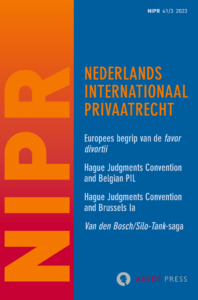
EDITORIAL
M.J. de Rooij, Het leed van de circulerende Unieburger en het Europese begrip van de favor divortii [The suffering of the circulating Union citizen and the European concept of favor divortii] / p. 381-384
Workshop on ‘The Commission Proposal for a EU Regulation on Parenthood and the Creation of a European Certificate of Parenthood. Czech-German Perspectives’
Magdalena Pfeiffer (Charles University Prague) and Anatol Dutta (Ludwig-Maximilians-Universität München) will be hosting a workshop on the Proposal for a EU Regulation on Parenthood and the Creation of a European Certificate of Parenthood (discussed here) on 24 November 2023 in Prague.
Further information can be found on the flyer.
European Union Private International Law – Role Model or Hegemony?
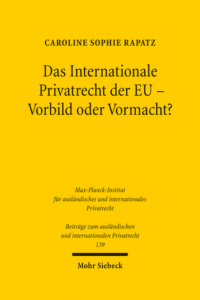 Caroline Sophie Rapatz, University of Kiel, has just published her German-language Habilitationsschrift on “European Union Private International Law – Role Model or Hegemony? Delimitations and Effects in Relation to National and International Conflict of Laws” (Das Internationale Privatrecht der EU – Vorbild oder Vormacht? Abgrenzungen und Wirkungen im Verhältnis zum nationalen und völkerrechtlichen Kollisionsrecht, Beiträge zum ausländischen und internationalen Privatrecht 139, Mohr Siebeck 2023 (XXVI, 693 p.) The book analyses the consequences of the Europeanisation of private international law (PIL) for the traditional regulatory levels of national and international (treaty and convention) conflict-of-laws rules and for the system of conflict-of-laws as a whole. The author has kindly provided has with the following summary of her insights: