


Views
Doors open for First Hearing of International Chamber at Paris Court of Appeal
Written by Duncan Fairgrieve (BIICL;Université de Paris Dauphine) and Solenn Le Tutour (avocat, Barreau de Paris)
When the French Government announced in February this year plans to launch an “English” Commercial court in Paris, eyebrows were raised and, it is fair to say, an element of skepticism expressed in the common law world as to whether such a development would really prove to be a serious competitor to the Commercial Courts on Fetter Lane in London. Read more
The Belgian Government unveils its plan for the Brussels International Business Court (BIBC)
Written by Guillaume Croisant, Université Libre de Bruxelles
In October 2017, as already reported in a previous post, the Belgian Government announced its intention to set up a specialised English-speaking court with jurisdiction over international commercial disputes, the Brussels International Business Court (“BIBC”). An update version of the text has finally been submitted to Parliament on 15 May 2018, after the Government’s initial draft faced criticisms from the High Council of Justice (relating to the BIBC’s independence and impartiality, its source of funding and its impact on the ordinary courts) and was subject to the review of the Conseil d’Etat. Read more
Proving Chinese Law: Deference to the Submissions from Chinese Government?
Written by Dr. Jie (Jeanne) Huang, Senior Lecturer, University of New South Wales Faculty of Law
The recent U.S. Supreme Court case, Animal Science Products, Inc. v. Hebei Welcome Pharmaceutical Co. Ltd, concerns what weight should be given to the Chinese government’s submission of Chinese law. On Page 58 of the trial transcript, Justices Kagan and Ginsburg asked how about other countries dealing with formal submissions from the Chinese government. There are two examples.
One is Hong Kong. In TNB Fuel Services SDN BHD v China National Coal Group Corporation ([2017] HKCFI 1016), the issue is whether the defendant, a state-owned enterprise, is protected by Chinese absolute sovereignty immunity under Chinese law. The court deferred to an official letter provided by the Hong Kong and Macao Affairs Office of the State Department in Mainland China. The Office answers no absolute sovereignty immunity to Chinese state-owned enterprises carrying out commercial activities. The Court adopted this opinion without second inquiry (para 14 of the judgment). After considering a bunch of other factors, the court ruled against the defendant.
The other is Singapore. In Sanum v. Laos ([2016] SGCA 57), the issue is whether the China-Laos Bilateral Investment Treaty (BIT) shall be applied to Macao Special Administrative Region. Chinese embassy in Laos and China Ministry of Foreign Affairs provided diplomatic announcements indicating that the BIT shall not be applied to Macao. However, the Court of Appeal of Singapore held that China’s announcements were inadmissible and, even if admitted, they did not change the applicability of the BIT to Macau. This is partly because, before the dispute with Sanum crystalized, no evidence showed that China and Laos had agreed that the BIT should not be applied to Macau. Therefore, the China’s diplomatic announcements should not be retroactively applied to a previous dispute. For a more detailed discussion, please see pages 16-20 of my article.
TNB Fuel Services and Sanum share important similarities with Animal Science Products, because the key issues are all about the proving of Chinese law. In the three cases, Chinese government all provided formal submissions to explain the meaning and the applicability of Chinese law. However, TNB Fuel Services and Sanum can also be distinguished from Animal Science Products, because comity plays no role in the former two cases. TNB Fuel Services concerns sovereign immunity, which is an issue that Hong Kong courts must follow China’s practices. This is established by Democratic Republic of the Congo v. FG Hemisphere Associates (FACV Nos. 5, 6 & 7 of 2010). Sanum is a case to set aside an investment arbitration award, so the Court of Appeal of Singapore need not consider comity between Singapore and China. In contrast, in Animal Science Products, the U.S. Court of Appeals for the Second Circuit elaborated the importance of comity between the U.S. and China. Therefore, Animal Science Products should not be considered as a technical case of proving foreign laws. The U.S. Supreme Court may consider deferring to the submissions of Chinese government to a certain extent but allows judges to decide whether the Chinese government’s submission is temporally consistent with its position on the relevant issue of Chinese law.
News
Revue Critique de droit international privé – issue 2023/2
The second issue of the Revue critique de droit International privé of 2023 was released in August. It contains four articles and several case notes.
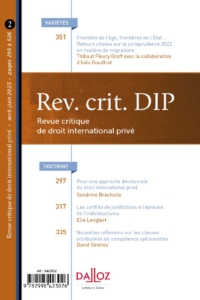 The first part of the issue features the doctrinal work of two young authors, who confront PIL techniques with contemporary developments in social sciences.
The first article Pour une approche décoloniale du droit international privé (A Decolonial Approach to Private International Law) is authored by Dr Sandrine Brachotte (Université Saint-Louis & Université de Lille). Following her doctoral work on The Conflict of Laws and Non-secular Worldviews: A Proposal for Inclusion (see presentation over at EAPIL), Dr Brachotte discusses colonial studies’ implications for PIL scholarship. She examines how plural normativities challenge the traditional conception of conflict of laws and then outlines the potential form of a decolonial PIL. An English translation of the article is available on the website of the editor. Its abstract reads as follows:
Call for Paper: Private International Law and Business Compliance in Asia Pacific
This national conference will be held on 21 February 2024 at The University of Sydney Law School in Australia.
Business compliance in international transactions across the Asia-Pacific region holds immense importance for organizations seeking to expand their activities within this dynamic and evolving landscape. Multinational corporations operating in Asia Pacific often confront unique compliance challenges due to the swiftly changing regulatory and geopolitical environment in the region.
The 2023 NGPIL Lecture Series
Originally posted today on the NGPIL website.
On the 23rd November 2023, 5pm (WAT/Lagos/Abuja) the NGPIL will host our guest speaker Professor Wale Olawoyin SAN, FCIArb at this year’s conference. The event will explore the coming into force of the Arbitration and Conciliation Act 2023 and how, from a private international law perspective, the arbitration appeal process in Nigeria can be enhanced. Discussions will build on practice thus far, and will allow practitioners, judges and academics alike to develop knowledge and insight into its utility.
To register: https://us06web.zoom.us/webinar/register/WN_q5pY1JWARiaUxi1TIw8xBQ
