


Views
A New Zealand perspective on Israeli judgment against New Zealand-based activists under Israel’s Anti-Boycott Law
Last year the New Zealand singer Lorde cancelled a concert in Tel Aviv following an open letter by two New Zealand-based activists urging her to take a stand on Israel’s illegal occupation of Palestine. A few weeks later, the two activists found themselves the subject of a civil claim brought in the Israeli court. The claim was brought by the Israeli law group Shurat HaDin, on behalf of three minors who had bought tickets to the concert, pursuant to Israel’s so-called Anti-Boycott Law (the Law for the Prevention of Damage to the State of Israel through Boycott). The Israeli court has now released a judgment upholding the claim and ordering the activists to pay NZ$18,000 in damages (plus costs).
Readers who are interested in a New Zealand perspective on the decision may wish to visit The Conflict of Laws in New Zealand, where I offer some preliminary thoughts on the conflict of laws issues raised by the judgment. In particular, the post addresses – from a perspective of the New Zealand conflict of laws – the concern that the judgment represents some kind of jurisdictional overreach, before discussing the enforceability of the judgment in New Zealand (and elsewhere).
Reports of HCCH Experts’ Groups on the Surrogacy/Parentage and the Tourism Projects available
The Permanent Bureau of the Hague Conference on Private International Law has made available two reports for the attention of its governance Council (i.e. the Council on General Affairs and Policy): the Report of the Experts’ Group on the Parentage / Surrogacy Project and the Report of the Experts’ Group on the Co-operation and Access to Justice for International Tourists.
The Group on Parentage/Surrogacy Project will need to meet one more time early next year to reach final Conclusions on future work. In particular, the Group discussed possible methods to ensure cross-border continuity of legal parentage both established by and in the absence of a judicial decision.
Importantly, “[t]he Group recalled that the absence of uniform PIL rules on legal parentage can lead to limping parentage across borders in a number of cases and can create significant problems for children and families. The Group further recalled that uniform PIL rules can assist States in resolving these conflicts and can introduce safeguards for the prevention of fraud involving public documents, while ensuring that the diverse substantive rules on legal parentage of States are respected. Any new instrument should aim to provide predictability, certainty and continuity of legal parentage in international situations for all persons involved, taking into account their fundamental rights, the UN Convention on the Rights of the Child and in particular the best interests of children. The Group agreed that any international instrument would need to be developed with a view to complementing the existing Hague Family Conventions and to attracting as many States as possible.”
Regarding the Group on the Tourism Project, it should be noted that it is currently exploring the need for an international instrument on the co-operation and provision of access to justice for international tourists. The Group concluded that “[t]he Experts’ Group recommends to the CGAP that it mandates the Experts’ Group to continue its work, with a view to assessing the need for, the nature (soft law and hard law options) and the key elements of, a possible new instrument. The composition of the Experts’ Group should remain open, and, if possible, also include representatives of Stakeholders, such as the UNWTO, as well as representatives of relevant organisations and private international law experts.” It was noted that the Consultant will finalise his draft (substantive) Report, which will be circulated at the end of this year.
The aide-mémoire of the Chair of the Tourism Project noted: “[i]f a new instrument were to be developed, the Experts identified a number of possible expected values such instrument might add. These included that tourists might be able to obtain appropriate information, including in a language they understand, to ascertain and understand their rights, and the potentially available options to seek redress. It might also provide co-operation mechanisms among suitable bodies that can work in a concerted manner to facilitate the resolution of complaints, with a view to guaranteeing access to justice in the broadest sense, including through alternative dispute resolution, in a non- discriminatory way. The instrument might also have a preventive effect. Finally, it might create an official record of the complaint, including for subsequent use abroad.”
In March 2019, the HCCH governance Council will determine whether work on these two subjects will go forward.
Forcing a Square Peg into a Round Hole – The Actio Pauliana and the Brussels Ia Regulation
Earlier today, the Court of Justice held that, under certain circumstances, special jurisdiction for an actio pauliana can be based on Art. 7(1) Brussels Ia (Case C-337/17 Feniks).
The actio pauliana is an instrument provided by the national laws of several EU member states that allows the creditor to challenge fraudulent acts by their debtor that have been committed to the creditor’s detriment. The ECJ already had several opportunities to decide on the availability of individual grounds of special jurisdiction for such an action, but has reliably denied their availability. In today’s decision however, the Court confirmed the availability of special jurisdiction for matters relating to contract, contrary to the proposition of AG Bobek (Opinion delivered on 21 June 2018). Read more
News
Conference on Digital Justice for Cross-border Cases: University of Alicante, 23 November 2023 (in Spanish)
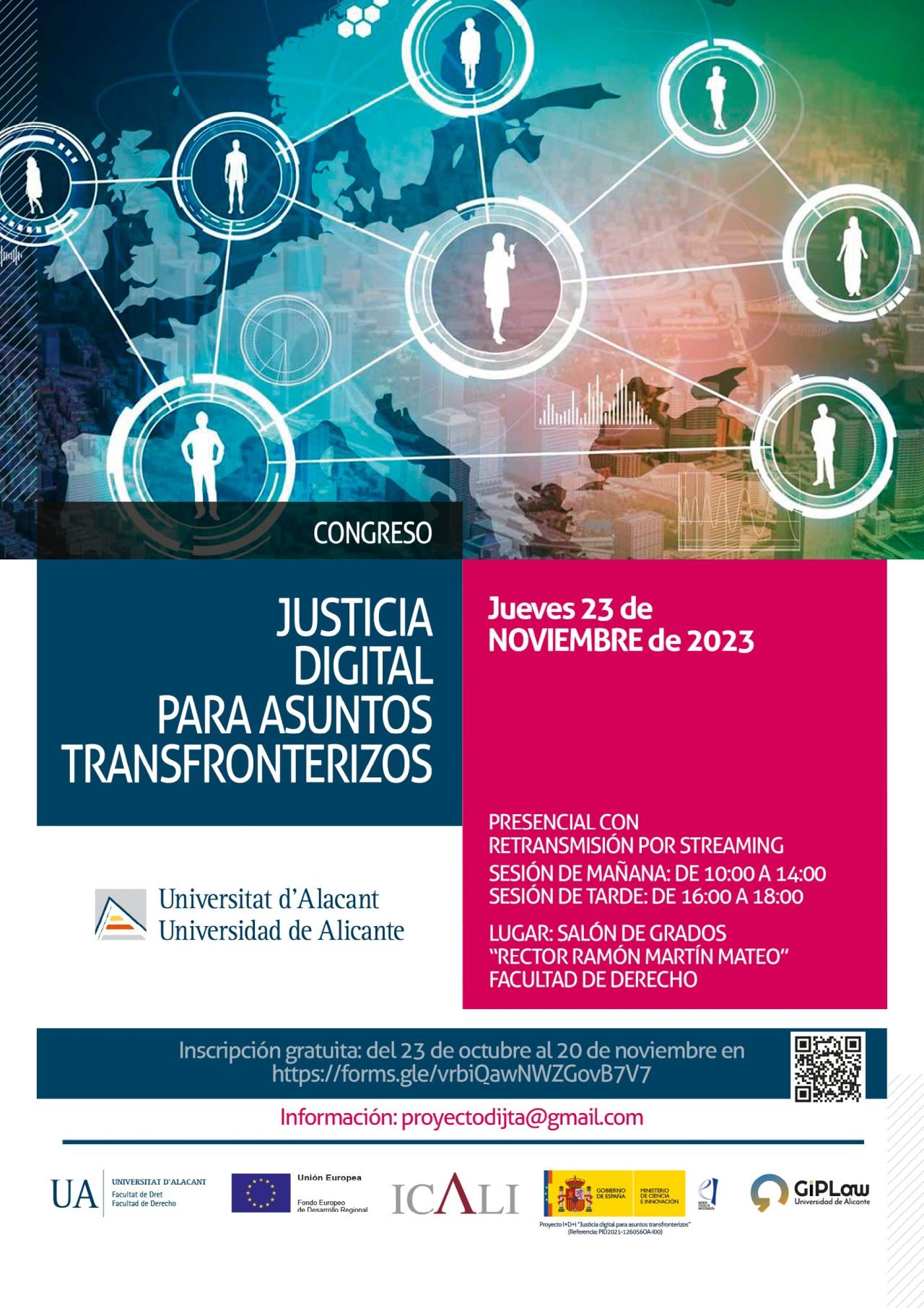
The Private International Law Department of the University of Alicante is organizing a conference entitled “Digital Justice for Cross-border Cases” (both onsite and online – in Spanish). The event will take place on 23 November 2023 at the Salón de Grados “Rector Ramón Martín Mateo” of the Faculty of Law at the University of Alicante.
Chinese Journal of Transnational Law Special Issue: Call for Papers
CHINESE JOURNAL OF TRANSNATIONAL LAW
Call for Papers
Special Issue: Private International Law and Sustainable Development in Asia
The United Nations Agenda 2030 with its 17 Sustainable Development Goals (SDGs) seems to have a blind spot for the role of private and private international law. That blind spot is beginning to be closed. A collective volume with global outlook published in 2021 addressed “the private side of transforming our world”: each of the 17 SDGs was discussed in one chapter of the book devoted to the specific relevance of private law and private international law. In 2022, the IACL-ASADIP conference in Asunción, Paraguay discussed sustainable private international law with regard to Latin America; the contributions published in 2023 in a special issue of the University of Brasilia Law Journal – Direito.UnB., V.7., N.3 (2023).
In this occasion the focus is on Asia. The Chinese Journal of Transnational Law invites submissions for its Vol. 2 Issue 2, to be published in 2025, engaging critically with the functions, methodologies and techniques of private international law in relation to sustainability from an Asian perspective, as well as in relation to the actual and potential contributions of private international law to the SDGs in Asia. Read more
Cycle de conférences: La refonte du règlement Bruxelles I Bis
Starting 30 November 2023, the French Cour de cassation is going to host a lecture series on the ongoing discussion of Brussels Ia reform under the direction of Marie-Elodie Ancel (Université Paris-Panthéon Assas) and Pascal de Vareilles-Sommières (Université Paris 1 Panthéon-Sorbonne).
The programme of the first session – and the video stream! – can be found here.