


Views
Same Region, Two Different Rulings on Fake News at the Internet
Fernando Pedro Meinero
Recently, two criminal court decisions investigating the spread of fake news show the difficulty of determining the scope of national court jurisdiction over the internet.
In Argentina, Google was successful in reversing a decision that determined the deindexation of a person’s name from search engines hosted outside the country. In this case, the searcher associated a person’s name with crimes of possession of drugs and weapons, something that proved to be false. But in Brazil, Twitter and Facebook were forced to globally block the access of investigated people to their respective accounts. These people are investigated for participating in the dissemination of defamatory publications through these internet platforms against members of the Legislative and Judiciary.
Although these are decisions taken in the context of criminal cases, the issues raised by them reflect difficulties that also arise in civil cases. Both decisions were taken against companies that have branches in the countries where the courts exercise their jurisdiction – Argentina and Brazil, but they see differently the scope of that jurisdiction for the fulfillment of an order outside the territory.
On the one hand, the idea that the imposition of removing content or access implies an obligation to do so outside the national territory. Therefore, this decision, in order to produce effects outside the territory, should pass through the control mechanisms of international cooperation, since otherwise there would be an invasion of foreign jurisdictions. Not to mention the issues that arise from the point of view of the applicable law, according to what each State considers as a defamatory act and what is the limit of freedom of speech.
On the other hand, the understanding that this obligation to comply, imposed on a company with legal personality in the country, based on national legislation, must be fulfilled by that company, regardless of where and how it will become effective. In this way, speculations about an eventual violation of foreign sovereignty are eliminated, as well as with regard to laws that may eventually consider such publications to be non-defamatory and just an exercise of freedom of speech.
This divergence exposes, in essence, issues related to international jurisdiction, applicable law and international legal cooperation, the three traditional pillars of Private International Law, and the challenges that the ubiquity of internet impose to this field of study.
Case no. CPF 8553/2015/4 / CA3 “C., E. – provisional measure – 1st Panel of the Federal Criminal and Correctional Chamber – Argentina
Last June 16, 1st Panel of the Federal Criminal and Correctional Chamber – Argentina – Appeal in Case no. CPF 8553/2015/4 / CA3 “C., E. – provisional measure”, decided in favor of Google Inc. in a case concerning fake news.
The giant of the internet appealed a decision that extended a provisional measure determining the removal of the indexation of a content in the search engine. The content – proved to be fake – referred to an alleged arrest of Enrique Santos Carrió in Mexico for drugs and weapons possession. He is the son of Elisa Carrió, an important figure in Argentine politics, currently serving as National Deputy.
The questioned order extended the restriction to domains hosted outside the national territory, namely: www.google.com, www.google.com.es and www.google.mx.
In its allegations, Google argued that, by virtue of the principle of state sovereignty, the implementation of that measure would represent a violation of the sovereignty of other states, which would affect services subject to foreign law. The company understood that the restrictive measure should be directed at the sites that published the fake news, and not at the search engine that, according to the company, is a mere intermediary between the users and the publishers.
Also, according to Google, the removal of the contents of www.google.com would require the deletion of them on global servers, which would represent that an Argentine judge could decide about the information that can be accessed worldwide. In turn, it believes that this type of measure constitutes a serious threat to freedom of expression and the right to seek, receive and disseminate information freely.
The Court, granting the appeal, understood that the categorization of the news as fake is typical of the activity of the intervening court. However, these categorizations cannot be imposed on foreign jurisdictions, except through judicial cooperation mechanisms that do not violate their legal order. In its understanding “the core of this controversy concerns the principle of the territoriality of the law, which prevents the possibility of taking for itself the prerogative to prohibit the global dissemination of certain contents published by the press, whose disclosure would be prohibited under the local regulatory framework, but its circulation may be authorized in the context of another territory, according to the legal provisions and the categorization that this content could be granted ”(in free translation).
By this basis, the Chamber decided to leave the proposed precautionary measure ineffective, understanding that, if it so wishes, the judge a quo may request measures of judicial cooperation from foreign authorities and thus limit the dissemination of such news.
The full text of the decision can be found here (in Spanish).
Criminal Investigation no. 4781 from Distrito Federal – Brazil. Justice Alexandre de Moraes (Monocratic Decision), Supreme Federal Court, Brazil.
On the other hand, we find in Brazil a decision that went in a very opposite direction if compared to the previous one.
In the context of the Criminal Investigation no. 4781 from Distrito Federal – Brazil, the Supreme Federal Court investigates the existence of organized use of accounts on social networks to create, publish and disseminate false information (commonly known as fake news). On May 26, 2020, Alexandre de Moraes, Minister of the Supreme Federal Court, ordered the blocking of Facebook, Twitter and Instagram accounts belonging to a group of allies of Jair Bolsonaro, current President of Brazil. Such profiles would be used to commit crimes against honor in concurrence with criminal association (typified in the Penal Code in arts. 138, 139, 140 and 288) and crimes against national security (typified in Act 7.170/1983, in arts. 18, 22, 23 and 26). Specifically, the investigation refers to attacks to the Supreme Federal Court and the National Congress.
Some of those investigated, however, evaded the order, changing the location settings on the sites, as if they were publishing from other countries. Therefore, on 07/28/2020, the said magistrate provided that the aforementioned social networks must block for access from any IP (Internet Protocol), from Brazil or abroad. To guarantee compliance, he imposed a daily fine of R $ 20,000.00 for each unblocked profile.
Twitter announced that it would comply with that decision, though it would appeal.
Differently, Facebook Serviços Online do Brasil Ltda. stated that it would refuse to comply with that decision, alleging its illegality. Thus, it would maintain the access of those investigated and the possibility of posting by accessing to the accounts abroad, allowing the viewing of content in the national territory. Facebook argued: “We respect the laws of the countries in which we operate. We are appealing to the Supreme Federal Court against the decision to block the accounts globally, considering that Brazilian law recognizes limits to its jurisdiction and the legitimacy of other jurisdictions”.
In view of this declaration, Minister Alexandre de Moraes issued a new decision, which raised the daily fine to R $ 100,000.00 for unblocked profile.
In his reasons, the Magistrate understood that “like any private entity that carries out its economic activity in the national territory, the social network Facebook must respect and effectively comply with direct commands issued by the Judiciary regarding facts that have occurred or with their persistent effects within the national territory; it is incumbent upon him, if deemed necessary, to demonstrate its non-conformity by means of the resources permitted by Brazilian law”. Then, he understood that “the blocking of social network accounts determined in this case, therefore, is based on the necessity to stop the continuity of the disclosure of criminal manifestations, which, in particular, materialize the criminal offenses found in this investigation and which continue to have its illicit effects within the national territory, including the use of subterfuge permitted by the social network Facebook”. Finally, he argued that “the issue of national jurisdiction over what is posted and viewed abroad is not discussed, but the dissemination of criminal facts in the national territory, through news and commentary by accounts banned.”.
After this decision, Facebook informed the observance of the global blocking of the investigated accounts.
Fernando Pedro Meinero is Professor of Private International Law at the Universidade Federal do Pampa, RS – Brazil.
Portugal joins the CISG
This post is authored by Ana Coimbra Trigo (Associate Lawyer at PLMJ Law Firm; PhD Candidate at NOVA Lisbon Univ.; LL.M. China-EU School of Law (China Univ. Political Science and Law, conferred by Univ. Hamburg); Law Degree from Univ. Coimbra), with contributions from Gustavo Moser.
Today, on 7 August 2020, Decree 5/2020 of the Council of Ministers approved the United Nations Convention on Contracts for the International Sale of Goods (CISG or Convention), making Portugal its newest signatory state (link to the official publication here). The Convention will enter into force, in respect of Portugal, on the first day of the month following the expiration of twelve months after the date of the deposit of its instrument of approval.
Portugal joins the Convention alongside two historic moments. First, this is the year that marks the 40th anniversary of the Convention, and second, the current Secretary General of the UN, António Guterres, is a Portuguese national.
Portugal was in fact active in the preparatory works at UNCITRAL and present at the diplomatic conference that adopted the CISG in 11 April 1980. Although “arriving late to the party”, it is foreseen that the CISG will be advantageous for Portugal, both at the legal and commercial level.
First, as is well known, the CISG provides a uniform and neutral regime for cross-border transactions regarding carriage of goods, and related dispute settlement. The text is based on a common set of remedies inspired by the principle of favor contractusand structured to maximize economic benefits of the contract.
Second, the CISG provides for overall legal certainty, especially in cases where there is and there is not a (valid) choice of law. It is drafted in plain language and this is particularly advantageous for small and medium-sized companies.
Third, scholars highlight the balanced system of solutions included in the Convention that allowsefficiencies in transaction costs and thus more competitive prices for imported and exported goods. This is beneficial for overall trade, but from a Portuguese viewpoint, will also allow Portuguese final users to get more value for their money, and Portuguese exporters to sell their products at lower prices in global markets.
Fourth, the above benefits are emphasized when one considers that the CISG has been ratified already by93 states. This includes 24 of 27 EU Member-States (excluding UK, Ireland, Malta and not for long Portugal) and also the United States of America, Canada, Brazil, China, Japan and South Korea. Some of these countries are relevant trade partners of Portugal.
Lastly, Portugal will now benefit from 40 years of scholarly writings and decisions for guidance, including in the Portuguese language, since Brazil recently became the first Lusophone country to adopt the CISG.
The increased availability of materials on the CISG in Portuguese may boost capacity building and contribute to the affirmation of the CISG in other Lusophone countries.
Scholars and diplomats have clamoured about this potential accession over the years, so we anticipate that this will be viewed positively by the local and international legal community.
Moreover, this can be seen as strategic boost for Portugal in international trade in this demanding international context.
CJEU on the deceased’s habitual residence
Written by Vito Bumbaca, University of Geneva
On 16 July the CJEU issued its preliminary ruling in case E.E. & K.-D. E. (CJEU, C-80/19, ECLI:EU:C:2020:569, not yet available in English). The case concerned, inter alia, the assessment of the deceased’s habitual residence under the EU Succession Regulation No. 650/2012. Given the novelty of the ruling, which represents the very first CJEU assessment of the deceased’s habitual residence under the EU Succession Regulation, we will focus on this particular aspect only.
Facts:
A Lithuanian mother and her son moved to Germany to live with the mother’s husband. Prior to her death in Germany, she drew up a testament in Lithuania, naming her son as her sole heir. The mother owned an apartment in Lithuania and when she died (in Germany), her son approached a notary in Lithuania concerning the apartment and in order to obtain a Certificate of Succession. This notary refused both requests based on their interpretation of the EU Succession Regulation according to which the deceased’s last habitual residence was in Germany at the time of death. The deceased’s son appealed against such a decision; subsequently the proceedings reached the Lithuanian Supreme Court (Lietuvos Aukš?iausiasis Teismas), which decided to stay proceedings and ask the preliminary ruling of the CJEU. The CJEU found that a person can have only one habitual residence.
Relevance:
This is the first CJEU ruling on the determination of the deceased’s habitual residence under the EU Succession Regulation.
It is welcomed to the extent that it provides a guiding assessment of the hierarchical order and practical implementation of recitals 23, 24 and 25. These are considered as explanatory rules for the determination of international competence and applicable law in matters of EU 25 cross-border succession based on habitual residence as a primary connecting factor.
Specifically, the Court clarifies which key factors should be assessed in the determination of the deceased’s habitual residence by virtue of the above-mentioned recitals and in line with the objectives followed by the EU Succession Regulation. Furthermore, it confirms that, when assessing the deceased’s habitual residence at the time of death, a lengthy determination of the deceased’s life circumstances preceding his/her death should be made. Lastly, it leaves unresolved the factual assessment of the manifestly closest connection criterion applicable on an exceptional basis.
Brief analysis:
According to the Court, the deceased cannot simultaneously have more than one habitual residence at the time of death (§ 41). This however does not exclude the possibility of acquiring an alternative and consecutive habitual residence at different points in time during the deceased’s life. The Court indicated that by virtue of recital 23 the main element in determining the deceased’s habitual residence is the stability of his/ her stay, and therefore of his/ her physical presence, at the time of death (§ 38). In the absence of stability, therefore on a subsidiary basis (§ 39), recital 24 advises national authorities, in some circumstances including notaries (§ 46), to refer to the deceased’s nationality (personal factor) and/ or assets (economic factor). Finally, the criterion relating to the “manifestly closest connection” in relation to the determination of applicable law will have to be applied in a strict manner and not subsidiary to the complex determination of habitual residence, in accordance with the principles of predictability and legal certainty as provided for by the EU Regulation (§ 37). The exceptional use of the “manifestly closest connection” criterion, however, is left to the judicial discretion of the first seised national courts (§ 45).
Ultimately, according to the Court’s reasoning, which follows the Advocate General’s Opinion of 26 March 2020 (§ 52), the element of stability relating to the deceased’s physical presence at the time of death must be sought in the reasons (subjective element) and the conditions (objective element) of his/ her stay showing a close and stable link between the succession and the given State, in line with the objectives of the EU Succession Regulation (§ 37). The assessment of both objective and subjective elements, and generally of habitual residence, should consider the deceased’s life circumstances at the time of death and the years preceding his/ her death (§ 23). Such a “lengthy” determination of the deceased’s life assessment leaves the debate open as to its pertinence in an increasingly globalised society within which cross-border settlements regularly occur, in particular when involving expats holding multiple nationalities and various assets in different countries.
Lastly, the Court has made clear that the habitual residence assessment must be twofold in matters of competence and threefold in relation to applicable law. With regard to competence, according to the Advocate General, the Court first seised will have to look primarily at the duration and regularity of the deceased’s settlement and subsidiarily at his/ her nationality and/ or assets. In relation to the deceased’s settlement, the Advocate General clarified that duration (time factor) cannot be considered, in itself, a decisive element and that it should be accompanied by other relevant factors such as the deceased’s family and social integration, or his/ her proximity to the State in question (Advocate General’s Opinion, § 54). Furthermore, the Advocate General confirmed that, in line with recital 24, the contexts typically falling under the subsidiary assessment of the deceased’s nationality and/ or assets are: (i) the scenario involving expats; and (ii) that involving a “peripatetic” cross-border movement and life not allowing the establishing of stable connection (Advocate General’s Opinion, § 55-57).
In relation to applicable law, the Court first seised should consider, as a last resort when none of the above elements can be traced, specific factors indicating a situation falling under “manifestly closest connection”. According to the EU Succession Regulation, and confirmed by the Advocate General (§ 25 of the Opinion), a typical situation falling under “manifestly closest connection” is when the deceased moved to his/ her new habitual residence fairly recently before his/ her death. Nonetheless, the Court has not yet identified any specific elements for the determination of the exceptional “manifestly closest connection” criterion (§ 59).
News
UEA Law School’s Second Podcast Series on Transnational Law
Written by Rishi Gulati
After a highly successful first series, all episodes of UEA Law School’s Second Podcast Series hosted by Rishi Gulati are now available on leading platforms, including on Apple Podcasts, Spotify and SoundCloud. The second series consists of several interesting discussions on key transnational concerns with experts from around the world.
There are two episodes on climate change litigation. Tyndall Centre PhD researcher Millie Prosser and Friends of The Earth Lawyer and PhD researcher Acland Bryant are joined by the renowned environmental lawyer David Wolfe KC and Norwich-based climate litigator Dr Andrew Boswell to discuss the opportunities and limitations in UK climate change litigation in the context of judicial review, and Rishi Gulati is joined by Dr Dalia Palombo on the potential impact of the landmark April 2024 European Court of Human Rights climate change decisions on corporations.
In other episodes, there are conversations between the host and Mr William Rook on sports and human rights, with Dr Nikos Skoutaris on state secession, and with Dr Hansong Li on the history & current political climate of the Indo-Pacific.
The series also consists of recordings from two fascinating events. One of the episode presents the Earlham Law Lecture 2024 by Professor Sarah Green, Law Commissioner for Commercial and Common Law “on the topic: Of Digital Assets and Sausages: Confessions of a Law Commissioner”. Another episode brings to listeners the launch of the Elgar Companion to the United Nations Commission on International Trade Law which includes remarks from Ms Anna Joubin-Bret, Secretary of the United Nations Commission on International Trade Law, and Director at the International Trade Law Division of the Office of Legal Affairs at the United Nations. Finally, one of the episodes is a conversation between Rishi Gulati and Ms Kate Lister, London-based singer and song-writer, voice coach, and graduate of the Guildhall School of Music, on presentation skills and voice tips.
The third series will return in September 2024 with several more fascinating discussions!
Out now: RabelsZ, Volume 88 (2024), Issue 2
 The latest issue of RabelsZ has just been released. It contains the following contributions which are also available open access:
OBITUARY
Holger Fleischer, Heike Schweitzer: Ernst-Joachim Mestmäcker – † 22 April 2024, pp. 215–222, DOI: https://doi.org/10.1628/rabelsz-2024-0033
ESSAYS
Klaus Ulrich Schmolke: Das Prinzip der beschränkten Gesellschafterhaftung – Ein Streifzug durch die Debatten- und Argumentationsgeschichte, pp. 223–277, DOI: https://doi.org/10.1628/rabelsz-2024-0022
The Concept of Limited Shareholder Liability – A Walk Through History’s Debates and Lines of Argument. Today, the concept of limited shareholder liability is considered a core feature of the modern corporation. And indeed, limited liability has been continuously provided for in the corporate (and limited partnership) laws of western jurisdictions since the 19th century. However, limited liability is not such a matter of course as it is widely perceived today. Rather, it took tough disputes and hard-fought debates before the legislators of the major European jurisdictions of the time were able to bring themselves to provide for limited shareholder liability without tying it to prior state approval. Even after this breakthrough, the debate about the legitimacy and scope of limited liability flared up time and again. This is particularly true for the close corporation, in which the shareholders also exercise control over the management of the business. This article traces the historical dimension of the transnational debate and evaluates the arguments for and against limited shareholder liability that have been put forward over time. The insights gained thereby provide a basis for analysing and evaluating the currently revived criticism of limited shareholder liability.
Sandra Hadrowicz: Natural Restitution in a Comparative Legal Perspective –
An Underappreciated Remedy or an Unnecessary Relic?, pp. 278–306, DOI: https://doi.org/10.1628/rabelsz-2024-0030
Natural restitution is one of the permissible methods for remedying damage in numerous legal orders. However, this form of compensation is much less frequently used in practice than monetary compensation. While monetary compensation is a universally found method of reparation in major legal orders, the issue is more complex when it comes to natural restitution. In some countries (e. g. England, France, the Netherlands), natural restitution is used only by way of exception, in specific cases. In others (e. g. Poland), despite the injured party being given the right to choose the method of reparation, natural restitution is very rarely requested by injured parties. Even more intriguingly, in jurisdictions where natural restitution is theoretically upheld as a principle – including Germany, Austria, Portugal, and Spain – its actual adoption by courts remains relatively rare. The question then arises: Have courts and victims come to undervalue natural restitution or even forgotten of its existence? Or, conversely, does it represent an obsolete or unnecessary element of compensation law?
Domenico Damascelli: Determining the Applicable Law in Matrimonial Property Regimes –
On the Interpretation of Article 26 Regulation (EU) No 2016/1103 in the Absence of Choice-of-law and Common Habitual Residence, pp. 307–324, DOI: https://doi.org/10.1628/rabelsz-2024-0032
Wishing to remain faithful to the alleged principle of immutability of the law governing matrimonial property regimes, the literature interprets Art. 26 para. 1 Regulation (EU) No 2016/1103 such that if the spouses have their habitual residence in different States at the time of marriage, it is necessary to wait for a period of time to ascertain whether they will move it to the same State. If so, only the law of that State is to apply (retroactively); if not, one of the other two laws indicated in Art. 26 is to apply (once and for all). This position gives rise to uncertainty in the determination of the applicable law and is contradicted by literal, systematic and teleological interpretations of the Regulation, which show that, in the absence of a common habitual residence, the law governing the matrimonial property relationships is, depending on the circumstances, the one provided for in letters b or c of para. 1 of Art. 26. However, this law may change the moment the existence of a first common habitual residence is ascertained, regardless of whether it was established immediately, shortly, or long after the conclusion of the marriage.
María Mercedes Albornoz: Private International Law in Mexico’s New National Code of Civil and Family Procedure, pp. 325–354, DOI: https://doi.org/10.1628/rabelsz-2024-0031
In June 2023, Mexico enacted a National Code of Civil and Family Procedure that includes private international law provisions on procedural matters. The adoption of this Code constitutes a landmark reform in the Mexican legal system, modernizing and, for the first time, unifying civil and family procedural laws across the country. The Code’s primary objectives are to streamline legal processes, enhance judicial efficiency, and promote consistency in civil and family litigation. This article contains a study of the main rules that adjust the goals of the Code to cross-border cases. Some of those rules introduce significant innovations compared with previous bodies of procedural legislation in force in Mexico. It sets direct rules for international jurisdiction as well as novel provisions on foreign law, rules on international cooperation and recognition and enforcement of foreign judgments, and provisions on international child abduction. Furthermore, the Code promotes digital justice and thus expressly allows and promotes the use of technological resources in international cooperation. All these rules are expected to improve access to justice in private international law cases.
MATERIALS
Jürgen Samtleben: Mexiko: Nationales Zivil- und Familienprozessgesetzbuch 2023 (Auszug) [Mexico: National Code of Civil and Family Procedures 2023 (German Translation, Excerpt)], pp. 355–378, DOI: https://doi.org/10.1628/rabelsz-2024-0021
BOOK REVIEWS
As always, this issue also contains several reviews of literature in the fields of private international law, international civil procedure, transnational law, and comparative law (pp. 379–421).
ZEuP – Zeitschrift für Europäisches Privatrecht 3/2024
Issue 3/2024 of ZEuP – Zeitschrift für Europäisches Privatrecht has just been published. It includes contributions on EU private law, comparative law, legal history, uniform law, and private international law. The full table of content can be accessed here.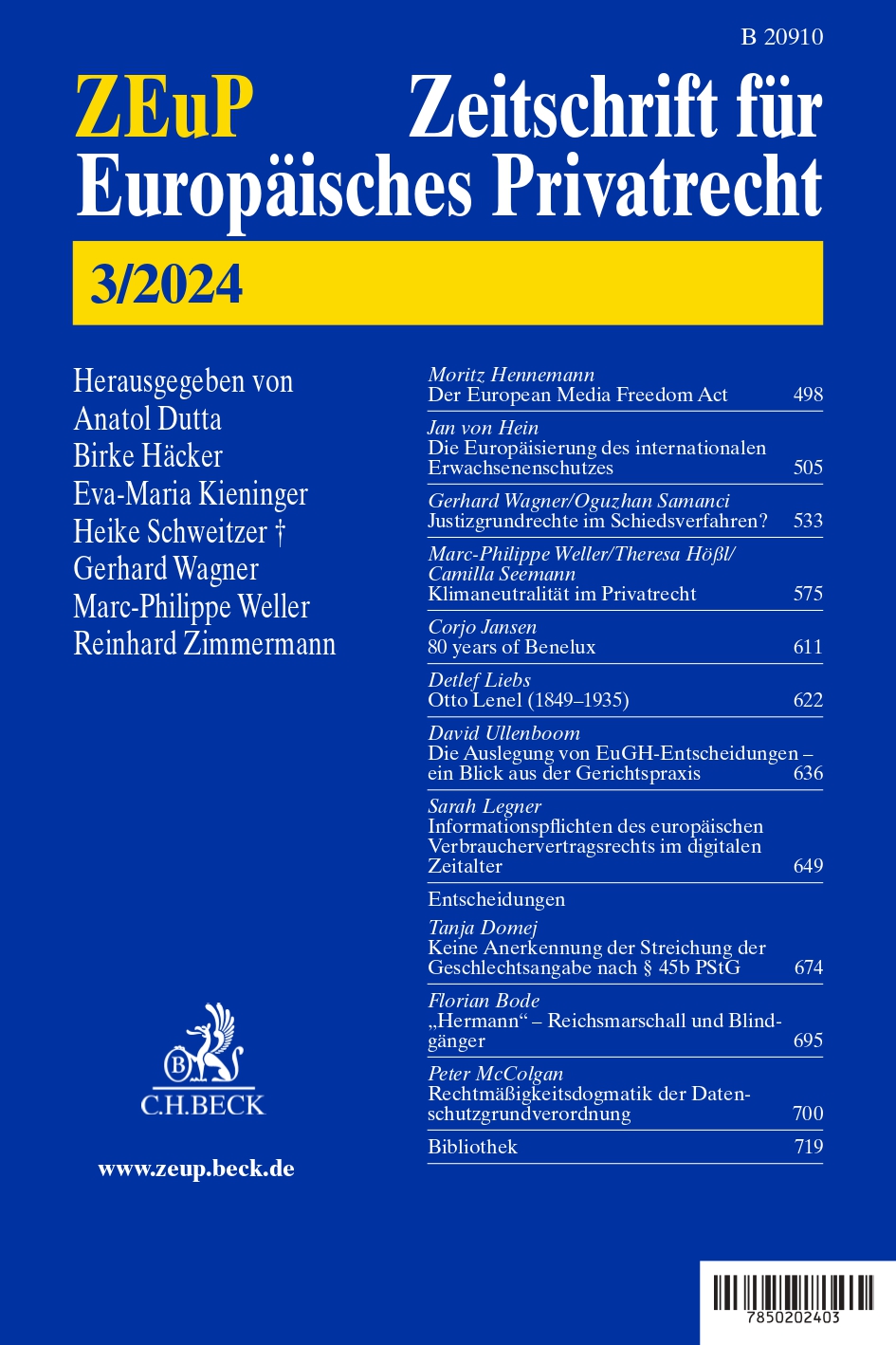
The following contributions might be of particular interest for the readers of this blog:
- Die Europäisierung des internationalen Erwachsenenschutzes
Jan von Hein on the proposal for a regulation on the international protection of adults: On 31.5.2023, the European Commission presented a proposal for a regulation on the international protection of adults. This proposal is closely intertwined with the Hague Convention on the international protection of adults. Therefore, the proposed regulation shall be accompanied by a Council decision authorising Member States to become or remain parties to the Hague Convention. The following contribution analyses the proposed regulation and its relationship with the Hague Convention. - Justizgrundrechte im Schiedsverfahren? – Pechstein und die Folgen fu?r die Handelsschiedsgerichtsbarkeit
Gerhard Wagner and Oguzhan Samanci on human rights and commercial arbitration: Does the ECHR and the German constitution require public hearings in arbitral proceedings, provided that one of the parties had the power to impose the arbitration agreement on the other through a contract of adhesion? This article analyzes the potential implications that the Pechstein decision of the Federal Constitutional Court and ist precursor in the jurisprudence of the ECHR may have for commercial arbitration. The focus is on arbitration clauses in general business terms and in contracts with undertakings that occupy a dominant position in a specific market. The conclusion is that, despite the broad formula employed by the Federal Constitutional Court, the right to a public hearing should remain limited to sports arbitration. - Die Auslegung von EuGH-Entscheidungen – ein Blick aus der Gerichtspraxis
David Ullenboom on the interpretation of CJEU decisions: This article examines the question whether a European methodology is needed to interpret judgments of the CJEU for judicial practice. It argues that judgments of the CJEU need to be interpreted in the same way as legal provisions and are therefore subject to a grammatical, systematic, genetic and teleological interpretation in order to determine their meaning for future legal cases. - Schweizerisches Bundesgericht, 8 June 2023, 5A_391/2021
Tanja Domej discusses a decision of the Swiss Federal Tribunal on the recognition of the deletion of a gender registration under German law.