


Views
Foreign law illegality and non-contractual claims
Written by Marcus Teo (Sheridan Fellow (Incoming), National University of Singapore)
Since Foster v Driscoll [1929] 1 KB 470, common law courts have recognised that contracts made with the intention to commit a criminal offence in a foreign state are unenforceable, even if the contract contemplated an alternative mode or place of performance. However, recent developments in domestic law illegality have sparked debate on whether foreign law illegality too should be reformed in a similar light (see Ryder Industries Ltd v Chan Shui Woo [2016] 1 HKC 323, [36], [52]-[55]; cf Magdeev v Tsvetkov [2020] EWHC 887 (Comm), [331]-[332]). The debate, however, has thus far not considered whether foreign law illegality should expand to bar certain non-contractual claims – a question which the Singapore Court of Appeal’s recent decision in Jonathan Ang v Lyu Yan [2021] SGCA 12 raises.
Lyu Yan wanted to transfer money from China to Singapore. Her bank in Singapore introduced her to Joseph Lim for assistance. Joseph proposed that Lyu transfer Renminbi from Lyu’s Chinese bank account to the Chinese bank accounts of two other individuals, Jonathan Ang and Derek Lim. Jonathan and Derek would then transfer an equivalent sum in Singapore Dollars from their Singapore bank accounts to Lyu’s Singapore bank account. Lyu performed the transfer in China, but received no money in Singapore. She then sued Joseph for breach of contract; and sued Joseph, Jonathan and Derek in tort and unjust enrichment. At first instance, the Singapore High Court ruled against all three defendants. Joseph did not appeal, but Jonathan and Derek did, arguing, inter alia, that Foster barred Lyu’s non-contractual claims against them because Chinese law prohibited their transaction.
Andrew Phang JCA, who delivered the Court’s judgment, dismissed Jonathan and Derek’s appeal. It was undisputed that the transaction, if performed, would have violated Chinese law (See Lyu Yan v Lim Tien Chiang [2020] SGHC 145, [15]-[16]). However, Lyu did not intend to break Chinese law – the facts at their “highest” showed that she thought the transaction contravened Singapore law rather than Chinese law (Jonathan Ang, [18], [20]). Thus, since Foster does not apply if the claimant does not intend to contravene a specific foreign law, it was inapplicable.
Of interest, though, were Phang JCA’s obiter comments: if Lyu had known the transaction contravened Chinese law, would her non-contractual claims be barred? Foster, he noted, was “not applicable in relation to non-contractual claims” ([26]). This was contrasted with the position in domestic law illegality, where an illegality affecting a contract could sometimes also bar other non-contractual claims arising from the contractual relationship ([27]-[28]). Here, Phang JCA referenced Ochroid Trading Ltd v Chua Siok Lui [2018] 1 SLR 363, where the Court of Appeal had held that claims in unjust enrichment (and, potentially, tort) arising from a contractual relationship would be barred if it stultified the policy underlying the law which rendered the contract unenforceable (Ochroid Trading [145]-[159], [168])
Phang JCA then considered whether Foster and Ochroid Trading could be “read together” (Jonathan Ang, [30]) – i.e., whether foreign and domestic law illegality, as separate doctrines, could apply on the same facts. This could only happen when Singapore law was the lex contractus, because, while Foster barred contract claims “regardless of their governing laws”, Ochroid Trading barred only claims governed by Singapore law. If indeed Foster and Ochroid Trading were “read together”, however, “possible difficulties” arose, because it would put a plaintiff with a Singapore law contract in a worse position than a plaintiff with a foreign law contract: the former would potentially have both his contractual and non-contractual claims barred, while the latter would have only his contractual claim barred ([33]). To Phang JCA, this was undesirable, because there was “no principled reason” for this distinction ([34]). While Phang JCA did not attempt to resolve these “difficulties”, he concluded by noting that for both foreign law and domestic law illegality “the concept of policy serves as a limiting factor to ensure that the illegality involved does not inflexibly defeat recovery where such recovery is justified” ([34]) – presumably, then, Phang JCA was noting tentatively that recourse to public policy arguments might help ameliorate the differences between the two classes of plaintiffs he identified.
Phang JCA’s comments in Jonathan Ang raise more questions than answers; this was of course by design, given their tentative and exploratory nature. However, with respect, the correctness of some of the assumptions Phang JCA relied on may be doubted. First, one may only conclude that there is no “principled reason” for treating plaintiffs with Singapore law contracts differently from plaintiffs with foreign law contracts if one accepts that domestic and foreign law illegality share the same “principled” basis. However, Foster’s principled basis remains shrouded in uncertainty: courts and commentators have variously called it a doctrine of public policy, comity and international jurisdiction, but only the first conception of Foster aligns it with domestic law illegality. Second, while it is true that the public policies of the forum limit both domestic and foreign law illegality, those public policies perform that function in different ways in those two contexts. In domestic law illegality, courts ask whether barring the plaintiff’s claim would give effect to the forum’s public policies; but in foreign law illegality, courts ask whether denying recognition of the relevant foreign law, and thus allowing the plaintiff’s claim, would give effect to the forum’s public policies. It follows that public policy arguments may not consistently resolve differences between the two classes of plaintiffs identified by Phang JCA.
At base, the questions posed in Jonathan Ang (and the assumptions they relied on) were only relevant because of Phang JCA’s continued acceptance of one central proposition: that foreign law illegality bars only contractual claims. Yet, this proposition is doubtful; in Brooks Exim Pte Ltd v Bhagwandas Naraindas [1995] 1 SLR(R) 543, Singapore’s Court of Appeal considered Foster in relation to a claim for “money had and received”, and found it inapplicable only because parties there did not intend to breach foreign law (Brooks Exim, [1], [14]). Moreover, the justification for limiting Foster’s rule to contractual claims remains unclear: in Jonathan Ang Phang JCA cited the English High Court’s decision in Lilly Icos LLC v 8PM Chemists Ltd [2010] FSR 4 for it, but there that proposition was simply accepted without argument (Lilly Icos, [266]). A possible justification might be that only in contract claims may parties, by virtue of their ability to choose the governing law, avoid the applicability of the (criminal) law of a foreign state objectively connected to their relationship. This, however, would be a poor justification, since parties have the autonomy to choose the governing law for various non-contractual claims as well. An expressly chosen law, for example, may govern not just parties’ contract, but also claims in unjust enrichment arising from that contractual relationship by virtue of a characterization sub-rule, and potentially also tort claims under an exception to the lex loci delicti rule (or, in Singapore’s context, the double actionability rule). If foreign law illegality exists to prevent parties from avoiding the law of a state objectively connected to their contractual relationship, it should bar all claims arising from that contractual relationship governed by parties’ chosen law, regardless of whether those claims are “contractual” or “non-contractual”.
Just released: Opinion of the US Supreme Court regarding the consolidated Ford Motor cases – A victory for consumers in two defective-product cases
Written by Mayela Celis
On 25 March 2021, the US Supreme Court rendered its opinion on the consolidated Ford Motor cases, which deals with personal jurisdiction (in particular, specific jurisdiction) over Ford Motor Company. These cases deal with a malfunctioning 1996 Ford Explorer and a defective 1994 Crown Victoria vehicles, which caused the death of a passenger in Montana and the injury of another passenger in Minnesota, respectively. The consolidated cases are: Ford Motor Co. v. Montana Eighth Judicial District Court et al. and Ford Motor Co. v. Bandemer.
The opinion is available here. We have previously reported on this case here.
The question presented was:
The Due Process Clause permits a state court to exercise specific personal jurisdiction over a nonresident defendant only when the plaintiff’s claims “arise out of or relate to” the defendant’s forum activities. Burger King Corp. v. Rudzewicz, 471 U.S. 462, 472 (1985) (internal quotation marks omitted). The question presented is: Whether the “arise out of or relate to” requirement is met when none of the defendant’s forum contacts caused the plaintiff’s claims, such that the plaintiff’s claims would be the same even if the defendant had no forum contacts.
As noted in our previous post, it can be argued that besides jurisdictional matters relating to the defendant, these cases deal with fundamental notions of access to justice for consumers. Fortunately, the US Supreme Court sided with the victims of the car accidents. As a result, buyers of Ford vehicles are able to sue in their home State / the place of injury (instead of chasing up the defendant). Undoubtedly, this promotes access to justice as it decreases the litigation costs of suing a giant company elsewhere, as well as it avoids the hardship of suing in a remote place.
For a summary of the facts, see the syllabus of the opinion. We also include the facts here:
“Ford Motor Company is a global auto company, incorporated in Delaware and headquartered in Michigan. Ford markets, sells, and services its products across the United States and overseas. The company also encourages a resale market for its vehicles. In each of these two cases, a state court exercised jurisdiction over Ford in a products-liability suit stemming from a car accident that injured a resident in the State. The first suit alleged that a 1996 Ford Explorer had malfunctioned, killing Markkaya Gullett near her home in Montana. In the second suit, Adam Bandemer claimed that he was injured in a collision on a Minnesota road involving a defective 1994 Crown Victoria. Ford moved to dismiss both suits for lack of personal jurisdiction. It argued that each state court had jurisdiction only if the company’s conduct in the State had given rise to the plaintiff’s claims. And that causal link existed, according to Ford, only if the company had designed, manufactured, or sold in the State the particular vehicle involved in the accident. In neither suit could the plaintiff make that showing. The vehicles were designed and manufactured elsewhere, and the company had originally sold the cars at issue outside the forum States. Only later resales and relocations by consumers had brought the vehicles to Montana and Minnesota. Both States’ supreme courts rejected Ford’s argument. Each held that the company’s activities in the State had the needed connection to the plaintiff’s allegations that a defective Ford caused instate injury” (Our emphasis).
Ford alleged that the Court should follow a causation-only approach. That means that as stated in the syllabus of the opinion that “In Ford’s view, due process requires a causal link locating jurisdiction only in the State where Ford sold the car in question, or the States where Ford designed and manufactured the vehicle. And because none of these things occurred in Montana or Minnesota, those States’ courts have no power over these cases.”
Fortunately, the Court did not follow that interpretation and stated that:
“To see why Ford is subject to jurisdiction in these cases (as Audi, Volkswagen, and Daimler were in their analogues), consider first the business that the company regularly conducts in Montana and Minnesota. See generally 395 Mont., at 488, 443 P. 3d, at 414; 931 N. W. 2d, at 748; supra, at 3?4. Small wonder that Ford has here conceded “purposeful availment” of the two States’ markets. See supra, at 7-8. By every means imaginable—among them, billboards, TV and radio spots, print ads, and direct mail— Ford urges Montanans and Minnesotans to buy its vehicles, including (at all relevant times) Explorers and Crown Victorias. Ford cars—again including those two models—are available for sale, whether new or used, throughout the States, at 36 dealerships in Montana and 84 in Minnesota. And apart from sales, Ford works hard to foster ongoing connections to its cars’ owners. The company’s dealers in Montana and Minnesota (as elsewhere) regularly maintain and repair Ford cars, including those whose warranties have long since expired. And the company distributes replacement parts both to its own dealers and to independent auto shops in the two States. Those activities, too, make Ford money. And by making it easier to own a Ford, they encourage Montanans and Minnesotans to become lifelong Ford drivers” (our emphasis).
[…]
“Here, resident-plaintiffs allege that they suffered in-state injury because of defective products that Ford extensively promoted, sold, and serviced in Montana and Minnesota. For all the reasons we have given, the connection between the plaintiffs’ claims and Ford’s activities in those States— or otherwise said, the “relationship among the defendant, the forum[s], and the litigation”—is close enough to support specific jurisdiction. Walden, 571 U. S., at 284 (internal quotation marks omitted). The judgments of the Montana and Minnesota Supreme Courts are therefore affirmed.”
In sum, in this David and Goliath scenario, the US Supreme Court sided with the consumers and promoted access to justice.
The Nigerian Court of Appeal declines to enforce a Commonwealth of Virginia (in USA) Choice of Court Agreement
I am coordinating together with other African private international law experts (Richard Frimpong Oppong, Anthony Kennedy, and Pontian Okoli) an extended and in-depth version of this blog post and more topics, titled “Investing in English-speaking Africa: A private international law toolkit”, which will be the topic of an online Master Class at TMC Asser Institute on June 24-25, 2021.
Introduction
In the year 2020, the Nigerian Court of Appeal delivered at least three decisions on foreign choice of court agreements.[1] I discussed two of those cases in this blog here and here. In the first two decisions delivered in the year 2020, the Nigerian Court of Appeal gave full contractual effect to the parties’ foreign choice of court agreement.[2] In other words, the Nigerian Court of Appeal interpreted the parties’ foreign choice of court agreement strictly according to is terms as it would do to a contractual document between commercial parties.
In November 30 2020, the Nigerian Court of Appeal delivered a third decision where it declined to enforce a Commonwealth of Virginia (in USA) Choice of Court Agreement.[3] In this connection, the author is of the view that the Court of Appeal’s decision was delivered per incuriam. This is the focus of this comment.
Facts
In this case, the claimant/respondent commenced action at the Kaduna High Court with a writ of summons and statement of claim dated the 18th December, 2018 wherein it claimed against the defendant/appellant, the sum of $18,103.00 (USD) being due and unpaid software licensing fee owed by them by virtue of the agreement between the parties dated 12th day of June, 2013.
The defendant/appellant filed a conditional appearance along with a Statement of defence and counter affidavit. Its argument, inter alia, was that by virtue of Article 12 and 13 of their agreement, the Nigerian court had no jurisdiction in this case. The relevant portion of their agreement reads as follows:
“ARTICLE 12
GOVERNING LAW: The Agreement shall be governed by and construed in accordance with the laws of the Commonwealth of Virginia, USA without regard to the principle of conflicts of any jurisdiction.”
“ARTICLE 13
With the exception of an action or suit for the Licensee’s failure to make any payment required hereunder when there was no suit or action arising under this Agreement may be brought more than one (1) year following the occurrence giving rise thereto. All suits and actions arising under this Agreement shall be brought in the Commonwealth of Virginia, USA and License hereby submits to the jurisdiction of the Courts of the Commonwealth of Virginia and the United States District Courts Sitting in Virginia.”
By a ruling delivered on the 11th December, 2019, the trial High Court entered judgment in favour of the claimant/respondent. The defendant/appellant appealed to the Nigerian Court of Appeal.
Decision
Though the Court of Appeal (Hussaini JCA) was of the view that the choice of court agreement in favour of the Commonwealth of Virginia (in USA) was clear and unambiguous and did not have any vitiating circumstances surrounding it (such as fraud), it unanimously held that it would not apply the principle of pacta sunt servanda (agreements between parties should be respected) in this case. It followed the obiter dictum of Oputa JSC which reads as follows:
“[Nigerian] Courts should not be too eager to divest themselves of jurisdiction conferred on them by the Constitution and by other laws simply because parties in their private contracts chose a foreign forum … Courts guard rather jealously their jurisdiction and even where there is an ouster clause of that jurisdiction by Statute it should be by clear and unequivocal words. If that is so, as is indeed it is, how much less can parties by their private acts remove the jurisdiction properly and legally vested in our Courts ? Our courts should be in charge of their own proceedings. When it is said that parties make their own contracts and that the courts will only give effect to their intention as expressed in and by the contract, that should generally be understood to mean and imply a contract which does not rob the Court of its jurisdiction in favour of another foreign forum.”[4]
In applying this obiter dictum to the facts of the case, Hussaini JCA held as follows:
“By reason of Section 6(1)(2)(6)(b) of the Constitution of FRN, 1999 (as amended) the judicial powers vested in the Courts “extend to all matters between persons or between Government or authority and to any person in Nigeria, and to all actions and proceedings relating thereto, for the determination of any question as to the civil rights and obligations of that person”. Consequently, no person or group of persons by their own private treaty or arrangements can agree to oust the jurisdiction and provisions vested in the Courts by the Constitution. Even where such clauses are put in place in or as a contract with international flavour to rob the Courts of the land of jurisdiction in favour of another foreign forum, the Courts of the land are obliged to apply the blue pencil rule to severe those clauses from the contract or ignore same by virtue of the Constitutional provision which confer on the Court, the jurisdiction and power to entertain those cases.
Talking about the jurisdiction of the Courts, the Court below, by virtue of Section 272 of the Constitution of Federal Republic of Nigeria, 1999 (as amended) has jurisdiction to entertain cases such as recovery of debts, as in the instant case on appeal. It is for this reason that clauses in the likes of Articles 12 and 13 in the Article of the Agreement should be ignored when determining the rights and liabilities between the parties herein in matters such as this and the trial Court took the right approach when it discountenanced same to reach the conclusion that it did.
In any case, is it for the recovery of the sum of $18,103, (USD) only claimed by the Respondents, that parties herein are required, by that contract or agreement to submit themselves to a foreign forum in Virginia, USA for adjudication of their case, without consideration of the concomitant procedural difficulties attendant thereto, as for instance, of having to return the case to Nigeria, the place where the contract was concluded initially, to register the judgment obtained at that foreign forum, in Virginia, USA, to be enforced in Nigeria? I think the Courts in Nigeria, fully seized of the case, will in the exercise of its discretion refuse the request to refer the case to a foreign forum for adjudication. It is for all the reasons already expressed in this discourse that I hold the firm view that the trial Court was competent or is competent when it entertained and adjudicated over the recovery suit or action filed by the Respondent against the Appellant.”[5]
Comments
There are five comments that could be made about the Court of Appeal’s decision (Hussaini JCA) in A.B.U. v VTLS.[6] First, the Court of Appeal (Hussaini JCA) in A.B.U. v VTLS[7] followed Oputa JSC’s obiter dictum in Sonnar (Nig) Ltd v Partenreedri MS Norwind.[8] It should be stressed that Oputa JSC’s obiter dictum is not binding on lower courts according to the Nigerian common law doctrine of stare decisis. In addition, Oputa JSC’s obiter dictum was a concurring judgment. Indeed, the Supreme Court in Sonnar (supra) had unanimously given preference to the enforcement of a foreign jurisdiction clause except where strong cause is advanced to the contrary.[9] The majority of the Supreme Court did not treat it as an ouster clause. It is incongruous to hold, on the one hand, that the Nigerian court would hold parties to their bargain in enforcing a foreign jurisdiction clause except where strong cause is shown to the contrary, and on the other hand, treat a foreign jurisdiction clause as if it were an ouster clause. In Sonnar, the choice of court agreement was not enforced because strong cause was shown to the contrary – the proceedings would be time-barred in a foreign forum, and the claimant would not have access to justice.
Furthermore, the Nigerian Supreme Court in another case held that where a plaintiff sues in Nigeria in breach of a foreign jurisdiction clause, Nigerian law “requires such discretion to be exercised by granting a stay unless strong cause for not doing so is shown. The burden of showing such strong cause for not granting the application lies on the doorsteps of…the plaintiff.”[10] The Supreme Court in this case enforced the choice of court agreement and stayed the proceedings in Nigeria because the plaintiff did not file a counter affidavit to demonstrate strong reasons why the proceedings should not be heard in a foreign forum chosen by the parties.[11]
If the ratio decidendi in the Supreme Court cases in Sonar and Nika are applied to the recent Court of Appeal’s decision in A.B.U. v VTLS (supra), it is clear that the Court of Appeal (Hussaini JCA) reached its decision per incuriam. There was nothing in the judgment to demonstrate that the plaintiff provided strong reasons (such as time bar in a foreign forum) why the choice of court agreement in favour of the Commonwealth of Virginia (in USA) should not be enforced. The argument that the choice of court agreement is an ouster clause without more is not a strong reason not to enforce the choice of court agreement.
Second, a foreign choice of court agreement does not mean the Nigerian court’s jurisdiction no longer exists (without jurisdiction) under the Nigerian Constitution, as the Court of Appeal (Hussaini JCA) held in this case. Such jurisdiction exists, but it is up to the Nigerian court in exercise of its jurisdiction to decide whether or not to stay proceedings. This view is consistent with the Nigerian Supreme Court’s decisions in Sonar and Nika. The fact that such proceedings are stayed and not dismissed means that a Nigerian court’s jurisdiction is not ousted.
Third, some Nigerian judges confuse choice of court with choice of law. The Court of Appeal (Hussaini JCA) also fell into this error. The choice of the law of the Commonwealth of Virginia is not the same thing as choosing the courts of the Commonwealth of Virginia. For example, the Nigerian courts could assume jurisdiction and apply the law of the Commonwealth of Virginia.
Fourth, looking at the bigger picture, I generally acknowledge that the principle of pacta sunt servanda in enforcing choice of court agreements are aimed at enhancing the efficacy of business transactions and, legal certainty and predictability in international commercial litigation. However, I must point out that despite the Nigerian Supreme Court decisions on the point that hold that choice of court agreements should be enforced except there are strong reasons to the contrary, I am generally not in favour of Nigerian courts declining jurisdiction in international commercial litigation. It ultimate hurts the Nigerian economy (e.g. less job for Nigerian lawyers), hampers access to Nigerian justice, and does not help Nigerian judges in strengthening our legal system. What is the solution? I suggest that in the future the Nigerian Supreme Court should apply the test of “interest of justice” in determining whether or not it will enforce a choice of court agreement. The burden of proof should rest on the claimant to manifestly demonstrate that taking into account all the relevant circumstances of the case, the interest of justice will not be served if the foreign choice of court agreement is enforced. I also suggest that in such cases where a foreign choice of court agreement is enforced in Nigeria, a stay should be granted. In addition, if it is sufficiently demonstrated that the chosen foreign forum later becomes inaccessible or impracticable for the claimant to sue, the Nigerian court in the interest of justice should retain jurisdiction to handle such claims.
Fifth, Nigeria should consider ratifying the Hague Choice of Court Convention, 2005. This Convention will work better in Nigerian courts if litigation is made attractive for international commercial actors, so they can designate Nigerian courts as the chosen forum. Speed, efficiency, legal aid for poor and weaker parties, and integrity of the Nigeria’s system are some of the issues that can be taken into account in enhancing Nigeria’s status as an attractive forum for international commercial litigation.
Conclusion
The Nigerian Court of Appeal has delivered three reported decisions on choice of court agreements in the year 2020. The recent Court of Appeal’s decision in A.B.U. v VTLS (supra) was reached per incuriam because it is inconsistent with Nigerian Supreme Court decisions that hold that a choice of court agreement should be enforced except there are strong reasons to the contrary.
The Nigerian Supreme Court in the future should rise to the occasion to create new tests for determining if a choice of court agreement should be enforced in Nigeria. These tests should reconcile the needs of access to Nigerian justice on the one hand, and respecting the contractual agreements of parties to designate a foreign forum.
The Nigerian government should create the necessary infrastructure and requirements that will enable Nigeria effectively ratify and implement the Hague Convention on Choice of Court agreements, 2005.
[1] Kashamu v UBN Plc (2020) 15 NWLR (Pt. 1746) 90; Damac Star Properties LLC v Profitel Limited (2020) LPELR-50699(CA); A.B.U. v VTLS (2020) LPELR-52142 (CA).
[2] Kashamu v UBN Plc (2020) 15 NWLR (Pt. 1746) 90; Damac Star Properties LLC v Profitel Limited (2020) LPELR-50699(CA).
[3] A.B.U. v VTLS (2020) LPELR-52142 (CA).
[4](1987) 4 NWLR 520, 544 – 45, approving Lord Denning’s statement in The Fehmarn [ 1958 ] 1 All ER 333 , 335 . Cf. Conoil Plc v Vitol SA (2018) 9 NWLR 463, 489 (Nweze JSC) – “our courts will only interrogate contracts which are designed to rob Nigerian courts of their jurisdiction in favour of foreign fora or where, by their acts, they are minded to remove the jurisdiction, properly and legally, vested in Nigerian courts.” See also LAC v AAN Ltd (2006) 2 NWLR 49, 81 (Ogunbiyi JCA as she then was).
[5]A.B.U. v VTLS (2020) LPELR-52142 (CA) 15 – 18.
[6] (2020) LPELR-52142 (CA),
[7] (2020) LPELR-52142 (CA),
[8](1987) 4 NWLR 520, 544 – 45
[9] Even Oputa JSC held thus: ‘Where a domestic forum is asked to stay proceedings because parties in their contract chose a foreign Court … it should be very clearly understood by our courts that the power to stay proceedings on that score is not mandatory. Rather it is discretionary which in the ordinary way, and in the absence of strong reasons to the contrary will be exercised both judiciously and judicially bearing in mind each parties right to justice ’ –Sonnar (supra) at 545 (emphasis added).
[10] Nika Fishing Company Ltd v Lavina Corporation (2008) 16 NWLR 509, 535 (Mohammed JSC, as he then was).
[11] Conoil Plc v Vitol SA (2018) 9 NWLR 463, 489 (Nweze JSC), 500-1 (Okoro JSC), 502 (Eko JSC).
News
Call for Applications: Lindemann Fellowship for Private International Law
Call for Applications
Lindemann Fellowship for Private International Law
The Lindemann Fellowship, generously funded by the Lindemann Foundation, is a newly established initiative aimed at supporting promising academics in the field of private international law. The Fellowship’s primary
goal is to provide early-career researchers with the opportunity to build a network with academics from all over Europe. Fellows will, in principle, be accepted for a three-year period, with new Fellows joining each year, as existing Fellows complete their tenure.
AMEDIP’s upcoming webinar: Private international law aspects in the case Estados Unidos Mexicanos v. Smith & Wesson Brands, et al. (28 November 2024 – in Spanish)

The Mexican Academy of Private International and Comparative Law (AMEDIP) is holding a webinar on Thursday 28 November 2024 at 14:30 (Mexico City time – CST), 21:30 (CET time). The topic of the webinar is the private international law aspects in the case Estados Unidos Mexicanos (Mexico) v. Smith & Wesson Brands et al. and will be presented by Dr. Manuel Segovia González (in Spanish). We have previously reported on the case here.
RabelsZ: New issue alert
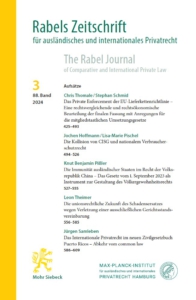 Issue 3 of RabelsZ 2024 has just been released. It contains the following articles:
Chris Thomale and Stephan Schmid, Das Private Enforcement der EU-Lieferkettenrichtlinie – Eine rechtsvergleichende und rechtsökonomische Beurteilung der finalen Fassung mit Anregungen für die mitgliedstaatlichen Umsetzungsgesetze (Private Enforcement in the EU Supply Chain Directive: A Critical Comparative Law and Economics Analysis of the Final Compromise with Suggestions for its Implementation by the Member States), pp. 425–493, https://doi.org/10.1628/rabelsz-2024-0046 Read more