
[Out Now!] New Open Access Book on Corruption and Investment Arbitration: Nobumichi Teramura, Luke Nottage and Bruno Jetin (eds), Corruption and Illegality in Asian Investment Arbitration (Springer, 2024)


Nobumichi TERAMURA (Assistant Professor, Universiti Brunei Darussalam; Affiliate, Centre for Asian and Pacific Law in the University of Sydney), Luke Nottage (Professor of Comparative and Transnational Business Law, Sydney Law School) and Bruno Jetin (Associate Professor of Economics, Universiti Brunei Darussalam) published an edited volume entitled “Corruption and Illegality in Asian Investment Arbitration” from Springer on 20 April 2024. The book is an open access title, so it is freely available to any states and organisations, including less well-resourced institutions in transitioning economies. Corrupt behaviour by foreign investors, like bribery to local government officials, faces wide condemnation in any society. Nevertheless, there remains a paucity of research appraising the consequences of corruption and illegality affecting international investment in Asia, especially investment arbitration involving East and South Asian jurisdictions. This book intends to fill the gap from an interdisciplinary (legal-economic) perspective.
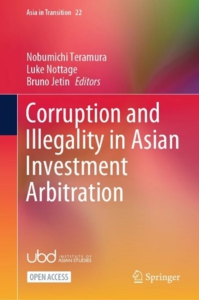 The volume’s description reads as follows:
This open access book explores Asian approaches towards investment arbitration—a transnational procedure to resolve disputes between a foreign investor and a host state—setting it in the wider political economy and within domestic law contexts. It considers the extent to which significant states in Asia are, or could become, “rule makers” rather than “rule takers” regarding corruption and serious illegality in investor-state arbitration. Corruption and illegality in international investment are widely condemned in any society, but there remains a lack of consensus on the consequences, especially in investment arbitration. A core issue addressed is whether a foreign investor violating a host state’s law should be awarded protection of its investment, as per its contract with the host state and/or the applicable investment or trade agreement between the home state and the host state. Some suggest such protection would be unnecessary as the investor committed a crime in the host state, while others attempt to establish an equilibrium between the investor and the host state. Others claim to protect investment, invoking the sanctity of promises made. The book starts with a deep dive into economic and legal issues in corruption and investment arbitration and then explores the situation and issues in major countries in the region in detail. It is a useful reference point for lawyers, economists, investors, and government officials who are seeking comprehensive and up-to-date information on anti-bribery rules in Asian investment treaties. It is of particular interest to students and researchers in economics, finance, and law, who are undertaking new research relating to the multifaceted impacts of corruption.
The book’s table of contents is as follows:
Chapter 1 – “Bribery and Other Serious Investor Misconduct in Asian International Arbitration” by Nobumichi Teramura, Luke Nottage and Bruno Jetin;
Chapter 2 – “Does Corruption Hinder Foreign Direct Investment and Growth in Asia and Beyond? The Grabbing Versus the Helping Hand Revisited” by Ahmed M Khalid (Professor of Economics, Universiti Brunei Darussalam);
Chapter 3 – “The Effect of Corruption on Foreign Direct Investment at the Regional Level: A Positive or Negative Relationship?” By Bruno Jetin, Jamel Saadaoui (Senior Lecturer of Economics, The University of Strasbourg), Haingo Ratiarison (The University of Strasbourg);
Chapter 4 – “Anti-Corruption Laws and Investment Treaty Arbitration: An Asian Perspective” by Anselmo Reyes (International Judge, Singapore International Commercial Court) and Till Haechler (Associate, Lenz & Staehelin);
Chapter 5 – “Multi-Tiered International Anti-Corruption Cooperation in Asia: A Review of Treaties and Prospects” by Yueming Yan (Assistant Professor, Chinese University of Hong Kong) and Tianyu Liu (ADR Case Manager, Hong Kong International Arbitration Centre);
Chapter 6 – “Corruption in International Investment Arbitration” by Michael Hwang SC (Arbitrator, Michael Hwang Chambers) and Aloysius Chang (Michael Hwang Chambers);
Chapter 7 – “Rebalancing Asymmetries Between Host States and Investors in Asian Investor–State Dispute Settlement: An Exception for Systemic Corruption” by Martin Jarrett (Senior Research Fellow, Max Planck Institute for Comparative Public Law and International Law);
Chapter 8 – “Foreign Investment, Investment Treaties and Corruption in China and Hong Kong” by Vivienne Bath (Professor of Chinese Law, Sydney Law School) and Tianqi Gu (Sydney Law School);
Chapter 9 – “Corruption and Investment Treaty Arbitration in India” by Prabhash Ranjan (Professor and Vice Dean, Jindal Global Law School);
Chapter 10 – “Corruption and Illegality in Asian Investment Disputes: Indonesia” by Simon Butt (Professor of Indonesian Law, Sydney Law School), Antony Crockett (Partner, Herbert Smith Freehills Hong Kong) and Tim Lindsey (Malcolm Smith Chair of Asian Law and Redmond Barry Distinguished Professor, Melbourne Law School);
Chapter 11 – “Foreign Investment, Treaties, Arbitration and Corruption: Comparing Japan” by Luke Nottage and Nobumichi Teramura;
Chapter 12 – “Corruption and Investment Arbitration in the Lao People’s Democratic Republic: Corruptio Incognito” by Romesh Weeramantry (Special Counsel, Clifford Chance Perth) and Uma Sharma (Associate, Jones Day Singapore);
Chapter 13 – “Corruption and Illegality in Asian Investment Arbitration: The Philippines” by Thomas Elliot A Mondez (Faculty Member, De La Salle University, Philippines) and Jocelyn P Cruz (Associate Professor, De La Salle University, Philippines);
Chapter 14 – “Investment Arbitration, Corruption and Illegality: South Korea” by Joongi Kim (Professor Yonsei Law School);
Chapter 15 – “Foreign Investment, Corruption, Investment Treaties and Arbitration in Thailand” by Sirilaksana Khoman (Professor, Thammasat University, Thailand), Luke Nottage and Sakda Thanitcul (Professor, Chulalongkorn University); and
Chapter 16 – “Towards a More Harmonised Asian Approach to Corruption and Illegality in Investment Arbitration” by Nobumichi Teramura, Luke Nottage and Bruno Jetin.