Commercial Disputes and anti-suit relief in Anglophone Africa – a panel discussion 06 Oct 2023
Location: 12:00-1:00 pm UK Time Virtual Event (Zoom)
Members: FREE to attend – Book by 06 Oct
Non Members: Register above as a member and attend for FREE – Book by 06 Oct
https://conflictoflaws.net/News/2020/08/CoL_Banner-1.png00Béligh Elbaltihttps://conflictoflaws.net/News/2020/08/CoL_Banner-1.pngBéligh Elbalti2023-09-22 08:35:502023-09-22 16:56:40Commercial Disputes and anti-suit relief in Anglophone Africa
Trevor has long been one of the world’s most distinguished scholars of Conflict of Laws (Private International Law), continuing a tradition started at the LSE by Professor Otto Kahn-Freund. For many decades, he has been at the forefront of developments in the field. As a prominent critic, notably of the Court of Justice’s efforts to unify European private international law. But also as an active participant in projects of legislation and modernization. And as author of authoritative treatises and clear and accessible student textbooks.
https://conflictoflaws.net/News/2020/08/CoL_Banner-1.png00Béligh Elbaltihttps://conflictoflaws.net/News/2020/08/CoL_Banner-1.pngBéligh Elbalti2023-09-22 08:28:172023-09-22 16:54:58Symposium for Trevor Hartley at LSE on 27 October 2023
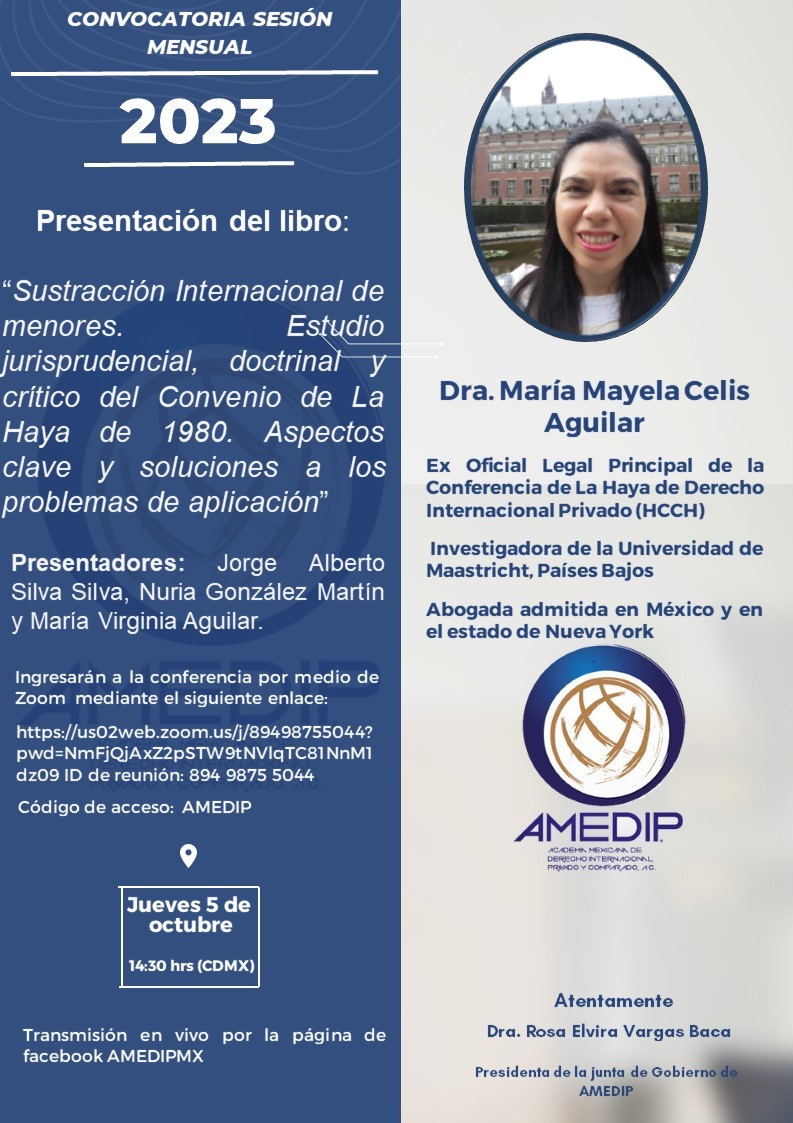
The Mexican Academy of Private International and Comparative Law (AMEDIP) is holding a webinar on 5 October 2023 at 2:30 pm (Mexico City time), 10:30 pm (Europe, CEST time) to launch the book entitled:
For more information about the book, see our previous post here.
The book will be presented by the author and the following AMEDIP members: Professors Jorge Alberto Silva Silva and Nuria González Martín, as well as the family law attorney María Virginia Aguilar.
The webinar will be held in Spanish and the details are:
https://conflictoflaws.net/News/2020/08/CoL_Banner-1.png00Mayela Celishttps://conflictoflaws.net/News/2020/08/CoL_Banner-1.pngMayela Celis2023-09-21 16:23:022025-07-21 13:45:09Book Launch: International Child Abduction, Mayela Celis (Madrid: Dykinson, 2023) on 5 October 2023 (in Spanish)
Written by Dr. Delphine Porcheron, Associate Professor at the University of Strasbourg Law Faculty
On October 19 and 20, the University of Strasbourg is organizing a symposium on Reparation for “Crimes of the Past”.
Mass crimes, deportations, spoliations, colonial exploitation, slavery… The “crimes of the past” are first known to us as historical facts. Their protagonists have mostly disappeared; they have been documented by historians; almost all of them are mentioned in school textbooks. They have become part of our collective memory as disastrous episodes of a bygone past.
https://conflictoflaws.net/News/2020/08/CoL_Banner-1.png00Samuel Fulli-Lemairehttps://conflictoflaws.net/News/2020/08/CoL_Banner-1.pngSamuel Fulli-Lemaire2023-09-21 07:32:472023-09-21 20:38:16Symposium on Reparation for “Crimes of the Past” in Strasbourg (Oct. 19–20)
The hybrid event will take place on 5 October, 5pm Swiss Time, both at the University of Lausanne, IDHEAP, AULA, and online (Zoom-Link; pw: 832357).
The event had originally been scheduled for 11 October (indicated wrongly above) but has been postponed for logistical reasons. The new date will be advertised shortly.
https://conflictoflaws.net/News/2020/08/CoL_Banner-1.png00Tobias Lutzihttps://conflictoflaws.net/News/2020/08/CoL_Banner-1.pngTobias Lutzi2023-09-18 12:48:422025-07-21 13:45:09Book Launch: Blockchain & Private International Law
The 2023 Annual Conference of the Chinese Society of Private International Law was held on 14-16 of September in Wuhan, PRC. This is probably the most important academic event for Chinese scholars specializing and researching in the area of private international law. This year, there were more than 300 participants.
After the HCCH Asia Pacific Week in Hong Kong, the Secretary General of the HCCH, Dr. Christophe Bernasconi was invited to attend the conference and give a speech. He was also invited to act as a commentator for a panel of plenary session which was conducted in English.
https://conflictoflaws.net/News/2020/08/CoL_Banner-1.png00Guangjian Tuhttps://conflictoflaws.net/News/2020/08/CoL_Banner-1.pngGuangjian Tu2023-09-18 11:18:192023-09-18 11:18:19The 2023 Annual Conference of the Chinese Society of Private International Law
HCCH Asia Pacific Week 2023 – Access to Justice and Sustainable Development: The Impact of the HCCH in an Inter-Connected World, was successfully held from 11 to 14 September 2023 in the Hong Kong Special Administrative Region (SAR), China.
The HCCH celebrated its 130th Anniversary during the HCCH Asia Pacific Week. During the week, many important conventions and instruments of the HCCH were promoted and examined by the experts from around the Asia Pacific Region.
Yuriko Haga, Professor at Seikei University, Avatars,Personalities in the Metaverse: Introductory Analysis on Conflict-of-Laws
When people perform various activities in the metaverse, another world on the Internet, they make avatars as their “proxy”, representing their personality. However, the connection between an avatar and its user is often unclear. In fact, avatars do not necessarily resemble to their user’s figure or face because people can decide its appearance at their disposal. The first question thus arises as to whether the attack on an avatar can be assimilated to an attack on the personality of a user, a person in real world. An avatar should be deemed part of the online personality of its user, and, considering the existing theory of personality rights, it is not completely separate from the person in the real world. Therefore, an attack brought against an avatar can deemed more or less an infringement against the user’s personality. The second question is then how to select the applicable law to such cases. An infringement of personality rights in the metaverse is by nature “international” because users can connect to that virtual “world” from all corners of the planet. This leads to a difficulty in determining the place that the connecting factor designates. This paper examines the applicability of actual Japanese conflict-of-laws rule to issues occurring in the metaverse to show its boundary. The traditional theory posits to apply national laws to resolve legal issues, but the world of metaverse is often governed by rules of its own. It follows that the conflict-of-laws theory should now consider the applicability of the rules of other communities, such as the metaverse.
https://conflictoflaws.net/News/2020/08/CoL_Banner-1.png00Cristina Mariottinihttps://conflictoflaws.net/News/2020/08/CoL_Banner-1.pngCristina Mariottini2023-09-16 08:29:002023-09-17 17:49:58Rivista di diritto internazionale privato e processuale (RDIPP) No 2/2023: Abstracts
The first issue of 2023 of Giustizia Consensuale (published by Editoriale Scientifica) has just been released, and it features:
Annalisa Ciampi (Professor at the University of Verona), La giustizia consensuale internazionale (International Consensual Justice; in Italian)
All means of dispute settlement between States, including adjudication, are based on the consent of the parties concerned. The post-Cold War era saw an unprecedented growth of third-party (judge or arbitrator) dispute resolution systems. In more recent years, however, we are witnessing a weakening of the international judicial function. This paper analyses and explains similarities and differences between dispute settlement between States and dispute resolution between private parties at the national level. Whilst doing so, it makes a contribution to the question of whether the de-judicialisation taking place in Italy and elsewhere, as well as in the international legal system, can be considered a step in the right direction.
Does a preliminary contract obliging the parties to conclude a future ‘contract for the provisions of services’ within the meaning of Article 7(1)(b) of the Brussels I bis Regulation borrow its characterisation from such a future contract and, as a consequence, the claims resulting from this preliminary contract can be brought before the courts for the place where the services were or should have been provided? This is the question that the Court of Justice answered in the negative in its judgment handed down this morning in the case EXTÉRIA, C-393/22.
https://conflictoflaws.net/News/2020/08/CoL_Banner-1.png00Krzysztof Paculahttps://conflictoflaws.net/News/2020/08/CoL_Banner-1.pngKrzysztof Pacula2023-09-14 12:09:442023-09-14 12:09:54Preliminary contract but not a ‘contract for the provision of services’ under Article 7(1)(b) of the Bru I bis Reg., CJEU in EXTÉRIA, C-393/22