
The 1961 HCCH Apostille Convention: Why All African Countries Should Ratify It? — Insights from Judicial Practice in Africa


I. The Apostille Convention
The HCCH has recently announced that “[o]n 9 July 2026, the Convention of 5 October 1961 Abolishing the Requirement of Legalisation for Foreign Public Documents (1961 Apostille Convention) entered into force for the People’s Democratic Republic of Algeria following the deposit of its instrument of accession on 5 November 2025.” With Algeria’s accession, the 1961 Apostille Convention now has 130 Contracting Parties, making it by far the most successful of all HCCH Conventions in terms of global participation.
The reason for this success appear to be straightforward: the Convention replaces the cumbersome and often costly chain of diplomatic and consular legalisations with a single formality: the issuance of an Apostille by the competent authority of the State from which the public document originates. Therefore, by considerably simplifying the circulation of public documents across borders, the Convention reduces both the time and expense involved in having documents recognised abroad, and significantly contributes to facilitating international mobility and cross-border legal transactions for individuals, businesses, and public official documents, including judgments, notarial deeds and authentic instruments alike.
2. The situation in Africa
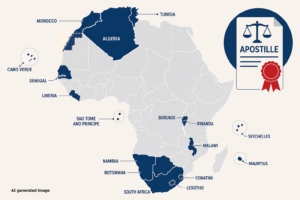
However, a closer look at the list of Contracting Parties reveals that only 17 African States have so far ratified the Convention. These are, Algeria, Botswana, Burundi, Cabo Verde, Eswatini, Lesotho, Liberia, Malawi, Mauritius, Morocco, Namibia, Rwanda, Sao Tome and Principe, Senegal, Seychelles, South Africa and Tunisia (countries in bold characters are HCCH Member States). In other words, only about 31% of the continent’s 54 sovereign States currently benefit from the simplified authentication procedure established by the Apostille Convention. This is the lowest rate in the world, as the following table clearly shows (AI generated table):
| Region | Contracting Parties | Total States | Coverage rate |
| Europe | 46 | 46 | 100.0% |
| North America (incl. Central America & Caribbean) | 20 | 23 | 87.0% |
| South America | 12 | 12 | 100.0% |
| Oceania | 9 | 14 | 64.3% |
| Asia | 26 | 49 | 53.1% |
| Africa | 17 | 54 | 31.5% |
| Total | 130 | 198 | 65.7% |
Yet, a closer look at judicial practice across Africa demonstrates beyond doubt the practical need for wider adherence to the Convention. Courts throughout the continent are frequently confronted with issues relating to the authentication and legalisation of foreign public documents, often resulting in delays, additional costs, and, in some cases, the refusal to admit or give effect to such documents because the applicable formal requirements have not been satisfied. Indeed, in a number of African states, particularly civil law jurisdictions, proof of the authenticity of a foreign judgment is one of the requirements for its enforcement. This is particularly the case in countries including Benin, Burkina Faso, Burundi, the Democratic Republic of Congo (DRC), Rwanda, and Mozambique, where authenticity is an independent requirement for the enforcement of foreign judgments. In some other African countries, notably Cameroon, Gabon, Guinea, Mali, and Senegal, while authenticity is not listed among the requirements for the enforcement of foreign judgments, reference to it is included in the list of documents to be submitted in support of the application for enforcement. More importantly, available case law shows that, where the Apostille Convention is not applicable, authentication is likely to become an issue in many jurisdictions.
III. Examples of judicial practice – The Rwandan High Commercial Court’s decision on the enforcement of a Congolese judgment
The difficulty stemming from the absence of a simplified method of authentication can be illustrated by a case decided by the High Commercial Court of Rwanda decided on 18 November 2021, which shows how how formal authentication requirements may become decisive in enforcement proceedings(*).
(*) Many thanks to Boris Awa (Kigali Independent University ULK, Kigali, Rwanda) for kindly sharing the text of the decision
1) Underlying facts
This case concerns the enforcement in Rwanda of a Congolese judgment. The background is rather complex, involving proceedings in both the DRC and Rwanda. It began with a successful action brought by X against his sister, Y, in the DRC, in which the court ordered Y to pay X a certain amount of money. X subsequently sought to enforce that judgment in Rwanda. Y opposed the enforcement on the ground that she had never been notified of the proceedings and had only become aware of the judgment when enforcement proceedings were initiated against her assets in Rwanda. The Rwandan courts, however, rejected her challenge and allowed the enforcement of the Congolese judgment (Judgment 1). Y then challenged the original judgment before the Congolese courts and succeeded in having it set aside in its entirety. She subsequently sought to enforce this second Congolese judgment in Rwanda so that the original judgment could no longer be enforced there.
2) Parties’ allegations
X eventually challenged the enforcement of the second Congolese judgment on the ground, inter alia, that it did not satisfy the requirement of authenticity. Y argued that there was no issue as to the judgment’s authenticity, since it bore the Congolese enforcement formula, certification by the Congolese Ministry of Foreign Affairs, certification by the Rwandan Embassy in the DRC, notarisation, certification by the Congolese Embassy in Rwanda, and authentication by the Rwandan Ministry of Foreign Affairs. According to Y, these certifications clearly established the authenticity of the judgment.
For his part, X argued that the copy of the judgment was not authentic because not all of its pages bore the required signatures and official stamps, as required by the standard practice in Rwanda. In particular, he maintained that affixing signatures and stamps only to the last page of a judgment of more than ten pages did not satisfy the applicable legal requirements.
3) The Court’s reasoning
The High Commercial Court refused to enforce the foreign judgment, holding that there was no proof that the chain of diplomatic certifications actually related to the judgment submitted for enforcement. In reaching this conclusion, the Court compared the judgment with another Congolese judgment in the case file (Judgment 1) and noted that every page of that judgment bore the complete chain of legalisation, including certification by the court, the Congolese Ministry of Foreign Affairs, the Rwandan Embassy, a Congolese notary, the Congolese Embassy in Rwanda, and the Rwandan Ministry of Foreign Affairs. The Court regarded this as the ordinary practice for Congolese judicial documents. Since the appellate judgment had not been authenticated in the same manner, it concluded that the applicant had failed to establish its authenticity.
IV. Insights
The Rwandan case is a good illustration of the practical difficulties associated with the traditional chain of legalization and authentication, particularly where questions arise as to whether the chain of authentications was physically attached to, and clearly identifiable with, the judgment itself. The decision illustrates the burden that the traditional system of diplomatic legalisation places on litigants. Had both Rwanda and the DRC been parties to the HCCH Apostille Convention, the lengthy chain of diplomatic and consular certifications that became the central issue in this case would likely have been replaced by a single Apostille certificate. This could have avoided the type of formal dispute that led to the refusal of exequatur.
The importance of authentication for the enforcement of foreign judgments is also illustrated by the available judicial practice in Mozambique, although the case law reflects a less rigorous approach. Indeed, according to the available decisions of the Mozambican Supreme Court, the authenticity of a foreign judgment is generally verified through the process of legalisation required by Article 540 of the Code of Civil Procedure. Where the required legalisation is not included in the initial application, the Supreme Court generally allows the applicant to submit the necessary documents at a later stage (see eg the Mozambican Supreme Court, Ruling of 5 October 2011, in which the Mozambican Supreme Court held that an English judgment could not proceed to review (recognition and enforcement) because it had not been recognised or authenticated by the Mozambican consular authorities in the United Kingdom, as required by Article 540 of the Code of Civil Procedure. The Court accordingly invited the applicant to cure the defect, but the proceedings were later dismissed after the applicant failed to comply).
Such practices vividly illustrate why African States should give greater consideration to joining the 1961 Apostille Convention. The increasing movement of persons, investment, trade, and family relationships within Africa and beyond requires foreign public documents to be produced before domestic authorities and courts with growing frequency. Yet, the traditional system of diplomatic and consular legalisation remains cumbersome, costly, and prone to disputes over formal requirements, often delaying or even preventing the recognition of documents whose authenticity is not genuinely in doubt. By replacing this complex chain of authentications with a single Apostille certificate, the Convention enhances legal certainty, reduces costs and delays, and facilitates access to justice. Wider adherence to the Convention would therefore represent a significant step towards improving cross-border judicial cooperation and promoting legal and commercial integration, both within Africa and with the rest of the world.
This situation also highlights the important role that the HCCH should continue to play in promoting the Convention across Africa. Much has already been done, but further efforts are needed to encourage wider adherence to the Convention.
Leave a Reply
Want to join the discussion?Feel free to contribute!