
RabelsZ: Issue 2/2026


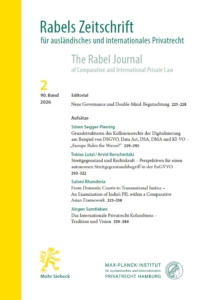 The latest issue of RabelsZ has just be released. It contains the following articles as well as an editorial with important information regarding the journal’s future governance structure and publication process. All content is Open Access: CC BY 4.0.
EDITORIAL
New Governance Structure and Double-Blind Peer Review, pp 225–228, https://doi.org/10.1628/rabelsz-2026-0020
ESSAYS
Sören Segger-Piening,Grundstrukturen des Kollisionsrechts der Digitalisierung am Beispiel von DSGVO, Data Act, DSA, DMA und KI-VO. „Europe Rules the Waves?“, [The Private International Law Dimensions of Digitalization. »Europe Rules the Waves?«], pp 229–292, https://doi.org/10.1628/rabelsz-2026-0012
The private international law of the digital single market is characterized by unilateral scope rules. This article analyses multiple pieces of legislation from the perspective of both private and public international law. In terms of substantive law, there is a substantive duality between private law and public law. With regard to connecting factors and principles, the market location principle dominates, but there are considerable differences in the details of each piece of legislation, particularly between the GDPR, the Data Act, and the AI Regulation on the one hand and the DSA and the DMA on the other hand. From the perspective of public international law the goal of a global regulation can be identified, even though the hoped-for »Brussels effect« may have the opposite impact. While the scope rules do have an impact in private international law, they hardly fit into the existing system; recognized goals such as decisional harmony and party autonomy are not being achieved. De lege ferenda, there are options for achieving justice under private international law while also attaining global applicability.
Tobias Lutzi, Arvid Kerschnitzki, Streitgegenstand und Rechtskraft. Perspektiven für einen autonomen Streitgegenstandsbegriff in der EuGVVO [Subject-Matter and Res Judicata. The Prospects of an Autonomous Concept of Subject-Matter under the Brussels Ibis Regulation], pp 293–322, https://doi.org/10.1628/rabelsz-2026-0011
While the debate on the reform of the Brussels Ibis Regulation is well underway, the concepts of lis pendens and res judicatahave thus far received little attention, despite constituting some of the Regulation’s core mechanisms. In fact, there has long been a structural mismatch between the autonomously defined »subject-matter« of a dispute – underpinning the rules on lis pendens and the grounds for refusal of recognition – and a concept of res judicata that remains determined by national law. This incongruence may lead to unsatisfactory outcomes, e.g. where the lis pendens rules successfully prevent parallel proceedings but the resulting judgment produces only a limited preclusive effect, creating the potential for (further) decisions that will be incapable of circulation within the EU. Against this background, the present article explores the prospects of developing an autonomous concept of subject-matter under the Brussels Ibis Regulation. It advocates harmonization based on the doctrine developed by the ECJ in its interpretation of Art. 29 Brussels Ibis. A more far-reaching harmonization – one which could include an extension of the rules on lis pendens – would also seem useful, but for now it appears unlikely to receive sufficient support.
Saloni Khanderia, From Domestic Courts to Transnational Justice. An Examination of India’s PIL within a Comparative Asian Framework, pp 323–358, https://doi.org/10.1628/rabelsz-2026-0018
India, with its vast population, economic presence, and historical prominence in constitutional and human rights jurisprudence, has profoundly shaped international legal discourse. However, it has lagged in developing its PIL rules, chiefly due to its particularistic views favouring national law and its focus on international commercial arbitration. Judicial efforts striving to pace the country’s economic policies post-liberalization are insufficient without concomitant efforts by the Parliament and the Law Commission of India. Using Singapore, China, Japan, and South Korea as examples, the study suggests that modernising India’s framework predominantly involves relaxing restrictions on foreign legal practitioners, empowering the judiciary to investigate foreign law ex officio, and overhauling the recognition and enforcement regime to align with international standards. Pending comprehensive codification, interim guidelines drawn by the highest court should encapsulate case law to ensure consistency. The author contends that India’s PIL cannot be internationalized by courts alone. Rather, the effort will require a collective of institutional perspectives – spanning the legislature, the Law Commission, and the judiciary – to foster sustainable growth.
Jürgen Samtleben, Das Internationale Privatrecht Kolumbiens. Tradition und Vision, [The Private International Law of Colombia. Tradition and Vision], pp 359–384, https://doi.org/10.1628/rabelsz-2026-0019
The private international law of Colombia follows in the territorialist tradition of the Chilean Civil Code of 1855, which Colombia adopted in 1873/1887. But Colombia opted for an even more rigid territorialist conception, under which Colombian law applies to all domestic transactions. Colombian nationals abroad continue to be subject to Colombian law as their personal statute inasmuch as their activities have effects in Colombia. Foreign law is entertained only as an exception under a vested-rights theory for transactions concluded abroad. Subsequent legislation has done hardly anything to alter this archaic system despite unabated criticism in the Colombian legal literature. Two recent proposals by Colombian scholars have breathed new life into the discussion. These proposals are based on a bilateral conception of the domiciliary principle and show the influence of modern tendencies in the conflict of laws. This article compares and contrasts the current law with the newly proposed rules and thereby shows the deficits of the existing rules. The new proposals so far have not elicited any official response.
BOOK REVIEWS
This issue also contains several reviews of literature in the fields of comparative private and private international law and on related topics (pp. 385–409).